
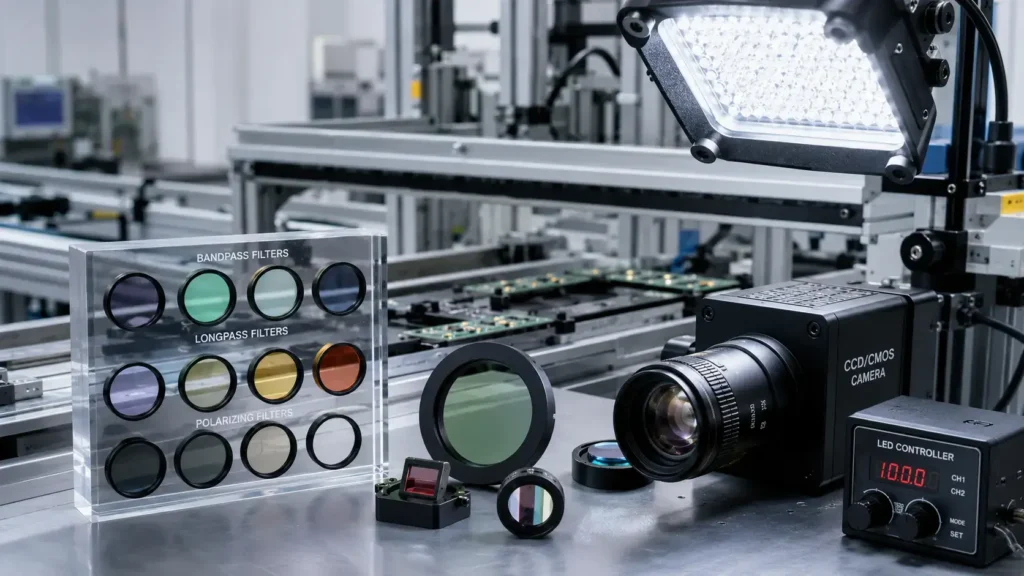
Modern machine vision systems are widely used in industrial automation, quality inspection, and smart manufacturing. These systems rely on high-quality imaging to detect defects, measure objects, and ensure production accuracy.
However, real-world environments are not perfect. Problems like ambient light interference, reflections, and low contrast can reduce the performance of a vision system.
To solve these issues, engineers use optical filters. These are critical components in optical imaging systems that improve image clarity by controlling the light entering the camera.
In this guide, you will learn how to select the right optical filters for machine vision systems in a simple and practical way.
What Are Optical Filters in Machine Vision Systems?
Optical filters are optical components placed in front of a camera lens to control the wavelength of light reaching the sensor.
They work by selectively transmitting or blocking specific parts of the light spectrum, including:
- Ultraviolet (UV)
- Visible light (VIS)
- Near-Infrared (NIR)
In a machine vision system, optical filters work together with:
- CCD sensors
- CMOS image sensors
- LED lighting systems
- laser illumination systems
Their main role is to improve image contrast and remove unwanted light noise.
Why Optical Filters Are Important in Machine Vision
Optical filters are essential in industrial imaging because they solve key problems:
1. Improve Image Contrast
Filters enhance the difference between the object and background, making defects easier to detect in industrial inspection systems.
2. Reduce Ambient Light Interference
Uncontrolled lighting in factories or outdoor environments can affect image quality. Filters help stabilize performance.
3. Enhance Detection Accuracy
Better image clarity improves the accuracy of automated inspection systems and quality control systems.
4. Improve Signal-to-Noise Ratio
Optical filters reduce unwanted wavelengths, improving sensor performance in CCD/CMOS cameras.
Types of Optical Filters Used in Machine Vision Systems
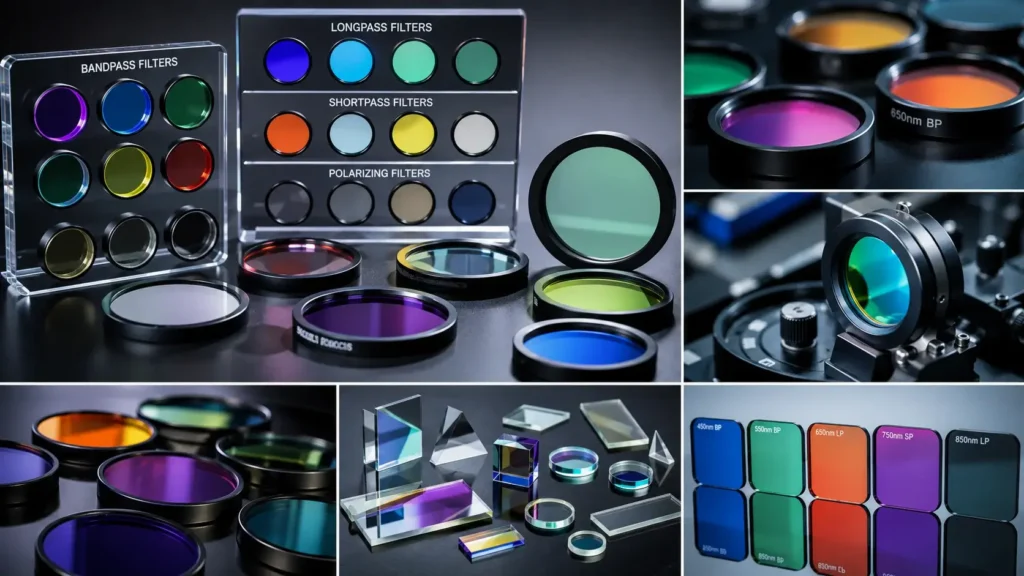
Bandpass Filters
Bandpass filters allow only a specific wavelength range to pass while blocking all others.
They are commonly used with LED lighting systems and laser-based machine vision systems to match exact wavelengths such as 630nm or 660nm.
Longpass Filters
Longpass filters transmit longer wavelengths (like infrared) and block shorter ones.
They are widely used in NIR imaging systems and low-light industrial inspection.
Shortpass Filters
Shortpass filters allow shorter wavelengths (UV or visible light) to pass and block longer wavelengths.
They are used in applications where only visible or UV light is needed.
Polarizing Filters
Polarizing filters reduce glare caused by reflective surfaces such as:
- glass
- metal
- plastic
They are widely used in industrial machine vision inspection systems for reflective materials.
Neutral Density (ND) Filters
Neutral Density filters reduce overall light intensity without changing color balance.
They help prevent overexposure in bright environments such as:
- LED inspection lines
- outdoor imaging systems
- high-intensity industrial lighting
How to Select the Right Optical Filter
Choosing the correct filter depends on your imaging conditions and system requirements.
Step 1: Identify the Light Source
Understand your illumination system:
- LED lighting systems
- laser diode systems
- natural or ambient light
Each light source has different wavelength properties.
Step 2: Define Wavelength Requirements
Machine vision systems operate in different spectral ranges:
- UV (Ultraviolet)
- Visible spectrum (VIS)
- NIR (Near-Infrared)
For example, a 660nm LED light source requires a matching bandpass filter for best performance.
Step 3: Understand Object Material
The material being inspected affects filter choice:
- reflective materials (metal, glass)
- transparent materials (plastic, liquid)
- low-contrast surfaces
Step 4: Identify Camera Sensor Type
Different sensors respond differently to light:
- CCD sensors (high image quality, low noise)
- CMOS sensors (faster, energy efficient)
Both respond to visible and near-infrared wavelengths differently.
Step 5: Choose the Right Filter Type
Now match your application:
- Bandpass filters → precise wavelength control
- Polarizing filters → glare reduction
- ND filters → brightness control
- Longpass filters → infrared imaging
Wavelength and Optical Imaging Considerations
Understanding wavelength selection is critical in machine vision design.
- UV light improves surface defect detection
- Visible light is used for general imaging
- Near-infrared (NIR) improves material penetration and contrast
Proper matching of LED wavelength, optical filter, and camera sensor improves system accuracy significantly.
Applications of Optical Filters in Machine Vision Systems
Optical filters are widely used in:
- Industrial inspection systems
- Automated production lines
- Autonomous driving systems
- Medical imaging systems
- Security and surveillance systems
- LED illumination systems
- Optical measurement systems
These applications depend heavily on accurate image processing and stable lighting conditions.
Common Mistakes in Optical Filter Selection
Many engineers make mistakes when selecting filters:
- Choosing the wrong wavelength range
- Ignoring CCD/CMOS sensor sensitivity
- Using incorrect filter types for the application
- Not considering ambient lighting conditions
- Overlooking reflection and glare issues
Avoiding these mistakes improves overall system reliability.
Best Practices for Optical Filter Selection
To achieve optimal results:
- Always test filters under real lighting conditions
- Match filters with LED or laser wavelength
- Use bandpass filters for controlled environments
- Use polarizing filters for reflective surfaces
- Use ND filters in high-brightness systems
Quick Selection Checklist
Before choosing a filter, confirm:
- Light source type (LED / laser / ambient)
- Required wavelength (UV / VIS / NIR)
- Object material properties
- Camera sensor type (CCD / CMOS)
- Imaging problem (contrast, glare, brightness)
Conclusion
Optical filters are essential components in modern machine vision systems. They improve image contrast, reduce noise, and ensure stable performance in industrial environments.
Proper selection depends on understanding wavelength, lighting conditions, camera sensors, and application requirements.
With the right optical filter, machine vision systems achieve higher accuracy, better stability, and improved industrial inspection performance.