
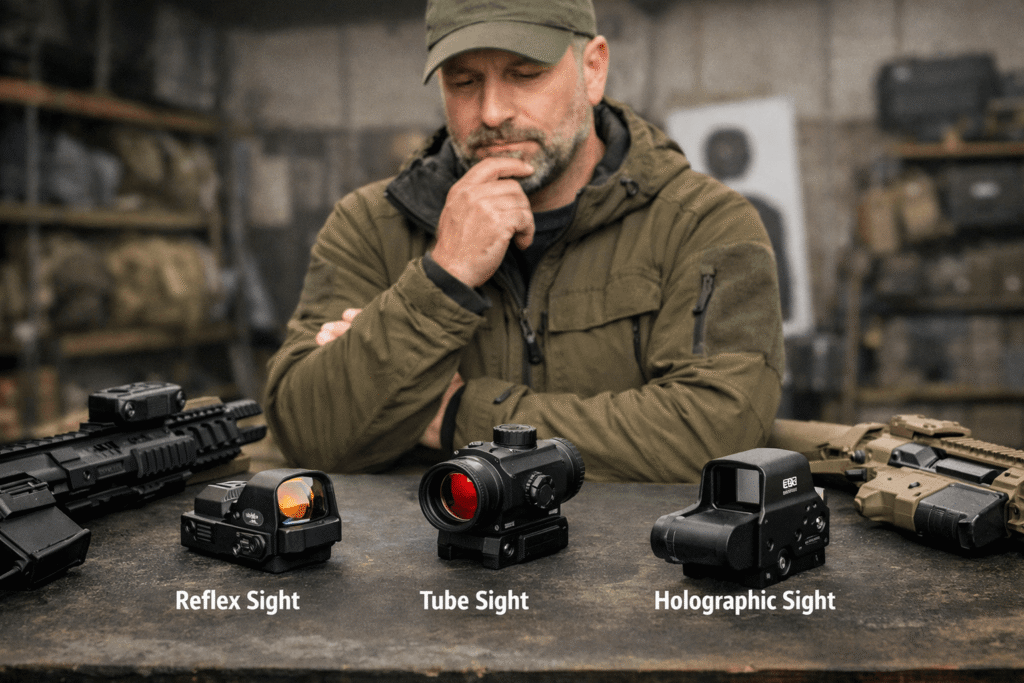
Choosing the right red dot sight can feel confusing. Many shooters ask the same question: Should I buy a reflex sight, a tube red dot, or a holographic red dot sight?
Each one works in a different way. Each one fits a different need. In this article, you will learn how these sights work, their real strengths and limits, and which one is best for hunting, home defense, tactical use, or sport shooting.
This guide is written in simple language and based on real performance factors like battery life, durability, reticle clarity, parallax, and field of view.
How Reflex, Tube, and Holographic Sights Actually Work
Before comparing them, you need to understand how each optic projects the aiming point.
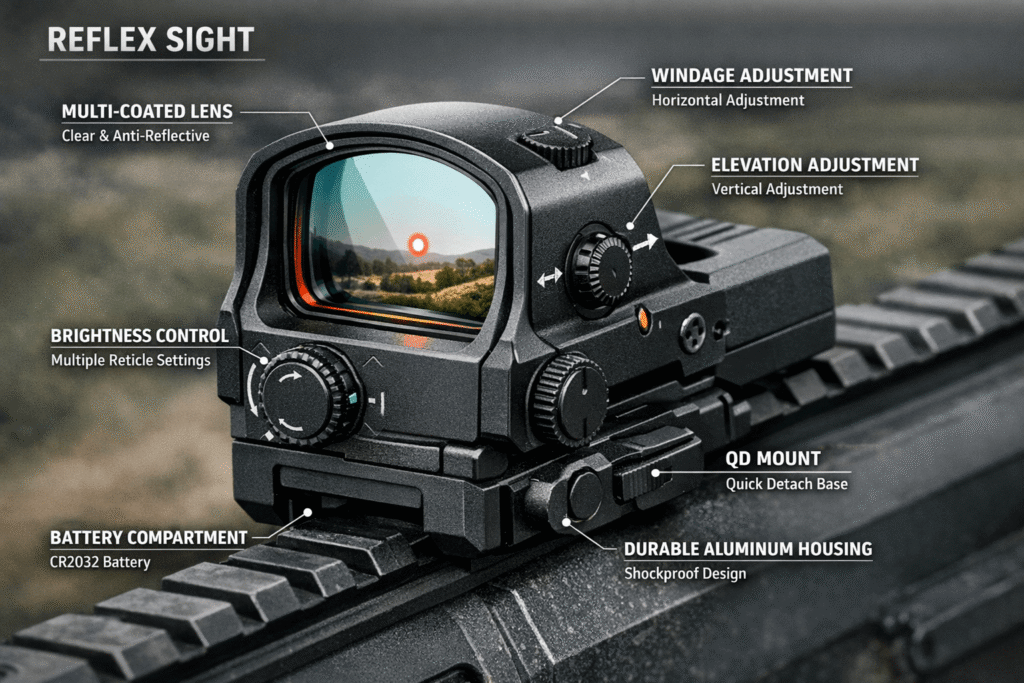
Reflex Sight Technology Explained
A reflex sight uses an LED light to project a red dot onto a coated glass lens. The lens reflects the dot back to your eye.
-
It has an open design (no tube around it).
-
It is lightweight and compact.
-
The dot appears on one layer of glass.
Most reflex sights are used on pistols and lightweight rifles. They are simple and fast.
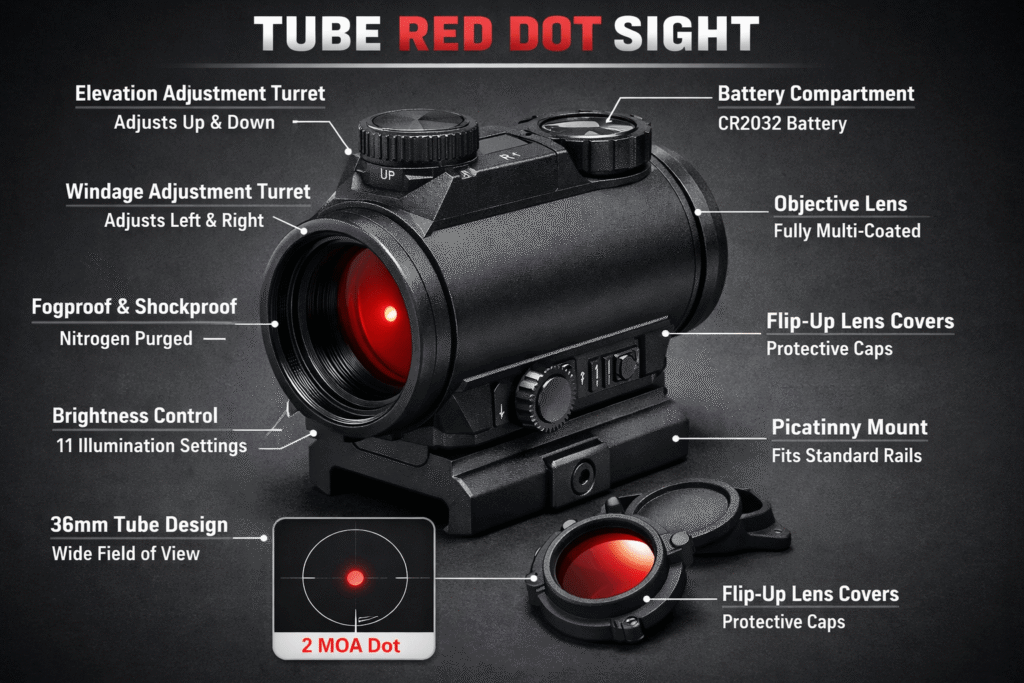
Tube Red Dot Internal Design
A tube red dot sight also uses an LED emitter. But the dot is placed inside a cylindrical housing (a tube).
-
The tube protects the internal parts.
-
It blocks outside light better.
-
It improves durability.
Tube red dots are common on rifles for hunting and tactical setups. They usually offer better battery life than open reflex sights.
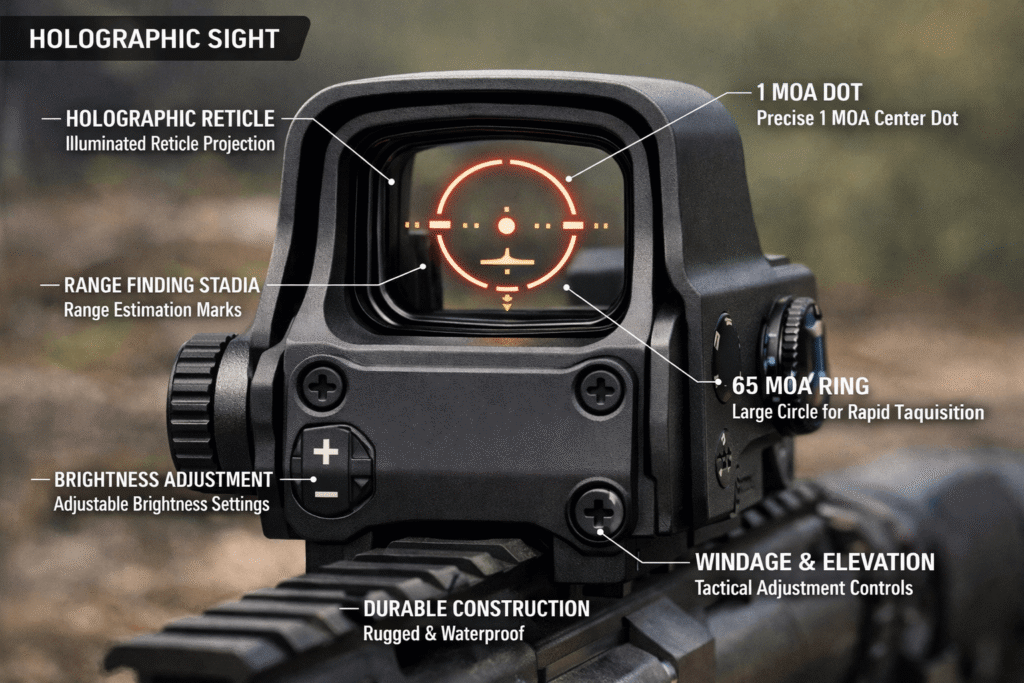
Holographic Sight Laser Projection System
A holographic sight works differently. It uses a laser to project a hologram of the reticle onto the viewing window.
Instead of a simple LED dot, it shows a holographic image.
Key facts:
-
The reticle stays clear even if the front glass cracks.
-
It often includes a ring-and-dot reticle.
-
It consumes more battery power than LED sights.
Holographic optics are widely used in military and law enforcement due to durability and fast target acquisition.
Key Differences at a Glance
| Feature | Reflex Sight | Tube Red Dot | Holographic Sight |
|---|---|---|---|
| Technology | LED reflection | LED in tube | Laser hologram |
| Battery Life | Moderate | Very long | Shorter |
| Durability | Medium | High | Very high |
| Weight | Very light | Medium | Medium |
| Cost | Lower | Medium | Higher |
| Best For | Pistols | Rifles | Tactical use |
Reflex Sights – Strengths and Limits
Where Reflex Sights Perform Best
-
Pistol mounting
-
Lightweight carbines
-
Close-range shooting
-
Fast target acquisition
They are small and easy to mount. They help shooters aim quickly at short distances (under 100 yards).
Common Drawbacks
-
Less protection from dirt and rain
-
Glass exposure can affect durability
-
Battery life is usually shorter than tube models
They are not ideal for extreme weather or heavy recoil rifles.
Tube Red Dot Sights – Strengths and Limits
Ideal Shooting Scenarios
-
Hunting rifles
-
AR-style rifles
-
Mid-range shooting
-
Outdoor environments
The enclosed design protects internal components. Many tube red dots offer 50,000+ hours of battery life on medium settings.
Common Weak Points
-
Slightly heavier than reflex sights
-
Narrower field of view due to tube shape
However, both-eyes-open shooting reduces this issue in real use.
Holographic Sights – Strengths and Limits
Tactical Advantages
-
Extremely fast reticle acquisition
-
Clear reticle under magnification
-
Works even if glass is damaged
-
Better parallax control at distance
They are very strong under recoil and harsh use.
Battery and Cost Considerations
-
Shorter battery life than LED optics
-
More expensive
-
Heavier electronics inside
Because of laser projection, holographic sights consume more power.
Important Performance Factors
Reticle Clarity and Astigmatism
Some shooters with astigmatism see LED dots as blurry or star-shaped.
Holographic reticles may appear clearer for these users because of the hologram design.
Parallax Performance
All red dot sights are “parallax free” at a set distance (usually 50–100 yards).
However:
-
Holographic sights generally manage parallax shift better at longer ranges.
-
Reflex and tube red dots may show slight shift at extreme angles.
Speed of Target Acquisition
-
Reflex sights = fastest for close range
-
Holographic sights = fastest for dynamic tactical shooting
-
Tube red dots = balanced speed and precision
Durability and Environmental Resistance
Tube and holographic optics usually offer:
-
Better water resistance
-
Shockproof housing
-
Fog resistance
Reflex sights may be more exposed due to open design.
Best Sight for Different Needs
Home Defense
A tube red dot is reliable and durable. Battery life matters here.
Hunting
Tube red dots are common for deer and hog hunting at short to mid range.
Tactical or Duty Use
Holographic sights are trusted for:
-
Harsh environments
-
Night vision compatibility
-
Fast moving targets
Competitive Shooting
Reflex sights are popular in speed competitions because of weight and fast sight picture.
Beginners
Tube red dots are often easiest to start with because they are simple and durable.
Price vs Performance
Higher price does not always mean better for your needs.
-
Reflex = budget friendly and lightweight
-
Tube = balanced cost and performance
-
Holographic = premium durability and advanced reticle
Choose based on use, not just price.
Final Verdict
There is no single “best” red dot sight.
-
Choose reflex sights for lightweight builds and pistols.
-
Choose tube red dots for durability and long battery life.
-
Choose holographic sights for tactical strength and advanced reticle clarity.
The right optic depends on:
-
Shooting distance
-
Environment
-
Budget
-
Battery preference
-
Eye condition
When you focus on real performance factors like durability, reticle design, parallax control, and battery life, the decision becomes clear.
Now you can confidently decide between reflex vs tube vs holographic red dot sights based on facts — not marketing hype.