
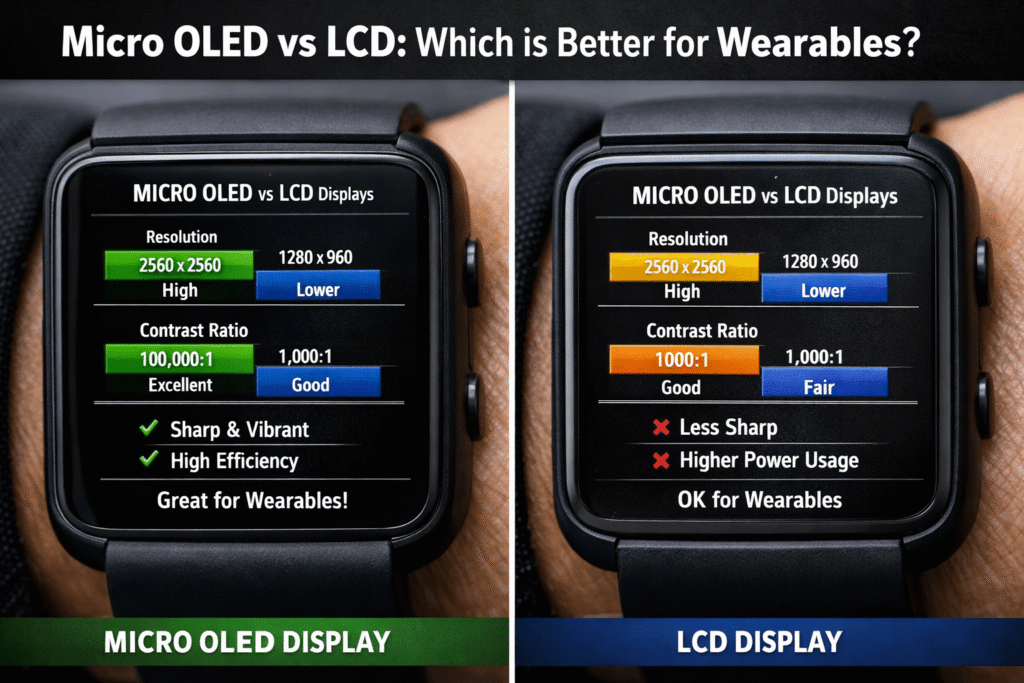
The evolution of wearable technology, from basic fitness trackers to high-end Augmented Reality (AR) and Virtual Reality (VR) headsets, has placed a massive spotlight on display performance. When designing or choosing a wearable, the core debate often centers on Micro OLED vs LCD.
While LCD has been the industry standard for decades, Micro OLED (OLED-on-Silicon) is emerging as the superior choice for next-generation devices.
This article analyzes the technical trade-offs in power efficiency, pixel density, and visual immersion to determine which technology truly wins the wearable race.
Understanding the Technology: CMOS vs. Glass Backplanes
To understand the Micro OLED vs LCD debate, we must look at how they are built. Traditional Liquid Crystal Displays (LCDs) rely on a thin-film transistor (TFT) layer on a glass substrate. They require a dedicated backlight unit (BLU) to shine light through liquid crystals to create an image.
In contrast, Micro OLED utilizes a CMOS (Complementary Metal-Oxide-Semiconductor) silicon backplane. Instead of a separate light source, Micro OLED is a self-emissive display where each individual pixel produces its own light. This shift from glass to silicon allows for significantly smaller pixels and a much thinner overall module, which is a critical factor for lightweight head-mounted displays (HMDs).
Visual Performance: Contrast, Color, and Response Times
When comparing Micro OLED vs LCD in terms of visual quality, Micro OLED holds a distinct advantage.
-
Contrast Ratio: Because Micro OLED can turn off individual pixels completely, it achieves “true blacks” and an essentially infinite contrast ratio. LCDs, even those with local dimming, often suffer from “blooming” or “light leakage” because the backlight cannot be fully masked by the liquid crystals.
-
Response Time: Micro OLED offers sub-millisecond response times. In the context of VR headsets, this is vital to prevent motion blur and “screen door effect,” ensuring a smooth user experience during rapid head movements.
-
Color Accuracy: Micro OLED typically covers a wider DCI-P3 color gamut, providing more vibrant and lifelike saturation compared to the filtered light of a standard LCD.
Power Efficiency and Battery Longevity
For wearables like smartwatches, battery life is the most significant constraint. The architecture of Micro OLED vs LCD dictates energy consumption:
-
Micro OLED Efficiency: Since it only consumes power for pixels that are turned on, using a “dark mode” or a simple watch face significantly extends battery life. This makes it ideal for Always-On Display (AOD) features.
-
LCD Power Drain: An LCD must power its entire backlight regardless of whether the screen is showing a full-color image or just a small notification. This constant energy draw is a major disadvantage for compact wearables with limited milliamp-hour (mAh) capacities.
Form Factor and Ergonomics
Wearables must be thin, light, and often curved to fit the human body.
-
Thinness: By eliminating the backlight and various optical filters required by LCDs, Micro OLED modules are substantially thinner. This allows for sleeker smartwatch profiles and less bulky AR glasses.
-
Heat Management: Micro OLED generally operates at lower temperatures for average brightness levels. However, driving Micro OLED to extreme brightness (nits) for outdoor legibility can generate heat, which requires careful thermal management in skin-contact devices.
-
Weight: The silicon-based construction reduces the physical footprint, helping manufacturers hit the “lightweight” targets necessary for all-day wearability.
Manufacturing Scalability and Cost Analysis
If Micro OLED is technically superior, why is LCD still prevalent? The answer is manufacturing yield and cost.
-
LCD Maturity: LCD production is highly optimized and inexpensive. For budget-friendly fitness trackers or entry-level smartwatches, LCD remains the most cost-effective solution.
-
Micro OLED Challenges: Producing OLED on silicon is a complex process. Achieving high yields (the percentage of functional units per batch) is difficult, keeping the unit price high. Currently, Micro OLED is reserved for premium flagship devices like the Apple Vision Pro or high-end industrial AR goggles.
Use Case Breakdown: Where Each Wins
Smartwatches and Fitness Trackers
In this category, Micro OLED is the winner for premium models due to its aesthetic “pop” and power-saving capabilities. LCD remains the go-to for low-cost wearables where price is the primary driver for the consumer.
AR/VR and Mixed Reality (MR)
For Near-Eye Displays (NED), Micro OLED is the undisputed champion. It offers the high PPI (Pixels Per Inch) needed to eliminate the “screen door effect” and provides the fast refresh rates required to prevent motion sickness in immersive environments.
Conclusion
In the battle of Micro OLED vs LCD, the choice depends on the device’s goal. If the priority is cost-efficiency and mass-market reach, LCD is a reliable, mature technology. However, for the future of high-performance wearables, Micro OLED is the clear winner. Its combination of infinite contrast, superior power management, and compact form factor aligns perfectly with the demands of modern wearable tech.
As Micro OLED becomes the standard for wearables, ARVR Optical leads the way. As a premier manufacturer and supplier, we deliver high-performance display solutions today.