
TL;DR
An EVF magnifier lens is the lens group between your eye and the tiny display inside an electronic viewfinder. It turns a small panel into a large, comfortable virtual image. Its magnification, eye relief, aberration control and coatings decide how sharp, comfortable and fog-free the viewfinder feels. Designers and buyers should judge it together with the display, not as a stand-alone part.
Quick Answer
An EVF magnifier lens is the optical system in an electronic viewfinder that enlarges the small internal display, so the eye sees a large, sharp image at a comfortable distance. It works like a magnifying glass: the display sits just inside the lens’s focal length, and the lens forms an upright virtual image. Quality depends on magnification, eye relief, aberration correction, coatings and diopter adjustment.
Introduction
Look into the viewfinder of a mirrorless camera and you are not looking at a screen. You are looking at a tiny display, often smaller than a postage stamp, through a small stack of glass or plastic that makes it feel as big as a window. That stack is the EVF magnifier lens, and it quietly decides whether the viewfinder feels crisp and relaxed or soft and tiring.
Most conversations about viewfinders focus on resolution, refresh rate and blackout. Those matter, but a display can only look as good as the optics in front of it. A sharp panel behind a weak EVF magnifier lens still looks soft at the corners, shows colored fringes around bright highlights, or fogs up on a cold morning.
For engineers and buyers, the part is just as important. An EVF magnifier lens has to fit a tight mechanical space, work with one specific micro display, allow diopter adjustment, and stay clear in rain, heat and cold, all while staying light enough for a handheld product.
This guide explains what an EVF magnifier lens is, how it works, which specifications matter, how it is built and tested, and what to ask before you commit to one. The numbers used in examples are illustrations of the physics, not specifications of any particular product.
What Is an EVF Magnifier Lens?
A plain definition
An EVF magnifier lens is the optical system that magnifies the small display inside an electronic viewfinder, or EVF. The display sits very close to the lens, just inside its focal length, so the lens forms an enlarged, upright virtual image that the eye can focus on without strain. In everyday terms, it is a purpose-built magnifying glass, tuned for one display and one human eye.
Names you will see for the same part
Datasheets and forums use several terms for the same job: EVF eyepiece, viewfinder eyepiece, EVF lens group and EVF optical module. Strictly speaking, the eyepiece is the lens group closest to the eye, while an EVF optical module may also include the display, the diopter mechanism and a protective window. In this article, EVF magnifier lens means the lens group that does the magnifying, whether it has one element or five.
Where it sits in the viewfinder
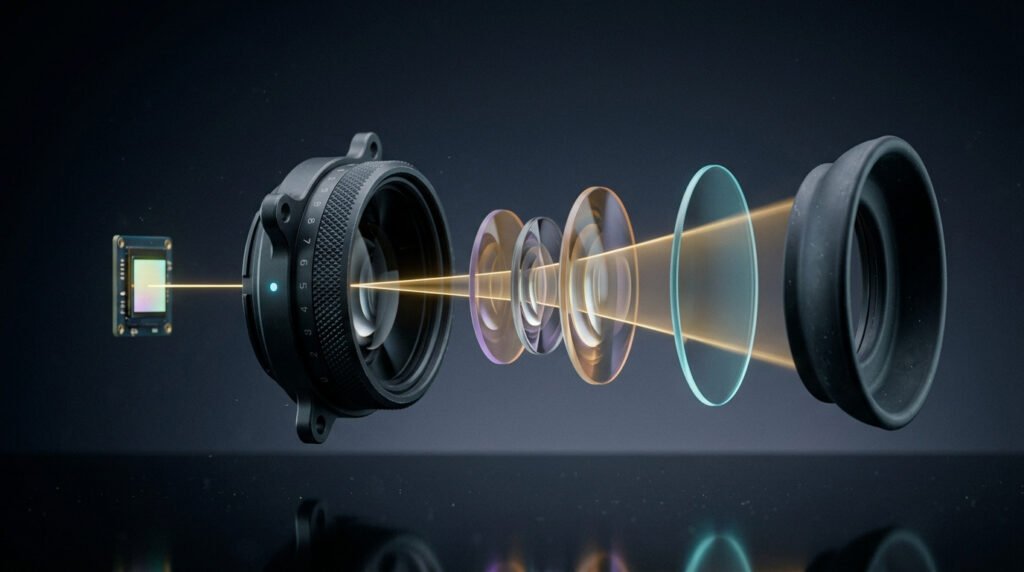
Following the light from the display toward the eye, the usual order is the display, the magnifier lens group, a protective window, the eyecup and then the eye. The EVF magnifier lens is the largest optical component in that chain and the only one that directly shapes how the image looks to the viewer. Everything else either feeds it or protects it.
How an EVF Magnifier Lens Works
The virtual image idea
A magnifying glass works by holding an object slightly closer than its focal length. Light from each point on the object leaves the lens nearly parallel, and the eye perceives an enlarged image sitting much farther away than the object really is. An EVF magnifier lens follows the same rule. The display is placed very near the focal plane, so the eye sees the image as if it were far away. That is easy to focus on and comfortable for long viewing, which is why you can watch a viewfinder for an hour without the eye fatigue you would get from staring at a screen inches away.
A worked example
Consider an illustrative case. Imagine a display with a diagonal of about 15 mm and an EVF magnifier lens with an effective focal length of 20 mm, with the display at the focal plane. The panel then appears to span roughly 41 degrees diagonally. Change the focal length to 25 mm and the same panel appears to span roughly 33 degrees.
The lesson is that a shorter focal length gives a larger apparent image, which is why designers push for it. The cost is that aberrations become harder to control and generous eye relief becomes harder to keep. Every EVF design lives somewhere on that trade-off curve.
The basic magnifier formula tells the same story. For relaxed viewing, magnification relative to a 250 mm reference distance is about 250 divided by the focal length in millimeters, so a 20 mm lens works out to roughly 12.5 times. Camera makers rarely quote magnification this way, so comparing viewfinder specifications across brands needs care.
Why tiny movements change focus
Small changes in the spacing between display and lens move the virtual image closer or farther away. As a rough guide, for a 20 mm focal length, shifting the display or the lens by about 0.4 mm changes the focus by about one diopter. This is why diopter adjustment in a viewfinder involves tiny, precise movements, and why mechanical tolerances inside an EVF magnifier lens assembly matter far more than they would in a larger optical system.
Key Specifications of an EVF Magnifier Lens
A handful of numbers describe most of what a user will feel. Understanding what each one controls, and what it costs, makes datasheets much easier to read.
Magnification
Magnification tells you how large the image appears. Camera makers usually quote it against a standard reference, so a figure on one camera is not automatically comparable with a figure from another brand or sensor format. Higher magnification feels more immersive, but it can make the corners hard to see at once, especially with glasses. A well-designed EVF magnifier lens balances magnification against the field the eye can comfortably scan.
Eye relief
Eye relief is the distance from the last optical surface to the eye at which the whole image is still visible. People who wear glasses need more of it. Shorter focal lengths and higher magnification tend to eat into eye relief, so it is a constant negotiation in the design of an EVF magnifier lens. Always check how it is measured: from the last lens surface, from the window, or from the eyecup can give quite different numbers.
Exit pupil and eyebox
The exit pupil is the bright circle where the eye should sit. If the eye drifts out of it, parts of the image darken. A larger eyebox forgives head movement but needs larger optics. Because the pupil of the eye changes with brightness, the practical eyebox is usually smaller than the paper one. A good EVF magnifier lens keeps the image evenly bright across a usable eyebox, not only at the exact center.
Field of view and diopter range
Field of view describes how much of the display the eye takes in at once. Diopter range describes how far focus can be adjusted to suit different eyesight. Many viewfinders cover mild nearsightedness and farsightedness, and people with stronger prescriptions often keep their glasses on. The team has to decide early how much diopter travel the EVF magnifier lens must support, because travel consumes space and complicates the mechanism.
| Specification | What it controls | Typical trade-off |
|---|---|---|
| Magnification | Apparent image size | Larger view can hide the corners |
| Eye relief | Comfort with glasses | Often shrinks as magnification rises |
| Eyebox | Tolerance to head movement | Larger eyebox needs larger optics |
| Field of view | How much you see at once | Wider view raises aberrations |
| Diopter range | Fit for different eyesight | More travel needs more space |
Inside an EVF Magnifier Lens: Elements, Materials and Coatings
Single element or multiple elements
The simplest EVF magnifier lens is a single aspheric element. It is light, inexpensive and adequate for lower-resolution displays. Higher-resolution panels demand more correction, so many designs use two to five elements, mixing convex and concave shapes and aspheric surfaces to flatten the field, cancel color error and reduce distortion. More elements improve image quality, but they add weight, assembly steps and tolerance stack-up.
Glass or plastic
Optical glass offers a stable refractive index, good scratch resistance and good thermal behavior. Optical resin allows complex aspheric shapes to be molded at lower cost and weight. Many EVF magnifier lens designs combine both, using glass where thermal stability or surface hardness matters and resin where shape freedom matters. Molding quality still affects clarity, because stress and surface errors show up as softness or haze when viewed this close to the eye.
Coatings
Coatings are not decoration. Anti-reflection coatings on each surface reduce ghost images and improve contrast. The outer surface of the EVF magnifier lens, or the protective window in front of it, often receives hydrophobic, oleophobic and anti-fog treatments, because it sits beside a warm face in cool air. A hard coating helps it survive wiping and cleaning. Coating design must cover the whole visible range evenly, since a coating tuned only for green can leave a color cast on the image.
The protective window
Many modules place a flat or slightly curved window in front of the EVF magnifier lens. It keeps dust and moisture out and gives the user something safe to wipe. Its flatness, coating and bonding all affect the final image, so it should be designed together with the lens group rather than added at the end.
Diopter Adjustment and Mechanical Design
Diopter adjustment moves the lens group or the display by a fraction of a millimeter, usually through a knurled ring or a small dial. The mechanism has to feel smooth, have no play, and stay stable across temperature. If the ring has backlash, the user feels it as vague focus. If the lens tilts as it moves, one side of the image softens. Because the EVF magnifier lens is so sensitive to small shifts, designers rely on tight guides, preloaded springs and consistent lubrication.
Sealing is the other mechanical challenge. Dust can enter through moving rings, and moisture can condense inside the housing. Gaskets, careful venting and suitable coatings all help.
Many viewfinders also include an eye sensor that switches between the rear screen and the viewfinder. It sits close to the EVF magnifier lens, so its infrared window and emitter must be placed so they do not create stray reflections in the image.
Common Problems in an EVF Magnifier Lens
Aberrations and distortion
Short focal length lenses viewed close to the eye can show lateral color, pincushion distortion and field curvature. Lateral color appears as colored edges around fine detail, especially toward the corners. Pincushion distortion makes straight lines bow. Many cameras pre-distort the displayed image to compensate, but electronic correction has limits, and the better the EVF magnifier lens, the less correction is needed and the less sharpness is lost.
Visible pixel structure
High magnification can reveal the gaps between pixels, an effect often described as a screen-door look. The remedy is a display with enough pixel density and a lens whose resolution matches it. Common figures for viewfinder panels include 2.36 million, 3.69 million and 5.76 million dots, but the count matters less than how sharply the EVF magnifier lens can render each pixel.
Ghosting and lifted blacks
Light bouncing between lens surfaces, or off the eyecup and eyewear, produces faint ghost images and lifts the black level. Anti-reflection coatings, black edge paint and internal baffling all help. This matters most with OLED panels, whose deep blacks make any stray light easy to notice, so every surface of an EVF magnifier lens should be treated as a potential reflector.
Fogging
A viewfinder pressed against a warm face on a cold day is a perfect fog trap. Anti-fog coatings and sealed, ventilated designs reduce the problem. The EVF magnifier lens surface closest to the eye usually needs this treatment most, and it should be tested in real cold-and-warm cycling rather than assumed.
Matching the Display to the EVF Magnifier Lens
A viewfinder display is typically a small OLED or LCD panel. Many modern designs use micro OLED, built on silicon, to get very high pixel density in a very small area. Panel size sets the focal length needed for a given field of view, and pixel pitch sets the resolution the EVF magnifier lens must deliver. If the panel size changes late in a project, the lens usually has to be redesigned, so the display decision comes first.
Emission behavior matters too. Some displays emit light in a narrow cone, and the lens must collect it evenly, otherwise the corners look dim. OLED panels offer strong contrast and fast response, which suits tracking moving subjects, while LCD panels can reach high brightness at lower cost. Whatever the panel, the EVF magnifier lens should be designed with its real data: pixel pitch, active area, cover glass thickness and emission pattern.
EVF Optics Beyond Cameras
The same principle, an EVF magnifier lens in front of a micro display, appears in camcorders, cinema cameras, drone and FPV equipment, thermal imaging and night vision devices, and some industrial inspection tools. The priorities shift with each use. Cinema users care about color accuracy and generous eye relief for long shoots. Handheld thermal devices need robust sealing and strong anti-fog behavior. Drone goggles may need a wide field of view and glasses compatibility. A supplier who understands these differences will ask about the use case before proposing a design.
Manufacturing and Testing
Lens elements are produced by precision injection molding for resin, or by glass molding, grinding and polishing for glass. Coatings are applied in vacuum chambers, where thickness uniformity is critical. Assembly depends on accurate centering, because a decentered element causes one-sided blur. For an EVF magnifier lens, even small decenter or tilt can be visible at the eye.
Typical tests cover several areas:
- Resolution and contrast, usually measured with MTF
- Distortion, field curvature and lateral color
- Ghost, flare and stray light levels
- Transmission and color cast
- Diopter travel and repeatability
- Environmental behavior, including fog, temperature cycling and humidity
Testing should be done on the full system, the lens together with a real display, because many problems only appear in combination. Conoscope-based equipment helps characterize how the display emits light at different angles, which feeds back into lens design. Batch-level checks for centering and cosmetic defects are good practice, so each EVF magnifier lens in a production run meets the same standard as the approved sample.
How to Choose an EVF Magnifier Lens
Start with the use case
Before comparing suppliers, write down who will use the viewfinder and how. Do they wear glasses? Will they work in the cold or rain? Is weight critical? Is color accuracy more important than brightness? Choosing an EVF magnifier lens without these answers usually leads to a design that looks fine on paper and disappoints in the field.
Questions worth asking a supplier
Ask for MTF curves at the center and the edges, at the diopter positions you care about, and ask how they were measured. Ask how eye relief and eyebox are defined. Ask about coating durability and fog tests. Ask how tolerances were chosen and what yield to expect. Ask whether the samples were assembled with a real display, and whether the supplier can support optical system design, structural design and coating design together, since fewer handoffs mean fewer errors.
A simple hands-on check
You do not need a lab to spot obvious problems. Display a fine checkerboard or small text and look at the corners, not only the center. Move your eye slowly around to see how the image darkens at the edges of the eyebox. Show a bright point on a black background and look for ghosts. Try it with and without glasses, and in cold conditions if your product will face them. Samples that survive this routine are worth measuring properly, and the EVF magnifier lens you receive in volume should be held to the same checks.
Where EVF Optics Are Heading
Higher-resolution micro displays, brighter panels and slimmer camera bodies keep pushing the optics. Expect more aspheric glass, hybrid glass and resin designs, and improved anti-fog and anti-reflection coatings. Folded or freeform concepts appear in research and in some compact devices, but conventional multi-element magnifiers remain the mainstream approach. Future EVF magnifier lens designs will likely gain from better coating processes and tighter assembly methods more than from any single new idea.
Conclusion
The EVF magnifier lens is easy to overlook because it is small, but it controls how everything else in the viewfinder is perceived. Its job is simple to state and hard to do well: enlarge a tiny display into a sharp, comfortable image, with enough eye relief, an even eyebox, controlled aberrations and a surface that stays clear in the real world.
If you are designing a product, settle the display early, decide how much diopter range and eye relief you need, and test with real users in realistic conditions. If you are sourcing, ask for measured data, check how samples were assembled, and prefer partners who can handle design, coatings and testing together. Treat any published specification as a starting point and confirm it on your own bench.
FAQs
What is an EVF magnifier lens?
An EVF magnifier lens is the lens group inside an electronic viewfinder that enlarges the small internal display into a large virtual image. It lets the eye see the picture comfortably at a distance, instead of staring at a tiny screen up close.
Why does an EVF magnifier lens affect sharpness so much?
The display is viewed very close to the eye and at high magnification, so any lens error is easy to see. Aberrations, decentered elements or weak coatings show up as soft corners, color fringes or ghosting, even when the display itself is excellent.
Can an EVF magnifier lens fog up, and how is it prevented?
Yes, especially when a cold viewfinder meets a warm face. Anti-fog coatings on the eye-side surface, a sealed and vented housing, and a well-designed protective window all reduce fogging. It should be tested under temperature and humidity cycling.
Is an EVF magnifier lens the same as an eyepiece?
They overlap. The eyepiece is the lens group nearest the eye, and in most viewfinders it performs the magnifying job, so the terms are often used interchangeably. An EVF optical module is broader and may also include the display, the diopter mechanism and the protective window.
How do I check whether an EVF magnifier lens is good?
Look at fine detail in the corners, move your eye around to test the eyebox, check for ghosts around bright points on black, and try it with glasses. For a more serious evaluation, ask for MTF data and test the lens with the real display.