
TL;DR
A glass lens for optical systems bends and focuses light with high stability, low scatter, and long service life. The right glass lens for optical systems depends on material, shape, tolerances, coatings, and the environment where it will work. Define the real performance need first, avoid over-specifying tolerances, and verify samples by measurement before ordering volume.
Quick Answer
A glass lens for optical systems is a precision-shaped element made from optical glass that refracts light to form images, focus beams, or collimate light. Glass offers better thermal stability, scratch resistance, and consistent transmission than most plastics. To choose a glass lens for optical systems, define focal length, aperture, and wavelength range, then select a material such as N-BK7 or fused silica, a lens shape, tolerances, and a coating. Confirm the result with measured samples.
Introduction
Every camera, headset, microscope, and inspection station relies on a few pieces of shaped glass doing their job quietly. When the lens is right, nobody notices it. When it is wrong, the whole system suffers from soft images, color fringes, or focus that drifts with temperature.
Choosing a glass lens for optical systems is therefore less about picking an item from a catalog and more about understanding what the system demands. Material, curvature, tolerances, and coatings all interact, and a small mismatch can cost weeks of redesign.
This guide explains what a glass lens for optical systems is, how glass compares with plastic, which lens types and materials exist, and which specifications deserve attention. It also covers how manufacturing and testing affect quality, then closes with a practical selection method and advice on working with a supplier.
What Is a Glass Lens for Optical Systems?
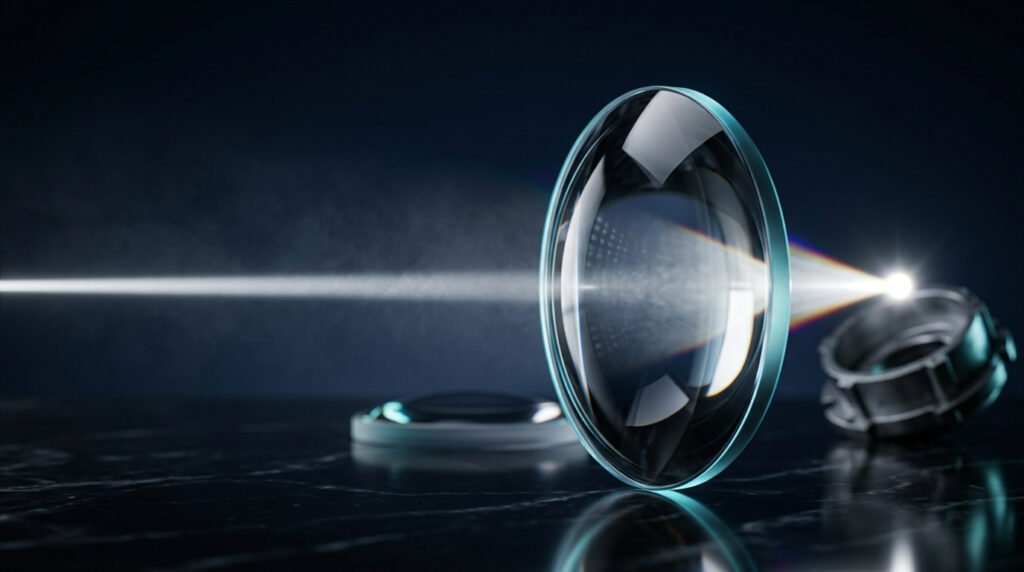
A glass lens for optical systems is an optical element made from engineered glass, ground and polished to a defined shape so that it refracts light in a predictable way. Refraction happens because light travels more slowly inside glass than in air, and curved surfaces turn that change in speed into a change in direction.
Shape decides what happens next. A converging lens brings parallel rays to a focus, while a diverging lens spreads them apart. Combined in groups, lenses cancel each other’s flaws and produce sharp images across the whole field of view.
Optical glass is not ordinary glass. Window glass has uneven composition and may contain bubbles or stress. Optical glass is melted under controlled conditions, annealed slowly, and tested for homogeneity, bubbles, and birefringence. That control is what lets a glass lens for optical systems behave the same way from one batch to the next.
Why Glass Lenses Matter in Optical Systems
An optical system is only as good as its weakest element. A well-designed glass lens for optical systems protects image quality, keeps focus stable, and survives years of use without clouding or warping.
Glass also gives designers freedom. The range of available refractive indices and dispersion values is wide, so engineers can balance color, size, and cost in ways that few other materials allow. For products that must perform the same way in year five as in year one, glass is often the safest foundation.
Glass vs Plastic Lenses
Plastic lenses are inexpensive at high volume and easy to mold into complex shapes, which is why they fill phone cameras and many consumer products. Glass is the better choice when stability and precision matter more than unit cost.
| Property | Optical glass | Optical plastic |
|---|---|---|
| Refractive index options | Wide range, including high values | Narrower range |
| Thermal focus shift | Low | Higher |
| Scratch resistance | High | Lower |
| Transmission range | UV to infrared, depending on type | Mainly visible and near infrared |
| Tooling for small runs | Low to moderate | High, because molds are needed |
| Cost at very high volume | Higher | Lower |
| Weight | Heavier | Lighter |
For prototypes and small to medium batches, glass is often the more economical route, because polishing does not need an expensive mold. In demanding environments such as outdoor, automotive, or industrial inspection use, a glass lens for optical systems holds its shape and focus through temperature swings where plastic may shift. Many real designs mix both materials, using glass where precision matters most and plastic where weight or cost dominates.
Common Types of Glass Lenses
The shape of a lens determines its job, and most projects use one or more of the following.
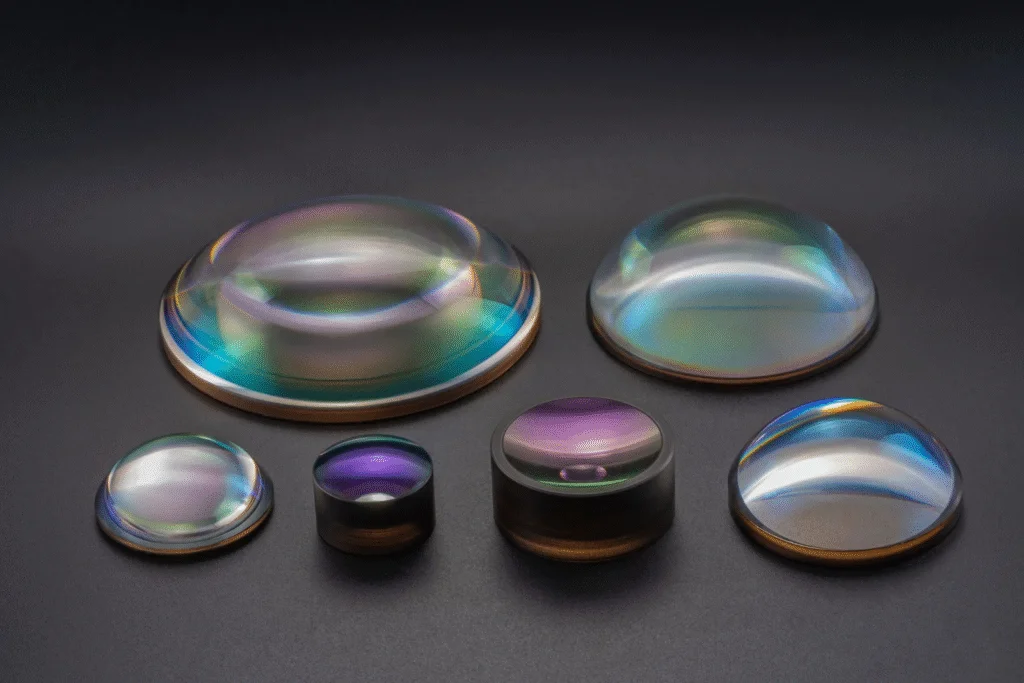
Spherical lenses
Spherical lenses have surfaces that are sections of a sphere, which makes them the easiest and most economical to produce. Common forms include plano-convex, bi-convex, plano-concave, bi-concave, and meniscus lenses. They suit imaging relays, collimation, condensers, and general-purpose focusing. Their limitation is spherical aberration at large apertures, which designers manage with element count, glass choice, or stopping down the aperture. If you are exploring this category in depth, the optical lens range shows how these elements are grouped.
Aspheric lenses
Aspheric surfaces depart from a perfect sphere to correct aberrations more efficiently. One aspheric glass lens for optical systems can replace two or three spherical ones, which saves space and weight. The trade-off is higher cost and more demanding metrology, so aspheres make the most sense in compact, high-performance designs.
Cylindrical lenses
Cylindrical lenses focus light in one direction only. They are used to shape laser beams into lines, in scanners, and in spectrometers where one axis needs different treatment from the other.
Achromatic doublets
A doublet cements a crown glass element to a flint glass element. Because the two glasses disperse color differently, the pair brings two wavelengths to the same focus and reduces color fringing. Doublets are a standard answer when a single lens produces visible chromatic error.
Ball, half-ball, and related elements
Ball lenses and half-ball lenses are common in fiber coupling and compact sensors. Prisms, windows, and filters are not lenses in the strict sense, but they sit in the same optical path and are often sourced together. You can see how these related parts are grouped on the optical components page.
Optical Glass Materials Compared
Material choice affects the transmission, thermal behavior, durability, and price of a glass lens for optical systems. The values below are typical and approximate, so always check the manufacturer’s datasheet for the exact grade you plan to buy.
| Material | Typical strengths | Typical limits | Common uses |
|---|---|---|---|
| N-BK7 (borosilicate crown) | Refractive index around 1.517, good visible and near-infrared transmission, economical | Limited ultraviolet transmission | General imaging, visible and near-infrared lasers |
| Fused silica | Very low thermal expansion, excellent ultraviolet transmission in UV grades, low fluorescence options | Higher cost, harder to process | UV optics, high-power lasers, precision instruments |
| High-index flint glass | High refractive index, allows compact designs | More dispersion, can be softer and more sensitive to handling | Doublets, compact imaging systems |
| Sapphire | Extremely hard, durable | Expensive, birefringent | Protective windows in harsh environments |
Two numbers help when comparing glasses. The refractive index tells you how strongly the material bends light. The Abbe number describes dispersion, meaning how much the refractive index changes with wavelength. Crown glasses usually have higher Abbe numbers and lower dispersion, while flint glasses have lower Abbe numbers and higher dispersion. Pairing the two is the classic way to correct color.
Thermal behavior matters too. N-BK7 expands at roughly 7 parts per million per degree Celsius, whereas fused silica expands at around half a part per million. In a system that heats up or runs outdoors, that difference can decide whether focus stays put. Matching the glass to the temperature range is a basic part of selecting a glass lens for optical systems.
Key Specifications to Understand
A drawing for a glass lens for optical systems lists many numbers. Most follow ISO 10110, the international standard for optical drawings, and each one affects performance and cost in a different way.
Focal length and diameter
Focal length sets magnification and working distance. Diameter, together with the clear aperture, determines how much light the lens can gather. The clear aperture is the usable area, and it is always smaller than the full diameter because edges are bevelled or chipped during processing.
Radius of curvature and thickness
These define the lens geometry. Center thickness affects weight, stress during mounting, and the lens’s behavior in the optical path. Edge thickness must be sufficient for handling and for holding the lens in its mount without chipping.
Surface quality
Surface quality, often given as scratch-dig, describes cosmetic defects. A grade such as 60-40 is common for general use, 20-10 suits precision imaging, and 10-5 is typical for laser work. Cosmetic grades matter most where scatter would harm results, so avoid paying for a finish the application will never reveal.
Surface accuracy
Surface irregularity shows how closely the surface follows its ideal shape, usually measured in fractions of a wavelength at a test wavelength such as 632.8 nm. A value around λ/4 may be enough for ordinary imaging, while λ/10 or tighter is used for high-end systems.
Centering
Centering describes how well the optical axis aligns with the mechanical axis. Poor centering causes coma and image shift, which becomes more visible in assemblies with many elements. It is usually specified as a wedge angle or beam deviation.
Transmission
Transmission depends on both the glass and the coating. If your system works at specific wavelengths, say so clearly. A glass lens for optical systems that transmits well in the visible range may be unsuitable for ultraviolet or infrared work.
The general rule is simple: tighten a tolerance only where it affects performance. Over-specification is the quickest way to inflate cost and lead time without improving the final image.
Aberrations and How Glass Choice Helps
No single glass lens for optical systems forms a perfect image. Designers deal with a familiar set of errors, and glass selection is one of their main tools.
Spherical aberration occurs when rays at the edge of a lens focus at a different point from rays near the center. Chromatic aberration happens because different colors bend by different amounts. Coma makes off-axis points look like comets, and astigmatism blurs them differently in two directions. Field curvature and distortion change where and how an image lands across the sensor.
Combining glasses with different refractive indices and dispersions, adding aspheric surfaces, and distributing optical power across several elements all reduce these errors. Optical design software lets engineers simulate the whole chain before any glass is cut. For projects that start from requirements instead of a finished design, a service such as optical system design can turn a performance target into a lens prescription.
Coatings: Small Layers, Large Effects
A bare glass lens for optical systems reflects roughly four percent of light at each surface at normal incidence. That sounds small, but a system with ten uncoated surfaces loses a large share of its light and gains ghost images and flare.
Anti-reflection coatings solve this with thin dielectric layers that cancel reflections at chosen wavelengths. A single layer of magnesium fluoride is a classic, economical option. Multi-layer broadband coatings cover wide spectral ranges, while narrow-band coatings are tuned for a specific laser line.
Other coatings serve different purposes: reflective and beam-splitting layers, filters that pass or block selected bands, and hydrophobic or anti-fog layers for outdoor and handheld equipment. Coating durability should match the environment, so ask about adhesion, humidity, and abrasion testing if the glass lens for optical systems will be handled or cleaned frequently. Coating design is its own discipline, and a dedicated optical film design service helps match spectral targets to a practical process.
How a Glass Lens for Optical Systems Is Made
Understanding the process explains why some specifications cost more than others.
It starts with selecting a glass blank and checking its quality. The blank is cut and roughly shaped, then generated on a machine that grinds the approximate curvature. Fine grinding follows, using progressively smaller abrasives to remove damage and approach the final shape.
Polishing creates the optical surface. Conventional polishing uses a tool and a slurry to reach the target radius and finish, while computer-controlled methods can correct small errors with more precision. The lens is then centered and edged so that its optical and mechanical axes match, and its edge is finished or blackened to reduce stray light.
After cleaning, coatings are applied in a vacuum chamber. Final inspection checks dimensions, surface form, cosmetic quality, and optical performance. Precision glass molding is another route for aspheric shapes at larger volumes, although it needs tooling and suits stable, repeated demand.
Testing and Inspection
A measured result is worth more than a promise. Reliable suppliers document how each glass lens for optical systems is checked.
An interferometer compares a surface with a reference and reveals irregularity. A spherometer or profilometer measures radius and form. Centering is checked with an autocollimator or similar instrument, and thickness and diameter are measured with calibrated gauges. Microscopes inspect scratch and dig, while a spectrophotometer verifies transmission and coating performance. For assemblies, resolution or MTF testing shows how the finished system performs.
When requesting quotes, ask which instruments are used and whether inspection reports come with each batch. Looking at a supplier’s testing equipment and production equipment gives a clearer picture of what it can actually control.
Where a Glass Lens for Optical Systems Is Used
The same material and design principles appear across very different products.
AR and VR modules. Headsets need compact optics with controlled distortion, careful coatings against ghost images, and consistent quality across thousands of units. A glass lens for optical systems of this kind often handles the most critical imaging tasks inside the module.
Industrial and machine vision. Inspection cameras depend on lenses that hold focus and resolution on production lines for years. Stable glass elements help avoid drift in demanding factory conditions, which is why detection and industrial lenses commonly rely on them.
Medical and endoscopic devices. Small diameters, sterilization resistance, and clear imaging make glass a natural fit, although the design and approval requirements are strict and vary by market.
Lasers and sensing. Fused silica and carefully coated glass handle high power and specific wavelengths, where low absorption and low scatter matter most.
Projection and illumination. Projection lamps, display engines, and ground-projection lights use lenses and lens arrays to shape light precisely, so edge definition and uniformity depend on optical quality.
How to Choose a Glass Lens for Optical Systems
Selection is easier when you follow an order instead of jumping to a catalog.
Step 1: Define the job. Write down what the lens must do: image an object, collimate a source, focus a beam, or relay a pupil. Include field of view, working distance, and required resolution.
Step 2: Fix the wavelength range. Visible, ultraviolet, near infrared, and laser lines each change the material and coating choices. State them early.
Step 3: Note the environment. Temperature range, humidity, vibration, cleaning methods, and handling all influence glass type, coating durability, and mounting.
Step 4: Select the material. Start with N-BK7 for general visible work, move to fused silica for ultraviolet, high power, or thermal stability, and consider high-index glass when compact size matters.
Step 5: Pick the shape and simulate. Choose spherical, aspheric, cylindrical, or doublet forms, and verify the result in optical design software. Simulation catches many problems before any glass is cut.
Step 6: Set tolerances with intent. Tolerance only the parameters that influence performance, and use sensitivity analysis to see which ones matter most.
Step 7: Specify the coating. Match the coating to wavelength, angle of incidence, and durability needs, and keep the coating callout consistent between drawing and purchase order.
Step 8: Prototype and measure. Order a small batch first, measure it independently, and test it inside the real assembly before approving volume production.
Followed in sequence, these steps keep the choice of a glass lens for optical systems tied to real requirements instead of habit.
Common Mistakes When Buying a Glass Lens for Optical Systems
The first frequent mistake is over-tolerancing. Tight values everywhere raise cost and lead time, yet only a handful of them usually drive performance.
The second is ignoring wavelength. A coating tuned for one band can perform poorly in another, and a material that transmits well in the visible range may absorb heavily elsewhere.
The third is overlooking temperature. Focus shift and stress from mounting often appear only after a system leaves the lab, so check thermal behavior early.
The fourth is choosing mainly on price. A cheap glass lens for optical systems that fails inspection or needs rework costs more than a properly specified one.
The fifth is poor handling. Fingerprints, aggressive cleaning, and harsh solvents damage coatings and surfaces. Teach assembly staff the correct cleaning method for each coating type.
Working With a Glass Lens Supplier
A clear request saves days of back-and-forth. When you approach a supplier for a glass lens for optical systems, prepare a drawing following ISO 10110 or equivalent, the glass type, wavelength range, coating specification, quantity, inspection requirements, and delivery expectations.
Ask about design support, sample lead time, minimum order quantity, and how defects are handled. A partner that combines design, manufacturing, and coating under one roof can resolve questions faster than one that outsources each step. ARVR Optical, for example, presents itself as a one-stop partner covering optical design, structure design, film design, and production, which suits projects that start with a concept rather than a finished drawing.
If you want to discuss a specific requirement, you can reach the team through the contact page. Sending a drawing or even a rough specification speeds up the first reply considerably.
What Affects the Cost and Lead Time of a Glass Lens for Optical Systems
Several factors determine the price of a glass lens for optical systems. Material is the first, since fused silica and special glasses cost more than N-BK7. Size and shape come next, because large diameters and aspheric surfaces need more machine time. Tolerances raise cost quickly, especially for surface accuracy, centering, and cosmetic quality.
Quantity changes unit price because setup, tooling, and measurement are shared across a batch. Coatings add a separate process step with its own tooling and test requirements. Inspection depth also matters, as full documentation takes more time than sampling.
Lead time depends on material availability, process complexity, and coating schedules. Ask for a written timeline with milestones, and clarify who pays for revisions if a prototype needs adjustment.
Trends Worth Watching
Several directions are becoming clearer. AR and VR products keep pushing toward smaller, lighter optics with tighter control of stray light. Aspheric and freeform surfaces are used more widely as metrology improves, so the typical glass lens for optical systems is becoming more refined. Coatings are getting more durable and more specialized, and manufacturers are adding automated inspection to reduce variation between batches. None of this changes the fundamentals, but it does raise expectations for documentation and consistency.
Conclusion
A good lens choice starts with clear requirements, not with a part number. When you know the wavelength range, environment, and performance targets, the material, shape, tolerance, and coating decisions become far more straightforward. The most dependable glass lens for optical systems is the one specified with intent, measured honestly, and matched to the real conditions of use.
Before committing to volume, define your requirements, simulate the design, tolerance only what matters, and verify prototypes by measurement. If you need help moving from a concept to a finished component, the team at ARVR Optical can discuss design and manufacturing options with you.
Frequently Asked Questions
What is a glass lens for optical systems used for?
A glass lens for optical systems is used to focus, collimate, or form images from light. It appears in cameras, AR and VR modules, industrial inspection, medical devices, laser equipment, and projection products.
Which glass is best for optical lenses?
It depends on the application. N-BK7 is a common, economical choice for visible and near-infrared work. Fused silica suits ultraviolet use, high power, and tight thermal stability. High-index glasses help when compact designs are needed.
Is glass better than plastic for lenses?
Glass generally offers better thermal stability, scratch resistance, and a wider range of refractive indices. Plastic is lighter and cheaper in very high volumes. Many systems combine both, so the best choice depends on cost, precision, and environment.
What tolerances should I specify for a glass lens for optical systems?
Specify tight tolerances only where they affect performance. Common drawing items include diameter, thickness, radius, surface irregularity, centering, and scratch-dig. Work with your optical designer to find which ones the system is actually sensitive to.
Why do glass lenses need coatings?
Uncoated glass reflects part of the light at every surface, which reduces transmission and can cause ghost images. Anti-reflection and other coatings improve throughput and contrast. The coating should be matched to your wavelength range and working environment.