
If you’ve ever looked at a display and wondered why some screens look strikingly vivid even in pitch-dark rooms — while others need a bright backlight just to show an image — you’ve already noticed the core difference between emissive and non-emissive displays.
Emissive display technology is at the heart of some of the most advanced visual systems in the world today — from AR/VR headsets to surgical visualization tools to military heads-up displays. And if you’re building a product in any of these spaces, understanding what an emissive display is, how it works, and why it outperforms alternatives isn’t just useful — it’s essential.
In this guide, we’ll break everything down — the science, the types, the performance advantages, the real-world applications, and what the future looks like. Let’s get into it.
What is an Emissive Display?
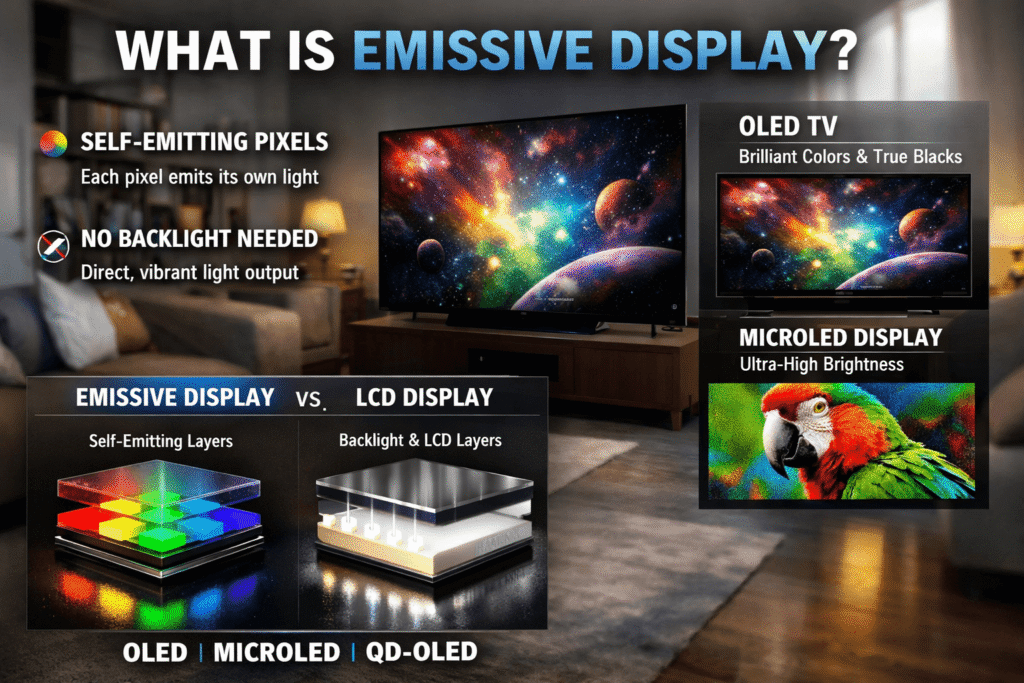
An emissive display is any display technology where each pixel produces its own light — without needing a backlight or external light source.
Think of it this way: in a traditional LCD screen, the pixels themselves don’t glow. They act like tiny shutters, blocking or passing light from a backlight panel behind them. An emissive display flips this entirely — every single pixel is its own light source, turning on and off independently.
The underlying principle that makes this possible is electroluminescence — the phenomenon where a material emits light in response to an electric current. When you apply voltage to an emissive pixel, it lights up. Remove the voltage, and it goes completely dark. That’s it. No backlight, no light leakage, no compromise.
This simple but powerful principle is what gives emissive displays their signature advantages: true blacks, exceptional contrast, wide viewing angles, and superior power efficiency.
Emissive vs Non-Emissive Displays: The Core Difference
To truly appreciate what makes emissive displays special, it helps to understand what they’re being compared against.
Non-emissive displays (like LCDs) rely on an external backlight. The backlight is always on, and the liquid crystals act as a gate — controlling how much of that light passes through to your eyes. Even when a pixel is supposed to show “black,” the backlight is still shining behind it. This is why LCD screens have a characteristic glow in dark environments.
Emissive displays, on the other hand, only consume power when a pixel is actually lit. A black pixel is simply off — drawing zero power and emitting zero light. This isn’t just a visual improvement; it’s an architectural advantage with real-world implications for device design, battery life, and image quality.
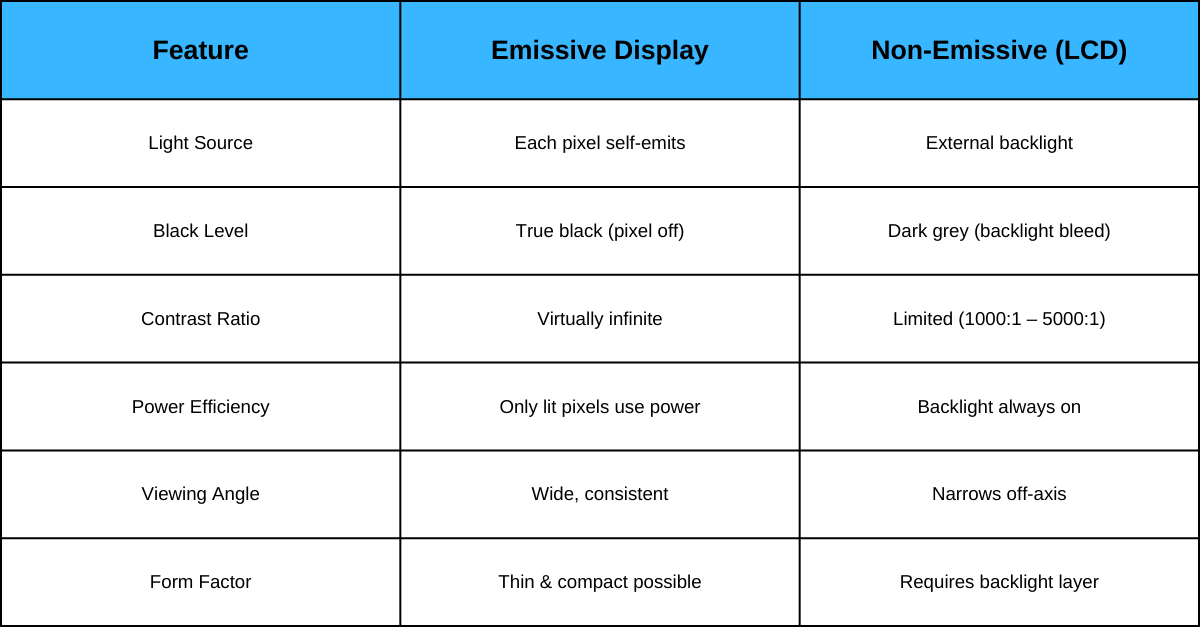
Here’s a quick side-by-side comparison:
Types of Emissive Display Technologies
Not all emissive displays are built the same. Several distinct technologies fall under this umbrella, each with its own architecture, strengths, and ideal use cases.
1. OLED (Organic Light-Emitting Diode)
OLED is the most widely recognized emissive display technology today. It uses organic compounds that emit light when an electric current passes through them. OLEDs are flexible, thin, and capable of incredible color accuracy — which is why you’ll find them in flagship smartphones, high-end TVs, and wearable devices. OLED comes in two main varieties: AMOLED (Active Matrix OLED), which uses a transistor per pixel for fast switching and is common in consumer devices, and PMOLED (Passive Matrix OLED), a simpler, lower-resolution variant used in small displays like smartwatch sub-screens.
2. Micro OLED
Micro OLED takes OLED technology and builds it directly onto a silicon wafer using CMOS fabrication processes — the same technology used to make microchips. The result is an incredibly small, ultra-dense display with pixel densities that can exceed 3,000 PPI (pixels per inch). This makes Micro OLED ideal for near-eye applications where the display is viewed through optics at very close range, such as AR/VR headsets, military HUDs, and medical viewfinders. Compared to standard OLED on glass substrates, Micro OLED offers higher pixel density, better thermal performance, and a dramatically smaller form factor.
3. MicroLED
MicroLED uses microscopic inorganic LED chips as individual pixels. It offers outstanding brightness — significantly higher than OLED — making it attractive for outdoor and high-ambient-light applications. MicroLED also has excellent longevity with no risk of burn-in. However, the manufacturing complexity and cost of MicroLED remain high, making large-scale production challenging. It’s an emerging technology with enormous promise, particularly for applications where extreme brightness is a requirement.
4. LED Displays
Traditional LED displays — most commonly seen as large outdoor billboards and indoor video walls — are emissive in nature. Each pixel consists of red, green, and blue LED elements that combine to produce full color. While they excel at size scalability and high brightness, they lack the pixel density needed for near-eye or precision medical imaging applications.
5. Quantum Dot Emissive Displays (QD-OLED)
QD-OLED combines the self-emissive structure of OLED with quantum dot color conversion layers. The result is an emissive display with dramatically expanded color volume, higher peak brightness, and more precise color accuracy than standard OLED. QD-OLED has gained traction in premium consumer TVs and professional monitors.
Key Performance Advantages of Emissive Displays
Understanding why engineers and product developers choose emissive displays comes down to five core performance pillars:
True Black & Infinite Contrast: Since pixels turn completely off to produce black, there is no minimum luminance floor. This delivers contrast ratios that are theoretically infinite — a critical advantage for medical imaging where distinguishing subtle tissue gradients matters, and for AR/VR where immersion depends on deep blacks.
Superior Power Efficiency: Emissive displays only consume power for the pixels that are actively lit. For battery-powered devices — wearables, AR glasses, portable medical instruments — this translates directly into longer usage times.
Ultra-Fast Response Times: Emissive pixels switch on and off in microseconds. For AR/VR developers, this is non-negotiable — slow response times cause motion blur and contribute to simulator sickness in head-mounted displays.
Wide Viewing Angles: Because light is emitted directly from each pixel, there’s no angular dependency. Colors and brightness remain consistent whether you’re looking straight on or at a sharp angle — important for surgical displays used by multiple team members simultaneously.
Compact Form Factor: Without a backlight assembly, emissive displays can be made significantly thinner and lighter — enabling product designs that simply aren’t possible with traditional display technologies.
Emissive Display Applications by Industry
The self-emissive advantage isn’t uniform across all products — its value is amplified in specific environments. Here’s where emissive display technology is making the most significant impact.
AR/VR Headsets & Smart Glasses
Near-eye displays are perhaps the most demanding application for any display technology. The display sits millimeters from the user’s eye, viewed through magnifying optics — meaning every imperfection is amplified. Emissive displays, particularly Micro OLED, deliver the pixel density (often 2,000–3,500+ PPI), contrast, and response time that near-eye optics demand. The lightweight nature of Micro OLED panels also helps reduce headset bulk — a persistent challenge for wearable developers. Major platforms in the AR/VR industry have already adopted Micro OLED as their display of choice for premium headsets.
Medical Imaging & Surgical Visualization
In medical environments, display accuracy isn’t just a preference — it can affect patient outcomes. Emissive displays offer the high contrast needed to distinguish subtle differences in tissue density, vascular structures, and instrument positioning. For wearable surgical displays and endoscopy viewfinders, Micro OLED’s compact size and color fidelity make it a natural fit. Additionally, the wide viewing angle of emissive panels ensures the entire surgical team has a consistent view without positional compromise.
Defense & Military Heads-Up Displays (HUDs)
Military applications push display technology to its absolute limits. Field environments demand displays that work in extreme temperatures, resist shock and vibration, deliver legible imagery in bright sunlight or complete darkness, and consume minimal power. Emissive displays — and Micro OLED in particular — check all these boxes. Their high contrast ensures critical targeting and navigation data remains readable under all conditions. Their compact, rugged form enables integration into helmet-mounted displays and weapon sighting systems without compromising the soldier’s mobility.
Limitations of Emissive Displays: What You Should Know
No technology is without trade-offs, and a complete understanding of emissive displays includes acknowledging their limitations:
Burn-In Risk (OLED): Prolonged display of static images can cause permanent pixel degradation in OLED-based emissive displays. This is less of an issue in applications with dynamic content, but worth managing in fixed-interface displays.
Peak Brightness Challenges: Standard OLED emissive displays can struggle to match the raw brightness output of high-end LCD or MicroLED panels at full sustained load. Advances in Micro OLED and QD-OLED are rapidly closing this gap.
Manufacturing Complexity & Cost: Especially for Micro OLED and MicroLED, the fabrication process is technically demanding. This impacts production yield and unit costs — though scale and technology maturity continue to improve pricing.
Lifespan Considerations: Organic materials in OLED can degrade over time, particularly the blue subpixels. Modern encapsulation and drive techniques have significantly extended operational lifespans, but it remains a factor in long-lifecycle product planning.
The Future of Emissive Display Technology
The emissive display market is in an accelerated growth phase, driven largely by the explosion of AR/VR, the expanding use of wearable medical devices, and defense modernization programs worldwide.
Several trends are shaping the near-term future:
MicroLED maturation: As manufacturing costs decrease, MicroLED will challenge OLED in high-brightness and longevity-critical applications.
Higher resolution Micro OLED: The push toward 4K and beyond on sub-1-inch panels is ongoing, enabling more immersive and clinically precise near-eye displays.
Color-on-silicon breakthroughs: New deposition techniques are improving the color purity and efficiency of Micro OLED panels, expanding their viability in color-critical medical and defense applications.
Integration with AI-driven display control: Smart pixel-level power management and adaptive brightness algorithms are making emissive displays smarter — extending battery life and preventing premature degradation.
The emissive display landscape in 2025 and beyond is one of rapid innovation, growing commercial adoption, and increasing importance in the most demanding application environments on the planet.
Conclusion
Emissive display technology represents a fundamental shift in how visual information is delivered — and it’s a shift that’s already well underway. From the AR headset on a developer’s desk to the surgical display in an operating theatre to the HUD visor of a military pilot, emissive displays are redefining what’s possible.
If you’re building a product that demands precision, compact size, power efficiency, and uncompromising image quality, emissive display technology — and Micro OLED in particular — deserves to be at the center of your display strategy.