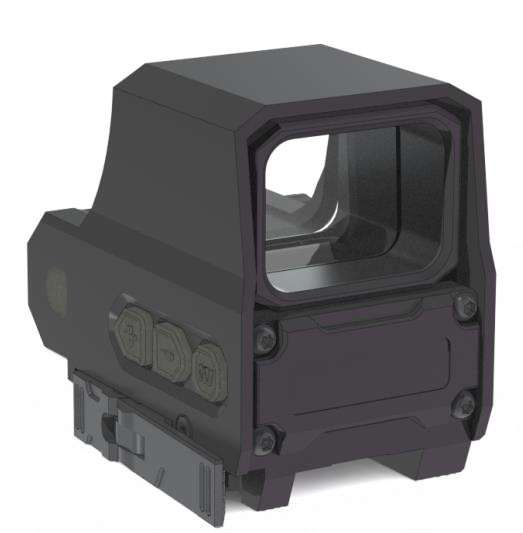

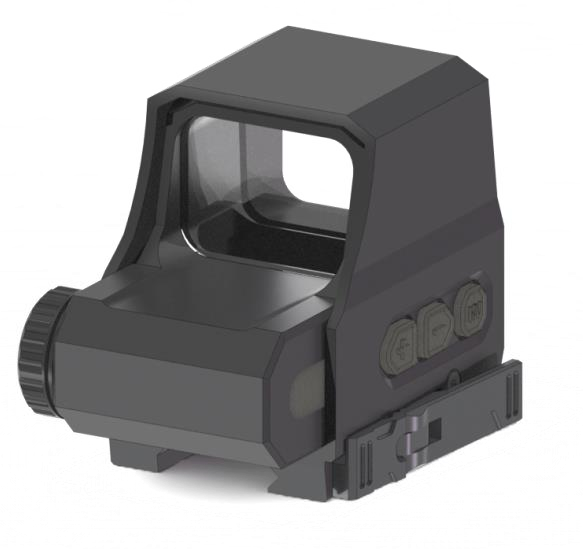
Typical Application Scenarios
1. Military and Counter-Terrorism
• Dynamic Combat Situations: Suitable for high-speed mobile scenarios such as urban warfare, beach landing, and airborne operations, supporting rapid aiming at targets within a direct line of sight up to 3 kilometers.
• Field Validation: In a recent military exercise, a squad equipped with holographic sights achieved “every shot a bullseye” during vehicle-mounted mobile shooting, increasing fire suppression efficiency by 40%.
2. Law Enforcement and Public Safety
• SWAT Close-Quarters Operations: In high-pressure scenarios such as hostage rescue and indoor raids, the reticle allows rapid target acquisition, improving shooting accuracy and reaction speed.
• Maritime Law Enforcement: Adapted to the rocking environment of boats, ensuring precise shooting on unstable platforms, effectively enhancing the success rate of law enforcement missions.
3. Civilian and Competitive Use
• Shooting Sports: Supports Olympic shooting events, military simulation training, and other scenarios, meeting the high-precision demands of fast-moving target tracking.
• Hunting Applications: The reticle stability outperforms traditional high-magnification scopes during target tracking in motion, aiding accurate hunting.
Core Principle: Laser Holographic Imaging
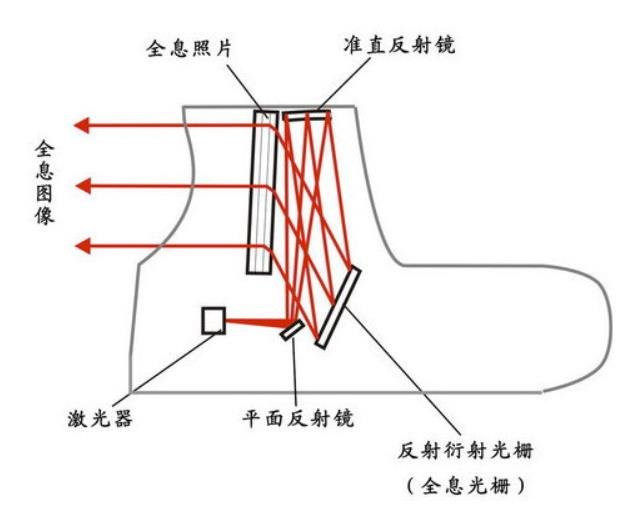
It uses the principles of laser interference and diffraction, employing a highly coherent laser as the light source. The laser is collimated into parallel light by a concave mirror and projected onto the holographic reticle, diffracting the reticle’s image into the viewer’s eye. The image appears at infinity. To reduce the influence of temperature on the aiming point, a holographic grating is added in the optical path for compensation.
Core Difference from Red Dot Sights
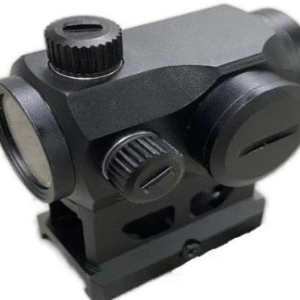
Red Dot Sight: Forms a virtual image using a reflected LED dot, which has parallax.
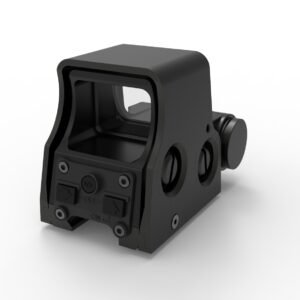
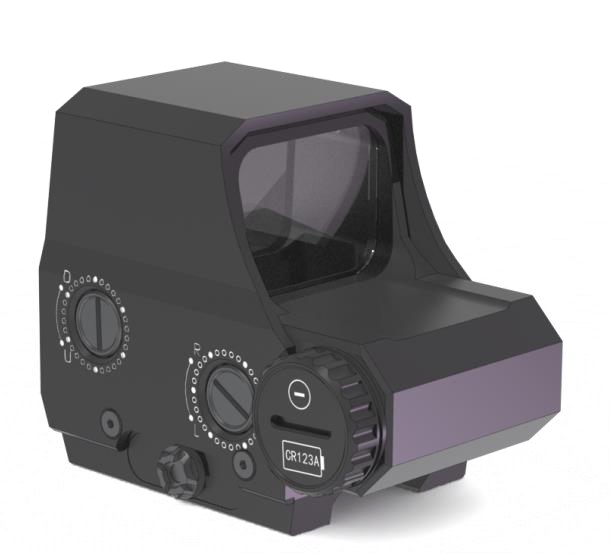
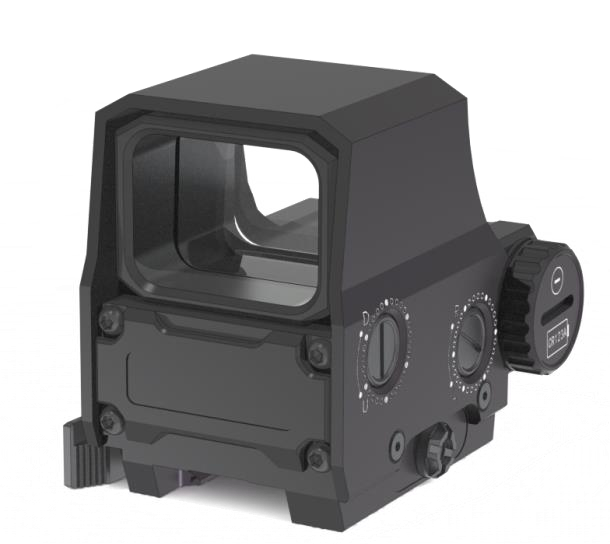
Holographic Sight: Projects a laser-diffracted image perceived at infinity, with almost no parallax and higher accuracy.
Holographic Sight – Product Manual
Download the full product manual (PDF) for the Holographic Sight — installation guide, optical specifications, brightness & adjustment settings, and maintenance instructions.
Click the button to open a new window. From there, click the download icon to download the manual.
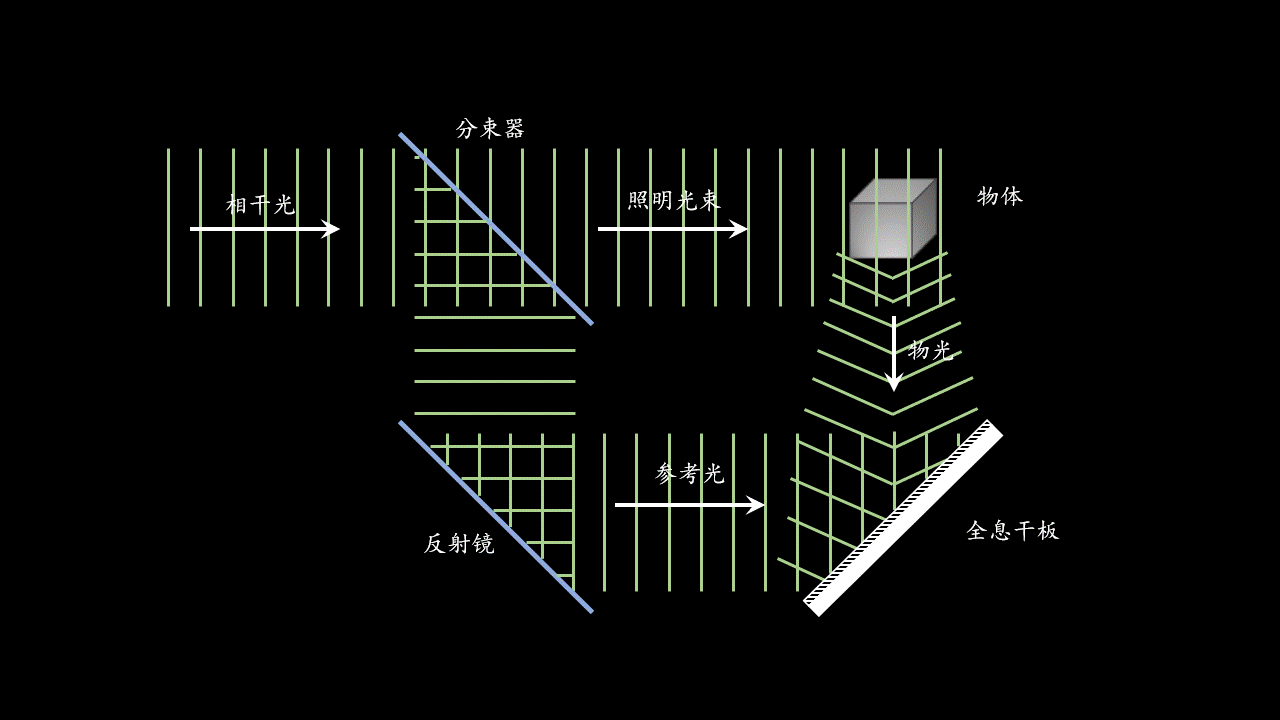
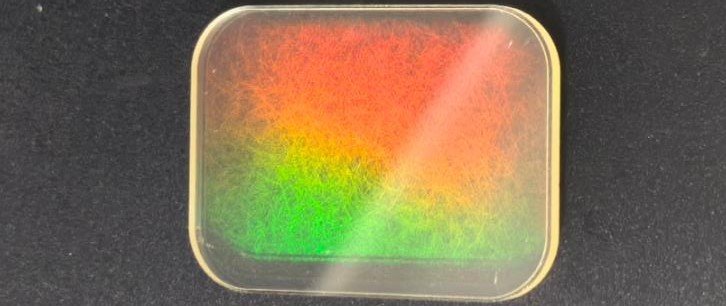
When the reference light directly illuminates the recording material and interferes with the object light reflected from the object, an interference pattern of alternating light and dark fringes is formed. The phase information of the object is encoded in the spacing, shape, and distribution of these interference fringes.
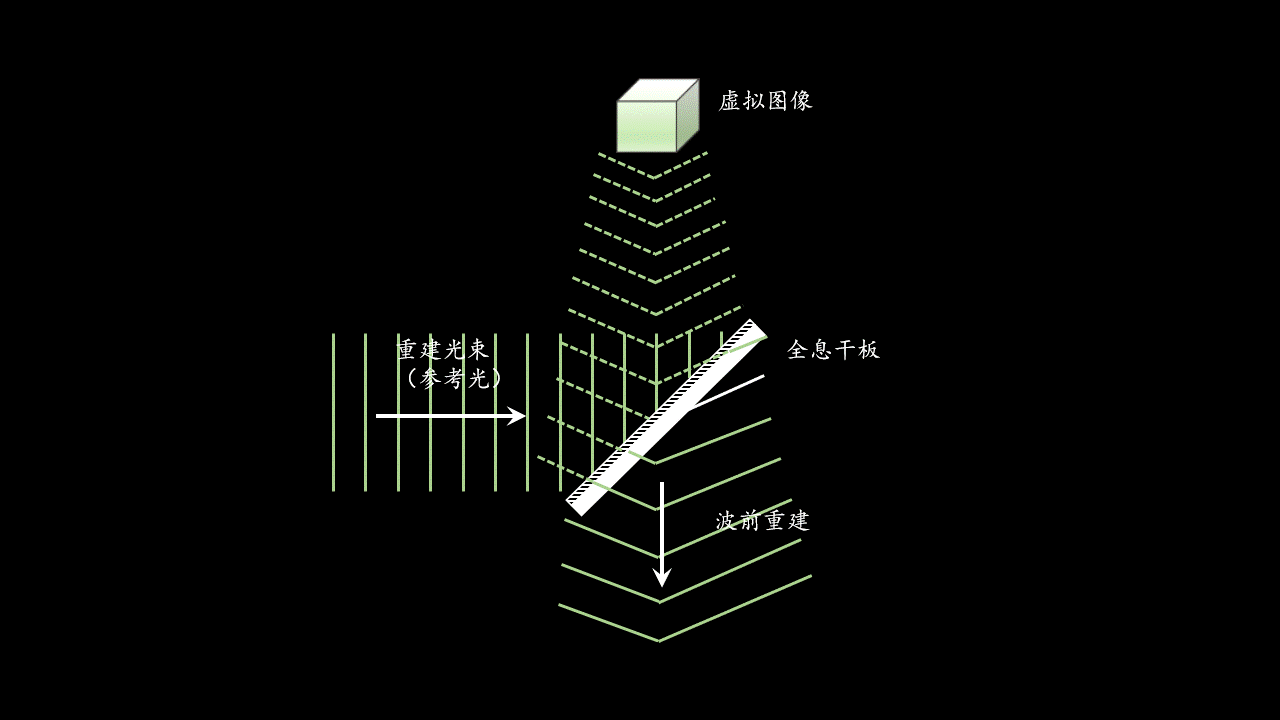
When the reference light illuminates the recorded material, part of the light is diffracted at specific angles. These diffracted rays propagate in directions consistent with the original object-reflected light, thereby reconstructing a three-dimensional image of the object at a specific spatial location.
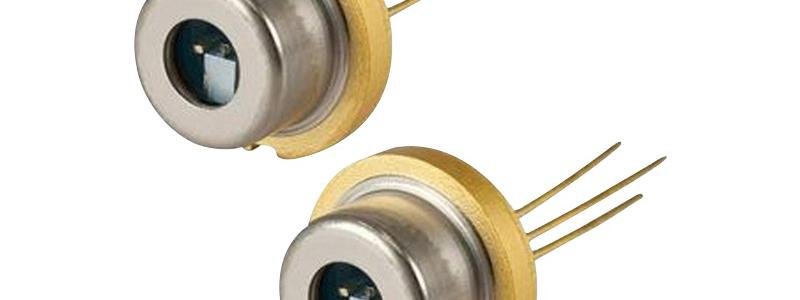
An internal laser diode generates a highly coherent and stable laser light source.
02. Beam Collimation
The beam direction is adjusted by a mirror and then collimated into parallel light using a concave mirror.
03. Holographic Diffraction
The parallel light illuminates the holographic grating, where diffraction occurs, directing the diffracted light toward the holographic reticle.
04. Image Reconstruction
The diffracted light enters the human eye, allowing the reticle image to be perceived at infinity.
| Category | Item | Value |
|---|---|---|
| Optical Specifications | Magnification | 1X |
| Optical Specifications | Windows size | ≥31mm×22mm |
| Optical Specifications | Targeting mode | 1MOA Dot, 68MOA Circle |
| Optical Specifications | Parallax | ≤2MOA |
| Optical Specifications | Laser wavelength | 650nm |
| Electrical Specifications | Battery | CR123A |
| Electrical Specifications | Max battery life | ≥1000 hours (Middle brightness) |
| Electrical Specifications | Brightness positions | 20 Daylight visible / 10 Night visible (Customization available) |
| Electrical Specifications | Shake awake | Yes |
| Electrical Specifications | Low battery alert | Aiming cursor flashing |
| Mechanical Specification | Material | Aluminium |
| Mechanical Specification | Processing method | CNC |
| Mechanical Specification | Surface treatment | Black oxidation |
| Mechanical Specification | Adjusting range | ±40MOA (Height, orientation) |
| Mechanical Specification | Adjusting accuracy | 0.7MOA |
| Mechanical Specification | Interface | Picatinny |
| Mechanical Specification | Outer size | ≤75mm×54mm×62mm |
| Mechanical Specification | Aiming baseline | 38mm |
| Mechanical Specification | Weight | 240g (without battery) |
| Environmental Specification | Operating temperature | -40℃~+55℃ |
| Environmental Specification | Storage temperature | -45℃~+60℃ |
| Environmental Specification | Impact-resistant | 1000G |
| Environmental Specification | IP level | IP67 |
Our holographic sight, developed based on proprietary patented polymer materials, completely solves the common issue of “window darkening” found in traditional holographic sights. Even under prolonged use in outdoor environments with strong direct sunlight, the sight window maintains high transparency and clarity.
2. Full Industry Chain Support
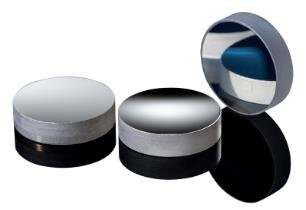
In addition to complete sight products, we also provide key optical components such as gratings and holographic reticle plates for firearm aiming. We support customized optical solution development to meet the technical requirements of various scenarios.
| Features | Holographic Sight | Red Dot Sight |
|---|---|---|
| Imaging Principle | Holographic Diffraction (Virtual image generated by holographic film) | Reflection (Virtual image generated by concave beam splitter) |
| Parallax Control | Theoretically no thermal drift; dual gratings suppress wavelength effects | Parallax always present; errors significantly increase with distance |
| Reticle Clarity | Minimal reticle obstruction, high resolution (1 MOA center dot) | Larger reticle, prone to obscuring target details at long distances |
| Environmental Adaptability | Temporary use possible despite lens dirt/damage; supports extreme weather | Lens contamination or damage directly causes failure |