
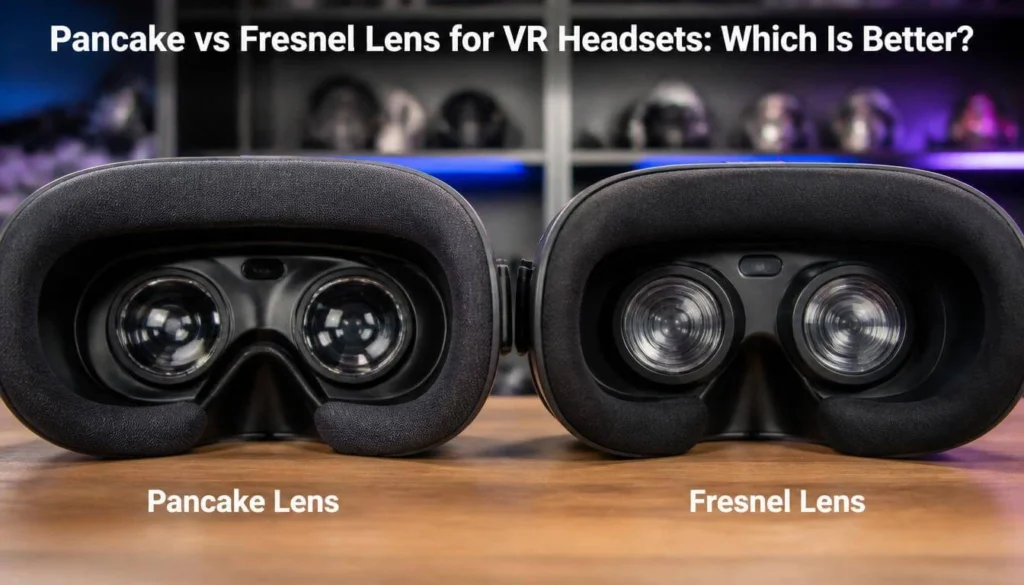
If you are building or sourcing a VR headset — whether for consumer use, enterprise training, or medical simulation — one of the most important decisions you will make is the optical design. And right now, the whole industry is asking the same question: pancake vs fresnel lens for VR — which one wins?
As an optical manufacturer that designs, builds, and tests VR optics every day, we have worked with both technologies for years.
In this guide, we will break down exactly how each lens type works, where each one performs better, and which one you should choose for your specific product.
What Is a Pancake Optical Module?
A pancake optical module is a type of VR lens system that uses a folded light path to create a very short distance between the display and the lens. It combines a beam splitter, polarizing films, and a reflective polarizer in a multi-layer stack. The light bounces back and forth inside this stack (that is where the name ‘pancake’ comes from) before reaching your eye.
The result is a dramatically thinner optical path, often 30 to 40% slimmer than a Fresnel-based design — without sacrificing image quality. This is why almost every premium VR headset launched after 2022 uses a pancake module.
How the Optics Work (Simply Explained)
Light from the display enters the pancake stack. A polarizing beam splitter reflects the light back toward the display side. A quarter-wave plate then rotates the polarization. The light bounces again and passes through the final lens element to your eye. This folded path is what gives pancake modules their compact size.
Key Specifications of Pancake Optical Modules
- Lens diameter: typically 35mm to 50mm
- Field of view (FOV): 90° to 120° depending on design
- Eye relief: 15mm to 22mm
- Light efficiency: approximately 25% to 35% (due to polarization losses)
- Best display pairing: micro OLED, silicon OLED (high-brightness compact panels)
- Typical headset thickness savings: 30–40% vs Fresnel stack
Expert Note : Because pancake modules lose about 65–75% of light in the folded polarization path, they require a very bright display — typically 5,000 nits or above. This is why micro OLED panels are the standard pairing for pancake-based headsets. If you use a lower-brightness LCD, the image will look too dim for comfortable use.
What Is a Fresnel Lens?

A Fresnel lens is a flat, lightweight lens with concentric circular grooves etched into its surface. These grooves replace the thick curved glass of a traditional convex lens and bend light in the same way — but with far less material.
Fresnel lenses were originally invented for lighthouses in the 1800s. In VR headsets, they became the dominant optic of the 2015–2022 era because they are inexpensive to manufacture, easy to mold in plastic, and highly light-efficient.
How a Fresnel Lens Works
Each concentric ring of a Fresnel lens acts as a small prism. Together, they focus light from a large flat panel toward your eye. Because the lens is thin and flat, it does not require a long focal length — making it compact enough for a headset form factor.
Key Specifications of Fresnel Lenses for VR
- Lens diameter: typically 50mm to 75mm
- Field of view (FOV): 90° to 100° in most consumer headsets
- Eye relief: 16mm to 25mm
- Light efficiency: approximately 65% to 75% (very good)
- Best display pairing: LCD, AMOLED (standard brightness panels)
- Known issue: ‘god rays’ — light scattering around bright objects in dark scenes
Expert Notes : Fresnel lenses are highly sensitive to dust and fingerprints on their grooved surface. For B2B OEM products going into enterprise or industrial environments, this requires extra consideration in the housing and cleaning guidelines. We always recommend an anti-smudge coating and a sealed optical chamber for Fresnel-based designs.
Pancake vs Fresnel Lens FOR VR: Side-by-Side Comparison
Here is the full technical comparison between pancake optical modules and Fresnel lenses across every specification that matters for a VR OEM buyer or product engineer:
| Specification | Pancake Optical Module | Fresnel Lens |
|---|---|---|
| Field of View (FOV) | Up to 120° | Up to 100° |
| Lens Thickness | Very thin (30–40% slimmer than Fresnel) | Thicker (concentric ring structure) |
| Headset Form Factor | Slim, lightweight, premium feel | Bulkier, heavier optical stack |
| Light Efficiency | ~25–35% (polarization loss) | ~65–75% (direct light path) |
| Display Brightness Needed | Higher brightness required (micro OLED ideal) | Standard brightness works fine |
| Cost to Manufacture | Higher (precision coatings + polarizers) | Lower (simpler molded optics) |
| Optical Clarity / Sharpness | Excellent edge-to-edge clarity | Good center, some edge softness |
| God Rays / Lens Artifacts | Minimal to none | Moderate (known issue with bright lights) |
| Weight | Lighter (shorter optical path) | Heavier optical module assembly |
| Best Display Pairing | Micro OLED / Silicon OLED | LCD / AMOLED |
| Ideal Headset Type | Premium consumer, enterprise, medical HMD | Entry/mid-range VR, budget HMD |
| OEM Customization Ease | Moderate (precision coatings required) | Easy (standard mold tooling) |
Which Should You Choose? Use Case Guide
The right optical module depends entirely on your product. Here is a clear, application-by-application breakdown based on our experience manufacturing optics for clients in 14+ countries.
Choose Pancake Optical Module If:
- You are building a premium consumer VR headset (similar to Meta Quest Pro, Apple Vision Pro category)
- Your headset design requires a thin, lightweight form factor — under 400g total weight
- You are pairing with a micro OLED or silicon OLED display (high brightness, small panel)
- Image clarity and minimal artifacts (no god rays) is a non-negotiable requirement
- You are targeting enterprise training, medical simulation, or surgical HMD applications
- Your buyers are comparing products and care about optical quality spec sheets
- You are building a mixed reality (MR) or pass-through AR device where optics quality directly impacts user trust
Choose Fresnel Lens If:
- You are building an entry-level or mid-range VR headset with aggressive cost targets
- Your display is an LCD or standard AMOLED — Fresnel works efficiently with these panels
- Your target market is price-sensitive (education, simulation training at scale, gaming markets in emerging economies)
- You need faster time-to-market — Fresnel tooling is simpler and faster to manufacture at volume
- You are doing a first prototype or MVP and want to validate the experience before upgrading optics
Your headset design allows for a wider, deeper optical module housing
Industry-Specific Recommendations
Medical & Surgical HMD: Pancake, always. Surgeons and medical professionals require sharp, artifact-free optics. Weight matters enormously when a device is worn for hours. Micro OLED + pancake module is the standard in this vertical.
Enterprise & Industrial Training: Pancake preferred. Enterprise buyers evaluate optical quality in procurement decisions. A thinner, lighter headset reduces user fatigue in long training sessions. The higher unit cost is acceptable in enterprise B2B pricing.
Consumer Gaming (Premium): Pancake. The shift is already happening — every major 2023–2025 premium headset launch moved to pancake optics. Buyers expect it.
Consumer Gaming (Budget): Fresnel. If your retail price target is below $200–$250, Fresnel is still the right choice. The optical cost savings are significant at high volume.
Drone FPV & Industrial Camera EVF: Pancake optical modules are increasingly used here, especially when paired with micro OLED EVF displays. Compact size and high image sharpness are critical for pilot situational awareness.
Defense & Military HMD: Pancake with ruggedized housing. Military applications demand optical performance above all else. Weight, reliability under environmental stress, and night vision compatibility are the deciding factors — pancake modules meet all three better than Fresnel.
What About Cost? A Realistic B2B Pricing View
One of the most common questions from OEM procurement teams: how much more expensive is a pancake module compared to a Fresnel lens?
At current market rates for mid-volume B2B orders (1,000 to 10,000 units), the cost difference is typically 3x to 5x for the optical module alone. A quality Fresnel lens set might cost $8–$15 per unit. A precision pancake optical module from a certified manufacturer starts around $35–$80 per unit depending on diameter, coatings, and display pairing.
However, the total cost of ownership calculation is more nuanced for B2B buyers:
- Pancake modules allow a thinner headset housing — this reduces plastic, reduces assembly time, and reduces overall product weight
- The higher optics cost is often partially offset by a simpler mechanical design
- Premium headsets command a higher retail price, which improves margin even with higher BOM cost
Fresnel’s lower upfront cost makes it the right choice when total unit economics are tight — especially for high-volume, price-competitive markets - The decision is not just about optics cost. It is about total product cost and the price point your market will bear.
Work With a Certified Optical Manufacturer
Choosing between pancake vs fresnel lens for VR optics is only the first step. The real value comes from working with a manufacturer who has deep experience in both technologies and can guide your optical design from concept to production.
At ARVR Optical, we manufacture both pancake optical modules and Fresnel lens systems for B2B OEM clients worldwide. Our capabilities include:
- Custom pancake optical module design: diameter, FOV, eye relief, coating specifications
- Fresnel lens manufacturing: injection-molded plastic, glass hybrid, custom groove profiles
- Micro OLED display + pancake module integration (complete optical engine)
- Optical system design services from Shanghai Visyu Optical Technology CO.,LTD
- First article inspection, MTF testing, and full quality documentation
- Sample program available: prototype order before committing to production MOQ