
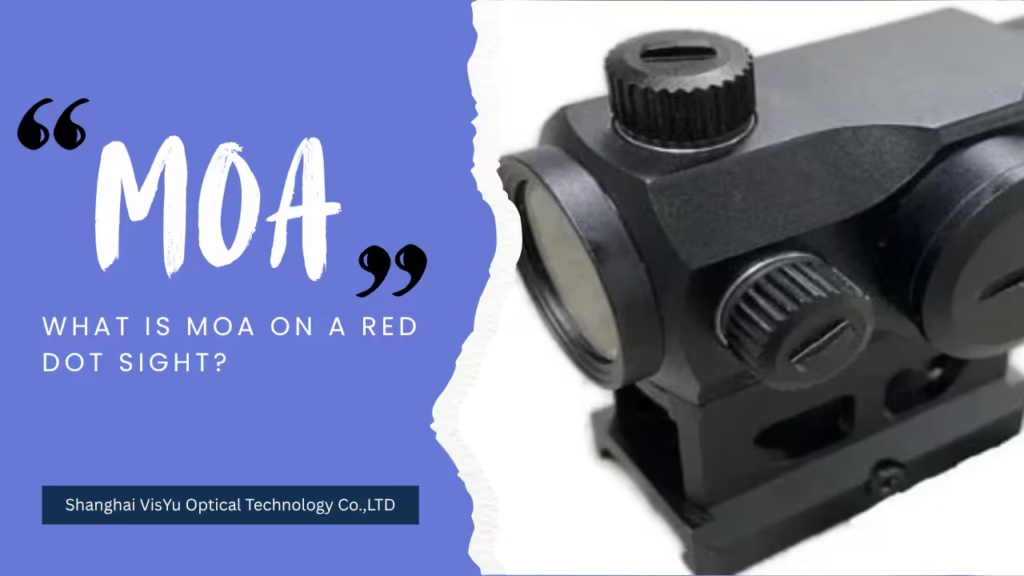
If you are shopping for a red dot sight in a Bulk from directly Manufacturer or supplier , you have probably seen terms like 2 MOA, 3 MOA, or 6 MOA in product descriptions. Many Business owners, especially beginners, wonder what MOA means and why it matters.
Understanding MOA is important because it affects how your red dot performs. The right MOA can help you aim faster, improve shooting accuracy, and make target acquisition easier. Whether you use a pistol optic for self-defense, a rifle optic for hunting, or a red dot sight for competition shooting, knowing how MOA works will help you choose the right optic.
In this guide, you will learn what is MOA on a red dot sight means, how it affects accuracy, and how to select the best MOA for your shooting needs.
What Does MOA Mean on a Red Dot Sight?
Definition of Minute of Angle (MOA)
MOA stands for Minute of Angle. It is a unit of angular measurement used in firearm optics and sighting systems.
A circle contains 360 degrees. Each degree is divided into 60 minutes. One of those minutes is called one Minute of Angle or MOA.
At 100 yards, 1 MOA equals approximately 1.047 inches. Most shooters simplify this and say:
1 MOA equals 1 inch at 100 yards.
1\ MOA \approx 1\ inch\ at\ 100\ yards
This measurement helps shooters understand both reticle size and sight adjustments.
Why MOA Is Important for Red Dot Sights
MOA affects two important parts of a red dot sight:
- The size of the red dot reticle
- The amount of adjustment made when zeroing the optic
A larger MOA creates a larger aiming point. A smaller MOA creates a smaller aiming point.
This directly impacts:
- Shooting accuracy
- Target visibility
- Speed of target acquisition
- Precision at different distances
MOA vs Dot Size Explained
When a red dot sight is labeled as 3 MOA, it means the dot covers about 3 inches of the target at 100 yards.
Examples:
- 1 MOA = 1 inch at 100 yards
- 2 MOA = 2 inches at 100 yards
- 3 MOA = 3 inches at 100 yards
- 6 MOA = 6 inches at 100 yards
A smaller dot covers less of the target and allows more precise aiming. A larger dot is easier to see and faster to acquire.
How Does MOA Work?
Understanding MOA in Simple Terms
Think of MOA as the amount of space your red dot covers on the target.
The farther the target is, the larger the dot appears on that target.
MOA itself never changes. What changes is the amount of target area covered at different distances.
Why 1 MOA Equals 1 Inch at 100 Yards
The actual mathematical value is:
1\ MOA = 1.047\ inches\ at\ 100\ yards
Most shooters round it to one inch because it makes calculations easier during shooting and zeroing.
How MOA Changes With Distance
As distance increases, target coverage increases.
| Distance | 1 MOA | 2 MOA | 3 MOA | 6 MOA |
|---|---|---|---|---|
| 25 yards | 0.25″ | 0.50″ | 0.75″ | 1.50″ |
| 50 yards | 0.50″ | 1.00″ | 1.50″ | 3.00″ |
| 100 yards | 1.00″ | 2.00″ | 3.00″ | 6.00″ |
| 200 yards | 2.00″ | 4.00″ | 6.00″ | 12.00″ |
This chart shows why shooters often choose different MOA sizes for different applications.
Red Dot Sight MOA Size Chart
MOA Coverage at 25 Yards
At close distances, even a large 6 MOA dot covers very little of the target.
This makes larger dots ideal for:
- Home defense
- Concealed carry
- Close-range shooting
MOA Coverage at 50 Yards
At 50 yards, a 6 MOA dot covers approximately 3 inches.
This still provides excellent visibility while allowing accurate shots.
MOA Coverage at 100 Yards
At 100 yards, differences become easier to notice.
A 2 MOA dot covers only 2 inches, while a 6 MOA dot covers 6 inches.
Shooters focused on precision often prefer smaller MOA sizes at this distance.
MOA Coverage at 200 Yards
At longer distances, larger dots begin covering more of the target.
This is why many rifle shooters prefer:
- 1 MOA
- 2 MOA
- 3 MOA
for longer-range accuracy.
How MOA Affects Accuracy
Target Coverage
Target coverage refers to how much of the target is hidden by the red dot.
Smaller dots cover less of the target, making it easier to place accurate shots.
Larger dots cover more of the target but are easier to see quickly.
Precision Shooting
Precision shooting benefits from smaller reticles.
A 2 MOA dot allows the shooter to see more of the target and make finer aiming corrections.
This is helpful for:
- Long-range shooting
- Hunting
- Competition shooting
Speed of Target Acquisition
Target acquisition means finding and placing the dot on the target quickly.
Larger dots help because the eye picks them up faster.
This is why many defensive pistol optics use:
- 4 MOA
- 5 MOA
- 6 MOA
reticles.
Close-Range vs Long-Range Performance
For close-range shooting:
- Larger MOA works well
- Faster sight acquisition
For long-range shooting:
- Smaller MOA performs better
- Greater aiming precision
The ideal choice depends on your shooting goals.
2 MOA vs 3 MOA vs 6 MOA Red Dot
Advantages of 2 MOA
Benefits include:
- Excellent precision
- Less target obstruction
- Better for longer distances
- Popular on rifle optics
Best for:
- Hunting
- Target shooting
- Competition shooting
Advantages of 3 MOA
Many experienced shooters consider 3 MOA the best balance.
Benefits include:
- Good speed
- Good accuracy
- Versatile performance
Best for:
- General use
- Home defense
- Recreational shooting
- Multi-purpose firearms
Advantages of 6 MOA
A 6 MOA dot offers:
- Fast acquisition
- Easier visibility
- Better performance under stress
Best for:
- Concealed carry
- Self-defense
- Close-quarter shooting
- Tactical applications
Comparison Table
| Feature | 2 MOA | 3 MOA | 6 MOA |
| Precision | Excellent | Very Good | Good |
| Speed | Moderate | Good | Excellent |
| Long Range | Excellent | Good | Limited |
| Close Range | Good | Very Good | Excellent |
| Home Defense | Good | Excellent | Excellent |
| Competition | Excellent | Very Good | Good |
What Is the Best MOA for a Red Dot Sight?
There is no single “best” MOA for every shooter.
The right choice depends on your firearm, shooting distance, eyesight, and intended use.
Best MOA for Beginners
Most beginners do very well with a 3 MOA red dot.
It provides a good balance between speed and precision while remaining easy to learn.
Best MOA for Home Defense
For home defense, speed is usually more important than extreme precision. Most defensive situations happen at short distances, often within 5 to 25 yards.
A larger red dot is easier to see and faster to place on the target. This is why many shooters prefer a 4 MOA to 6 MOA red dot for home defense.
Benefits include:
- Faster target acquisition
- Easier aiming under stress
- Better visibility in low-light conditions
For most home-defense pistols, a 6 MOA dot is an excellent choice.
Best MOA for Hunting
Hunters often shoot at varying distances depending on the game and environment.
For medium and long-range hunting, a smaller MOA dot provides better precision because it covers less of the target.
Recommended options:
- 1 MOA for maximum precision
- 2 MOA for long-range hunting
- 3 MOA for general-purpose hunting
Smaller reticles help place accurate shots on vital areas, especially when shooting at greater distances.
Best MOA for Competition Shooting
Competition shooters often need a balance of speed and accuracy.
The ideal MOA depends on the type of competition:
- Close-range competitions often favor 6 MOA dots.
- Mixed-distance competitions often favor 3 MOA dots.
- Precision-focused competitions may use 2 MOA dots.
Many experienced competitors choose a 3 MOA red dot because it performs well in almost every shooting scenario.
Best MOA for Tactical Use
Tactical shooters often engage targets at multiple distances.
A 3 MOA red dot is commonly considered the most versatile option because it offers:
- Fast target acquisition
- Good precision
- Effective performance at both short and medium ranges
This balance makes it popular for law enforcement, security professionals, and defensive firearm owners.
MOA and Red Dot Sight Adjustments
MOA is not only used to describe dot size. It is also used when adjusting your optic.
Windage Adjustment
Windage moves the point of impact left or right.
If your shots are landing to the left of the target, you can use windage adjustments to move the reticle and bring the shots closer to the center.
Elevation Adjustment
Elevation moves the point of impact up or down.
If your shots are hitting low, you can adjust elevation upward to correct the problem.
Understanding MOA Click Values
Most red dot sights use adjustment clicks.
Common click values include:
- 1 MOA per click
- 1/2 MOA per click
- 1/4 MOA per click
For example:
If your optic uses 1 MOA clicks and your shots are 2 inches low at 100 yards, you would adjust upward by 2 clicks.
Understanding click values makes zeroing faster and more accurate.
How to Zero a Red Dot Sight
Zeroing means aligning the red dot with the point of impact.
Follow these basic steps:
Step 1: Choose Your Zero Distance
Common zero distances include:
- 25 yards
- 50 yards
- 100 yards
Many shooters prefer a 25-yard zero for pistols and a 50-yard zero for rifles.
Step 2: Fire a Group
Shoot a group of three to five rounds from a stable shooting position.
Step 3: Measure the Difference
Check how far the group is from the center of the target.
Step 4: Make Adjustments
Use windage and elevation adjustments based on your optic’s click value.
Step 5: Confirm Your Zero
Fire another group and repeat adjustments until the point of impact matches the point of aim.
A properly zeroed red dot sight improves shooting accuracy and confidence.
MOA for Different Firearms
Best MOA for Pistols
Pistols are often used at short distances.
Popular choices include:
- 3 MOA
- 5 MOA
- 6 MOA
A larger dot helps shooters find the reticle quickly during defensive shooting.
Best MOA for Rifles
Rifles are commonly used at longer distances.
Many rifle shooters prefer:
- 1 MOA
- 2 MOA
- 3 MOA
These smaller dots provide greater precision and less target obstruction.
Best MOA for Shotguns
Shotguns are often used for hunting or home defense.
Most shotgun users choose:
- 3 MOA
- 6 MOA
These sizes allow fast target acquisition while maintaining practical accuracy.
Best MOA for PCCs
A Pistol Caliber Carbine (PCC) is commonly used in competitions and recreational shooting.
Many PCC owners prefer a 3 MOA red dot because it offers excellent all-around performance.
MOA and Astigmatism
Why Red Dots Appear Blurry
Many shooters with astigmatism notice that red dots appear distorted.
Instead of a clean round dot, they may see:
- Starbursts
- Smears
- Comma-shaped dots
- Blurry reticles
This happens because the eye focuses light differently.
Can a Larger MOA Help?
In some cases, yes.
Many shooters with astigmatism find larger dots easier to see because they appear more defined.
A 4 MOA or 6 MOA dot may look clearer than a 1 MOA or 2 MOA dot.
Tips for Shooters With Astigmatism
Consider these tips:
- Lower brightness settings
- Test different reticle colors
- Try circle-dot reticles
- Experiment with larger MOA dots
Every shooter’s vision is different, so testing multiple options is important.
Common MOA Mistakes to Avoid
Thinking Bigger MOA Means Better Accuracy
A larger dot is easier to see, but it does not automatically improve accuracy.
Accuracy depends on skill, training, and proper sight alignment.
Choosing Dot Size Based on Trends
Many shooters buy a specific MOA simply because it is popular.
Instead, choose a dot size based on your intended use.
Ignoring Shooting Distance
Distance should always influence your MOA choice.
Long-range shooters usually benefit from smaller dots, while close-range shooters often prefer larger dots.
Confusing MOA With Sight Adjustments
Remember that dot size and adjustment clicks are different.
A 6 MOA reticle does not mean the optic adjusts in 6 MOA increments.
Always check your optic’s specifications.
Frequently Asked Questions
What does MOA stand for on a red dot sight?
MOA stands for Minute of Angle, an angular measurement used to describe dot size and sight adjustments.
Is 2 MOA or 6 MOA better?
Neither is universally better. A 2 MOA dot offers greater precision, while a 6 MOA dot offers faster target acquisition.
What MOA is best for 100 yards?
For shooting at 100 yards, many shooters prefer 2 MOA or 3 MOA because they cover less of the target.
Does MOA affect accuracy?
Yes. MOA affects how much of the target is covered by the reticle, which can influence aiming precision.
What MOA should beginners choose?
A 3 MOA red dot is often the best starting point because it balances speed and accuracy.
Is 3 MOA good for home defense?
Yes. A 3 MOA red dot works very well for home defense while also remaining useful for longer-range shooting.
Can MOA help shooters with astigmatism?
A larger MOA dot may appear clearer for some shooters with astigmatism, although results vary from person to person.
Conclusion
Understanding what MOA on a red dot sight means can help you make a smarter buying decision and improve your shooting performance. MOA, or Minute of Angle, affects both the size of the reticle and the adjustments used when zeroing your optic. Smaller MOA dots provide greater precision for long-range shooting, while larger MOA dots offer faster target acquisition for close-range applications.
Whether you use a pistol optic for home defense, a rifle optic for hunting, or a red dot sight for competition shooting, selecting the right MOA is important. For many shooters, a 3 MOA red dot offers the best balance of speed and accuracy. By understanding MOA, target coverage, windage, elevation, and zeroing, you can choose a red dot sight that matches your firearm, shooting style, and personal preferences with confidence.
OEM/ODM red dot sight manufacturer—Shanghai VisYu Optical Technology Co.,LTD offers fast bulk supply worldwide.