
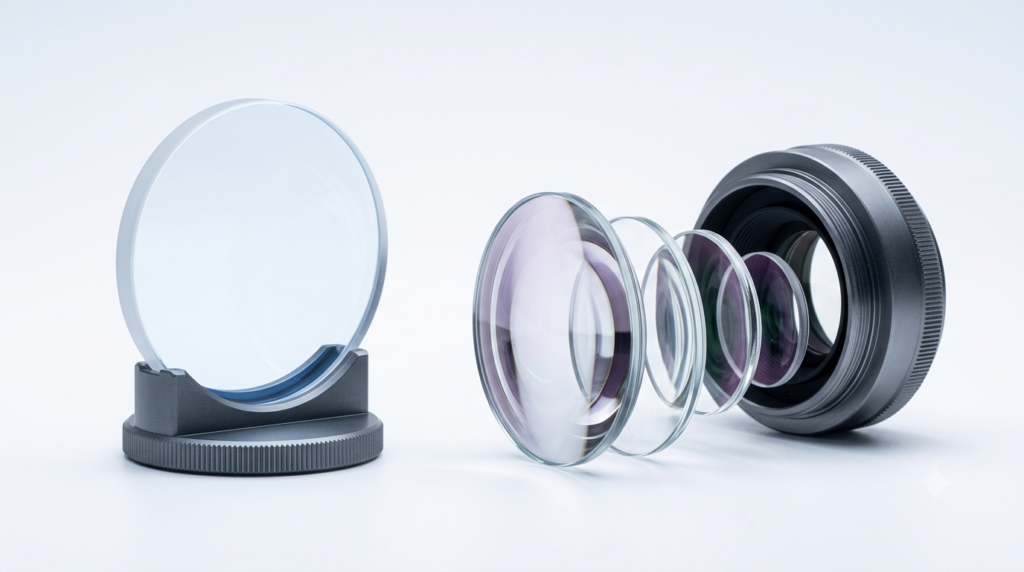
Difference Between Optical Window Glass and Camera Lens
The main difference between optical window glass and camera lens components is function: an optical window glass is a flat, non-focusing element designed to protect internal components while allowing light to pass through with minimal distortion, while a camera lens is a precisely curved optical element engineered to bend, focus, and direct light to form a clear image on a sensor or detector. Optical window glass has no optical power, while a camera lens has defined focal length and curvature. Understanding the difference between optical window glass and camera lens is essential for engineers designing AR/VR devices, imaging systems, sensors, and industrial optical assemblies.
The difference between optical window glass and camera lens components comes down to purpose and geometry. Optical window glass is typically flat on both surfaces and used to protect sensors, seal enclosures, or allow light transmission without altering the light path, meaning it has zero or near-zero optical power. A camera lens, by contrast, has curved surfaces specifically engineered to refract light, control focal length, and focus an image onto a sensor. In short, optical window glass transmits light without changing its direction, while a camera lens actively bends light to create a focused image.
Introduction
For engineers, procurement teams, and product designers working in optics, AR/VR, imaging, and industrial sensor design, understanding the difference between optical window glass and camera lens components is fundamental to selecting the right part for a given application. While both are transparent optical elements made from glass or optical-grade materials, they serve entirely different functions within an optical system.
This confusion is common among buyers new to optical component sourcing, since both parts may look visually similar, round or rectangular pieces of clear glass, but their internal geometry, material specifications, and intended function are fundamentally different. Using the wrong component in a design can lead to image distortion, poor light transmission, sensor damage, or complete system failure.
In this guide, we will break down the difference between optical window glass and camera lens components in detail, covering their function, structure, material composition, coatings, manufacturing tolerances, and typical applications. By the end, you will have a clear technical understanding of when to specify optical window glass versus a camera lens for your specific project.
What Is Optical Window Glass?
Optical window glass is a flat, transparent optical component designed primarily to allow light to pass through an enclosure or system while providing protection, sealing, or environmental resistance. Unlike lenses, optical window glass is manufactured with two parallel flat surfaces, meaning it does not intentionally bend or focus light as it passes through.
Optical window glass is commonly used to protect sensitive internal components such as sensors, detectors, micro OLED displays, or optical assemblies from dust, moisture, impact, and environmental contaminants. Because it introduces minimal optical distortion, it is often placed in front of cameras, laser systems, medical devices, and AR/VR modules where a clear, undistorted light path is required without adding any focusing power.
Materials used for optical window glass vary depending on the application. Common options include BK7 optical glass, fused silica, sapphire, and specialty glass types selected for their transmittance range, durability, and thermal stability.
What Is a Camera Lens?
A camera lens, in contrast, is an optical element or system of elements specifically engineered to refract and focus light onto an image sensor or film plane. Camera lenses have curved surfaces, either convex or concave, calculated with precise radii to achieve a specific focal length, field of view, and image quality.
Unlike optical window glass, a camera lens is designed with intentional optical power. This means light entering the lens is bent according to the lens curvature and refractive index of the material, allowing the system to focus light rays to a single point or plane, creating a sharp, properly scaled image.
Camera lenses are often composed of multiple lens elements grouped together, known as a lens assembly, to correct for optical aberrations such as chromatic aberration, spherical aberration, and distortion. This is one of the most fundamental aspects of the difference between optical window glass and camera lens design, a single flat window glass has no imaging function on its own, while a camera lens system is specifically engineered around imaging performance.
Difference Between Optical Window Glass and Camera Lens: Function and Purpose
The clearest difference between optical window glass and camera lens components lies in their intended function. Optical window glass exists purely to transmit light while protecting or sealing an optical system. It plays a passive role, allowing light through without altering its path in any meaningful way.
A camera lens plays an active role in image formation. Its entire design purpose is to manipulate incoming light rays through refraction, converging or diverging them as needed to produce a focused image on a sensor. This functional distinction is the starting point for nearly every other difference between optical window glass and camera lens components discussed in this guide.
Difference Between Optical Window Glass and Camera Lens: Surface Geometry
Surface curvature is one of the most technically significant points in the difference between optical window glass and camera lens design. Optical window glass is manufactured with flat, parallel surfaces on both sides, which is why it does not have a defined focal length or optical power.
A camera lens, on the other hand, is manufactured with precisely calculated curved surfaces. These surfaces may be spherical, aspherical, or a combination of multiple curved elements within a lens assembly. The curvature directly determines the lens’s focal length, magnification, and field of view. Even a small deviation in surface curvature during manufacturing can significantly affect image quality, which is why camera lens production requires extremely tight tolerances compared to flat optical window glass.
Difference Between Optical Window Glass and Camera Lens: Optical Power
Optical power refers to the degree to which an optical element converges or diverges light. This is another core difference between optical window glass and camera lens components.
Optical window glass is specifically designed to have zero, or as close to zero as possible, optical power. Engineers select and manufacture window glass to avoid introducing any unwanted focusing or distortion effects into the optical path. A camera lens, by definition, has a specific and intentional optical power, expressed through its focal length. This optical power is what allows a camera lens to project a real image of a scene onto a sensor at a usable size and sharpness.
Difference Between Optical Window Glass and Camera Lens: Material Selection
While both components can be made from similar base materials, such as optical glass, fused silica, or sapphire, the selection criteria differ based on function. Optical window glass materials are often chosen primarily for transmittance across a specific wavelength range, durability, scratch resistance, and thermal or chemical stability, since it frequently serves a protective role in harsh environments.
Camera lens materials are selected not only for transmittance, but also for their refractive index and dispersion characteristics, since these properties directly affect how the lens bends light and how well it controls chromatic aberration. Specialty optical glass types with specific refractive indices are commonly used in multi-element camera lens assemblies to balance image sharpness and color accuracy.
Difference Between Optical Window Glass and Camera Lens: Coatings
Coatings are applied to both optical window glass and camera lenses, but often for different reasons, which adds another layer to the difference between optical window glass and camera lens specifications.
Optical window glass frequently uses anti-reflective coatings to maximize light transmission and reduce glare, along with protective coatings such as anti-fog, scratch-resistant, or hydrophobic layers, particularly in AR/VR headsets, industrial sensors, and outdoor optical devices. Camera lenses also use anti-reflective coatings, but often in more complex multi-layer configurations designed to reduce lens flare, ghosting, and internal reflections between multiple lens elements within the assembly. In high-performance camera systems, coating design becomes a critical factor in overall image contrast and color fidelity.
Difference Between Optical Window Glass and Camera Lens: Manufacturing Tolerances
Manufacturing precision requirements differ substantially between the two components. Optical window glass, while still requiring high-quality flatness and parallelism specifications, generally has more forgiving tolerances compared to imaging optics, since its role does not involve focusing light to a precise point.
Camera lenses require extremely tight manufacturing tolerances for surface curvature, centration, and element alignment within a lens assembly. Even minor deviations can introduce noticeable image quality issues such as blur, distortion, or reduced resolution. This is why camera lens manufacturing typically involves more complex quality control processes, including interferometric testing and precision polishing, compared to standard optical window glass production.
Difference Between Optical Window Glass and Camera Lens: Typical Applications
Understanding where each component is used further clarifies the difference between optical window glass and camera lens design choices in real-world engineering.
Optical window glass is commonly used as a protective cover for image sensors, laser emitters, detectors, micro OLED displays, and AR/VR optical modules, where the goal is to allow light through cleanly without adding any focusing effect. It is also widely used in industrial and medical devices as an environmental barrier for internal optics.
Camera lenses are used wherever image formation is required, including digital cameras, smartphone camera modules, security and surveillance systems, machine vision equipment, endoscopic devices, automotive imaging systems, and optical instruments requiring magnification or focused image capture.
Difference Between Optical Window Glass and Camera Lens: Cost and Design Complexity
Cost is another practical factor that distinguishes optical window glass and camera lens components, and it stems directly from the manufacturing complexity discussed earlier. Optical window glass, being flat and requiring fewer precision curvature specifications, is generally less expensive to produce, particularly in standard sizes and thicknesses. This makes it a cost-effective solution for applications where its role is purely protective.
Camera lenses, especially multi-element assemblies designed for high-resolution imaging, involve significantly more design and manufacturing investment. Each element within a lens assembly must be individually calculated, ground, polished, coated, and aligned to work in combination with the other elements. For engineers working within a defined budget, understanding this cost difference between optical window glass and camera lens components can help guide early-stage design decisions, particularly when determining whether a project genuinely requires imaging optics or simply a protective transmissive barrier.
Difference Between Optical Window Glass and Camera Lens: Testing and Quality Control
Quality control processes also differ significantly between the two component types. Optical window glass is typically tested for parameters such as flatness, parallelism, surface quality, and transmittance across the required wavelength range. These tests confirm that the glass will not introduce unwanted distortion or excessive light loss into the system.
Camera lens testing is considerably more involved, since image quality depends on multiple interacting factors. Manufacturers commonly test camera lenses using modulation transfer function (MTF) analysis to measure resolution and contrast performance, along with checks for centration accuracy, focal length verification, and distortion measurement across the field of view. This more rigorous testing process reflects the greater complexity involved in ensuring a camera lens performs correctly as part of a complete imaging system, and it is a practical extension of the broader difference between optical window glass and camera lens engineering standards.
Difference Between Optical Window Glass and Camera Lens: Integration in AR/VR and Optoelectronic Systems
In modern AR/VR devices and optoelectronic systems, both optical window glass and camera lens components frequently appear within the same product, but positioned to serve distinct roles. A typical AR/VR module may use a camera lens assembly to capture or project imagery, paired with a separate optical window glass positioned to protect the internal micro OLED display, sensor, or optical engine from dust, moisture, and mechanical impact.
Engineers designing these integrated systems need to clearly define the functional boundary between the two components early in the design process. Treating a protective window as though it were part of the imaging path, or expecting a flat window to contribute focusing power, can lead to costly redesigns later in development. This is why a solid understanding of the difference between optical window glass and camera lens function is particularly valuable during the early optical architecture phase of AR/VR and sensor-based product development.
Choosing between optical window glass and a camera lens depends entirely on the functional requirement of your optical system. If the goal is simply to protect an internal sensor, detector, or display while allowing light to pass through without distortion, optical window glass is the correct choice. It is lightweight in design complexity, generally more cost-effective, and easier to manufacture in various shapes and sizes compared to imaging lenses.
If your system requires forming an image, focusing light onto a sensor, or achieving a specific field of view and magnification, a camera lens or lens assembly is necessary. In many real-world optical systems, both components are used together. A camera lens focuses the image, while a separate flat optical window glass may be positioned in front of the sensor or module purely for protection, without interfering with the lens’s optical performance.
Engineers designing AR/VR devices, industrial imaging systems, or optoelectronic assemblies should clearly define whether a given component’s role is protective and transmissive, which calls for optical window glass, or image-forming, which calls for a properly specified camera lens.
Conclusion
The difference between optical window glass and camera lens components ultimately comes down to function, geometry, and optical power. Optical window glass is a flat, non-focusing element designed to protect and transmit light cleanly, while a camera lens is a precisely curved optical system engineered to refract and focus light into a usable image. Recognizing this distinction is essential for engineers, procurement teams, and product designers working with optical assemblies, since specifying the wrong component can compromise both system performance and image quality. Whether you are designing a protective barrier for a sensor or building a complete imaging system, understanding how optical window glass and camera lens components differ ensures your optical design meets its intended performance requirements.
Frequently Asked Questions
What is the main difference between optical window glass and camera lens components? Optical window glass is flat and has no optical power, meaning it does not focus light, while a camera lens has curved surfaces specifically designed to refract and focus light into an image.
Can optical window glass be used instead of a camera lens? No, optical window glass cannot replace a camera lens because it lacks the curvature and optical power needed to form a focused image. It is only meant to transmit light and provide protection.
Do optical window glass and camera lenses use the same materials? They can use similar base materials such as optical glass or fused silica, but the selection criteria differ, camera lenses are chosen based on refractive index and dispersion, while window glass is chosen mainly for transmittance and durability.
Why do camera lenses require tighter manufacturing tolerances than optical window glass? Camera lenses must precisely focus light to form a sharp image, so even small deviations in curvature or alignment can significantly affect image quality, requiring much stricter manufacturing tolerances.
Are optical window glass and camera lenses ever used together in the same device? Yes, many optical systems use both components together, a camera lens focuses the image while a separate optical window glass protects the sensor or internal components without affecting the lens’s optical performance.