
Quick answer: “Micro display manufacturer” covers any company producing ultra-compact, high-density display panels — including micro OLED (OLEDoS), LCoS, DLP, and microLED technologies — for AR, VR, viewfinders, sights, and other near-eye or space-constrained optical systems.
These four technologies aren’t interchangeable: they differ fundamentally in how they produce light (emissive vs. reflective vs. transmissive), which drives very different trade-offs in brightness, contrast, power draw, and cost. Shanghai VisYu Optical Technology Co., Ltd. (ARVR Optical) is one such manufacturer, specializing specifically in silicon micro OLED displays, with a current lineup of five sizes from 0.32″ to 1.3″ and an ISO 9001:2015/14001:2015-certified production facility in Taicang City, Jiangsu Province, China.
Micro Display Manufacturer: Types, Specs & Buying Guide
I put this guide together because “micro display manufacturer” is a broader, more technical search than it looks — it’s really a request to understand an entire category of display technology and figure out which type and which supplier actually fits a specific project.
We’re covering the full landscape here: what a micro display actually is, the four major technology families and how they genuinely differ, how to decide between them, what a real manufacturer’s production process looks like, and the specific questions worth asking before you commit to a supplier. Our goal is that you don’t need to open five more tabs after this one.
What Is a Micro Display?
A micro display is a display panel built at a dramatically smaller scale and higher pixel density than conventional screens — typically under 2 inches diagonally, often built on a silicon or semiconductor substrate rather than a standard glass backplane.
Because they’re built with semiconductor-level precision, micro displays can pack in extremely high pixel densities (often 3,000+ pixels per inch) in an area smaller than a coin, which is what makes them viewable through magnifying near-eye optics without visible pixelation.
Micro displays aren’t a single technology — the term is an umbrella covering several genuinely different approaches to producing that image, and understanding the difference matters more than most buying guides let on.
The Four Major Micro Display Technologies, Explained
We think this is the part most guides skip past too quickly, so let’s actually break it down.
Micro OLED (OLEDoS – OLED-on-Silicon): An emissive technology, meaning each pixel produces its own light rather than relying on a separate backlight or external light source. Micro OLED panels are built on a silicon wafer backplane with organic emissive sub-pixels layered on top. This self-emissive nature is what gives micro OLED its defining strengths: true blacks (a pixel that’s “off” emits no light at all), extremely high contrast ratios, and fast pixel response times.
LCoS (Liquid Crystal on Silicon): A reflective spatial light modulator technology — liquid crystals are applied to a reflective mirror substrate, and external light is bounced off that surface and modulated by the liquid crystal layer to form the image. Because it’s reflective rather than emissive, LCoS depends on an external illumination source, but that same architecture lets it achieve very high resolution and strong contrast at a comparatively mature, lower manufacturing cost.
DLP (Digital Light Processing): Also a reflective technology, but instead of liquid crystals, DLP uses an array of microscopic mirrors — one per pixel — that tilt toward or away from the lens path to modulate brightness. DLP is well established in projector applications and tends to favor brightness and portability.
MicroLED: An emissive technology like micro OLED, but built from microscopic inorganic LED elements rather than organic emissive material. Because inorganic LEDs can be driven to extremely high brightness levels, microLED has generated significant interest as a light engine for AR glasses, promising high brightness, small size, fast response time, and high image quality.
The catch is manufacturing difficulty — mass-transferring millions of microscopic LEDs onto a backplane at high yield remains a genuine engineering challenge, which keeps microLED displays a premium, harder-to-source category relative to OLED and LCoS today.
How These Technologies Actually Compare
Here’s where the real decision-making happens:
- Brightness at scale: Outdoor-usable AR glasses need extremely high luminance because of losses across optical combiners and multi-focal-plane projection — the total optical loss for AR glasses can exceed 99%, which is why microLEDs, capable of over 10⁶ nits, are more viable than micro-OLEDs (around 10³ nits) for demanding outdoor brightness requirements.
- Market maturity: Micro OLED remains the dominant AR microdisplay technology today. Industry analysis found that OLED microdisplays led the AR display market with roughly 70% share and around 670,000 units shipped, while microLED, LCoS, and DLP each held meaningfully smaller volumes.
- Cost and pragmatism: For enterprise AR and waveguide-based smart glasses, LCoS remains the pragmatic choice where brightness and cost outweigh contrast requirements — which is part of why it’s shown up in established products like HoloLens 2 and Magic Leap 2-class devices.
- Where each technology wins: for buyers prioritizing color accuracy and fine detail, LCoS is generally the stronger option, while DLP tends to serve better in situations demanding portability and brightness.
If you’re sourcing a micro display and don’t yet know which of these four technologies fits your project, that decision should come before you start comparing manufacturers — because most suppliers specialize in one or two of these technologies, not all four.
Featured Micro OLED Micro Display Manufacturer: Shanghai VisYu Optical (ARVR Optical)
Given that micro OLED is currently the dominant technology in the AR/VR microdisplay market, we want to walk through what a real micro OLED-focused manufacturer looks like in practice, using Shanghai VisYu Optical Technology Co., Ltd. (trading as ARVR Optical, originally founded as Shanghai Guiyu Optoelectronics Technology Co., Ltd.) as our working example.
Company background: Founded in 2019, the company runs a two-site structure — an R&D headquarters in Shanghai’s Jiading District and a dedicated production plant in Ludu Town, Taicang City, Jiangsu Province. That split between design/engineering and manufacturing is standard practice among established optics manufacturers in the region, and it’s worth confirming with any supplier you’re evaluating.
Certifications: The company holds ISO 9001:2015 (quality management) and ISO 14001:2015 (environmental management) certifications — third-party-audited standards, not self-declared claims, and something you should be able to request certificate numbers for directly.
Core capabilities: Optical cold processing, advanced coating technologies (anti-reflective, IR-blocking, and specialty films), precision lens assembly, and gluing/inking for display modules — supported by named equipment including Japan Guangchi coating systems and ZYGO interferometry for metrology, alongside Hitachi/Shimadzu spectroscopy for color and brightness testing.
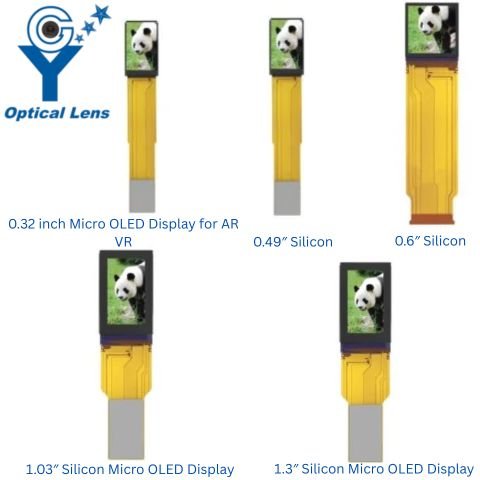
Product lineup: Five silicon micro OLED display sizes, ranging from a compact 0.32″ panel (800×600, 3,136 PPI, 220mW power draw) built for lightweight FPV and AR applications, up to a flagship 1.3″ panel (3552×3552, 3,882 PPI, 4,000 nits, 98% DCI-P3 color coverage) built for premium AR/VR products where image fidelity is the priority.
In between, the lineup includes a 0.49″ panel using Sub-Pixel Rendering to reach the highest density in the range at 4,523 PPI, a 0.6″ panel rated for 6,000 nits peak brightness, and a 1.03″ square-format panel with a 500,000:1 contrast ratio. All models use a MIPI display interface, which matters practically because it’s the interface most commonly supported by AR/VR reference SoCs and driver ICs — reducing custom driver development on the integrator’s side.
We’ll be upfront that everything in this section comes from the manufacturer’s own published materials — a reasonable starting point for evaluating a supplier’s EEAT signals (named certifications, named equipment, specific product specs), but not a substitute for your own verification. Request certificates directly, ask for a facility video call, and request evaluation samples before committing to production volumes.
How Micro Displays Are Actually Manufactured
The manufacturing path differs by technology, but for micro OLED (OLEDoS) specifically, the general workflow runs like this:
- Silicon backplane and OLED deposition: The pixel-driving circuitry and organic emissive layer are built on a silicon wafer — typically handled by a specialized semiconductor fab, and the step that determines resolution, PPI, and baseline electro-optical performance.
- Optical cold processing: Cover glass, encapsulation, and optical bonding are precision-assembled without heat-based processes that could damage the sensitive OLED layer beneath.
- Thin-film coating: Anti-reflective, IR-blocking, or specialty coatings are applied for glare control, durability, and color accuracy.
- Module assembly: The display is integrated with any associated optical components and bonded into its final module form.
- Metrology and testing: Interferometry validates optical/surface precision, while spectroscopy confirms brightness and color accuracy, typically before every unit or batch ships.
For LCoS and DLP micro displays, the process differs in meaningful ways — LCoS involves liquid crystal cell assembly onto a reflective silicon backplane rather than organic material deposition, and DLP involves MEMS-based micromirror array fabrication.
If you’re evaluating a manufacturer that claims to produce multiple micro display technologies, it’s worth asking specifically which stages of each process they perform in-house versus which components they source from a specialized fab.
Applications: Where Micro Displays Get Used
- AR smart glasses and waveguide-based headsets — where size, weight, and power draw are the binding design constraints
- VR headsets — where brightness, refresh rate, and contrast drive perceived immersion quality
- Enterprise and industrial near-eye displays — often favoring LCoS for its cost and color-accuracy profile
- Digital rifle sights and holographic sights — typically micro OLED or LCoS depending on brightness and power requirements
- Medical imaging devices — endoscopes, surgical loupes, and diagnostic viewfinders needing compact, high-resolution displays
- Projector light engines — DLP’s traditional stronghold, and an emerging application for microLED-as-light-source designs
- Microscopes and industrial inspection equipment — compact eyepiece and viewfinder integrations
How to Choose the Right Micro Display Technology and Manufacturer
We’d work through this in roughly this order:
- Decide on technology first, manufacturer second. If your product needs outdoor-usable brightness in a tiny form factor, microLED or a very high-brightness micro OLED panel is your starting point. If cost and color accuracy for an indoor or enterprise application matter more than peak brightness, LCoS deserves serious consideration.
- Match panel size to your optical design, not the other way around. Your field of view and magnification determine the physical active area you need — panels aren’t interchangeable across sizes even at matching resolution, because your optics are built around a specific display footprint.
- Check interface compatibility early. MIPI dominates current AR/VR reference designs, but confirm lane count and timing compatibility with your specific driver IC or SoC before you commit to a panel.
- Weigh brightness against your power and thermal budget — don’t default to the brightest available panel if your product is battery- or weight-constrained; match the spec to the actual application.
- Confirm what the manufacturer actually produces in-house. A manufacturer with in-house optical design and reverse-engineering capability can support a non-catalog spec; a manufacturer that’s purely assembling third-party panels usually can’t.
- Request real certification numbers, named equipment, and samples before committing to a purchase order — this is the single biggest predictor of whether a supplier can deliver consistently at volume.
Common Integration Challenges (and How to Solve Them)
Screen door effect at magnification: If individual pixels are visible when viewed through your optics, you likely need a higher-PPI panel or a technology (like OLEDoS with sub-pixel rendering) engineered specifically to minimize this at your target magnification.
Power budget overruns: Compare a panel’s power draw at your actual target brightness, not its peak-brightness rating — many datasheets list power consumption at a specific nit level, and running below or above that level changes the real-world draw significantly.
Interface mismatch during integration: Confirm MIPI lane configuration (and RGB support, if needed) against your driver IC before finalizing panel selection — this is one of the most common late-stage integration delays we’ve seen referenced across sourcing discussions in this category.
Thermal management in compact housings: Emissive technologies like micro OLED and microLED generate heat directly at the pixel level; reflective technologies like LCoS and DLP shift more of that thermal load to the external light source. Factor this into your housing design early, not after your first thermal test fails.
What to Verify Before Choosing Any Micro Display Manufacturer
- Which specific technology (micro OLED, LCoS, DLP, or microLED) they actually manufacture — not just claim to support
- Real, verifiable ISO certification numbers and named production equipment
- Whether in-house optical design capability exists for custom or non-catalog specs
- Sample availability and realistic lead times before committing to production volume
- Per-batch testing and QC documentation (brightness, contrast, color accuracy, dead-pixel rate)
- Track record and reference customers in your specific application category
Frequently Asked Questions
What is a micro display? A micro display is a compact, high-pixel-density display panel — usually under 2 inches — built for near-eye or space-constrained optical systems like AR/VR headsets, viewfinders, and digital sights.
What are the main types of micro display technology? The four major types are micro OLED (OLEDoS, emissive), LCoS (reflective liquid crystal), DLP (reflective micromirror), and microLED (emissive inorganic LED).
Which micro display technology is most common in AR devices today? Micro OLED currently leads the AR microdisplay market by shipment volume, with LCoS as a common pragmatic alternative, and microLED still emerging as a premium, harder-to-manufacture option.
Is micro OLED or microLED brighter? MicroLED can reach far higher brightness levels than micro OLED, which is why it’s considered more viable for outdoor-usable AR applications, though it remains more difficult and costly to manufacture at scale today.
What is the difference between LCoS and DLP? Both are reflective technologies, but LCoS uses a liquid crystal layer on a reflective silicon backplane, while DLP uses an array of microscopic tilting mirrors — LCoS tends to favor color accuracy and detail, while DLP tends to favor brightness and portability.
Who manufactures micro OLED displays specifically? Companies like Shanghai VisYu Optical Technology Co., Ltd. (ARVR Optical) specialize in silicon micro OLED (OLEDoS) displays, offering multiple sizes and resolutions for AR/VR and other near-eye applications.
What interface do most micro displays use? MIPI is the dominant interface for current micro OLED panels used in AR/VR reference designs; some smaller panels also support RGB interfaces.
How do I know which micro display technology is right for my product? Start with your brightness and outdoor-usability requirements, then weigh cost, power budget, and manufacturing maturity — micro OLED and LCoS are the most production-ready choices today, while microLED suits premium applications where extreme brightness justifies higher cost and complexity.
Does panel size affect image quality? Yes — larger active areas generally allow higher native resolution and larger pixel structures at a given PPI, but the “right” size is determined by your optical system’s field of view, not by which panel has the highest raw resolution number.
What should I ask a micro display manufacturer before ordering? Confirm which technology they actually manufacture in-house, request real ISO certification numbers, ask for evaluation samples, and request per-batch QC documentation before committing to a production order.
Final Take
“Micro display manufacturer” is a bigger question than it first appears — it spans four genuinely different technologies, each with real trade-offs in brightness, contrast, cost, and manufacturing maturity, and the right answer depends entirely on what you’re building.
Micro OLED remains the dominant, most production-ready choice for most AR/VR and near-eye applications today, LCoS remains the pragmatic cost-and-color-accuracy alternative, DLP holds its ground in brightness- and portability-driven use cases, and microLED is the technology to watch as manufacturing yields improve.
Once you’ve settled on the right technology for your project, evaluating the manufacturer itself — certifications, named equipment, in-house design capability, and sample availability — is what actually determines whether your sourcing decision holds up past the first production run.