
TL;DR
Holographic sights offer faster target acquisition, a clearer field of view, and better performance in low-light conditions compared to traditional red dot sights. They use laser-generated reticles instead of LED reflections, which makes them more durable, more accurate at distance, and easier to use with both eyes open. This article breaks down every major advantage of holographic sights, how they compare to red dot and reflex sights, and who benefits most from using one.
Quick Answer
The main advantages of holographic sights are faster target acquisition, superior low-light performance, a wider field of view, better durability against lens damage, and a more precise reticle that stays accurate even with magnification. Unlike red dot sights, holographic sights project a laser-generated reticle rather than reflecting an LED, which allows shooters to keep both eyes open, track moving targets more easily, and maintain accuracy at longer ranges. These features make holographic sights a preferred choice for tactical shooting, home defense, and competitive applications.
Introduction
Choosing the right optic can make or break your shooting performance. Whether you’re on a range, in the field, or relying on your firearm for home defense, the sight you use directly affects how fast and how accurately you can hit your target.
Holographic sights have become one of the most talked-about optics in the shooting community. Unlike traditional red dot sights, they use a completely different technology to project the reticle, and that difference brings a long list of practical benefits.
Many buyers get overwhelmed by the sheer number of optics on the market today. Terms like reflex sight, reticle, MOA, and parallax get thrown around without much explanation, which makes it hard to know what actually matters for your shooting style.
This guide cuts through that confusion. We’ll walk through the real, practical benefits of this optic, explain how the underlying technology works, and compare it to red dot and reflex sights so you can decide if it’s the right choice for your needs.
By the end, you’ll have a clear understanding of when this type of sight makes sense, and when a simpler alternative might serve you just as well.
What Is a Holographic Sight?
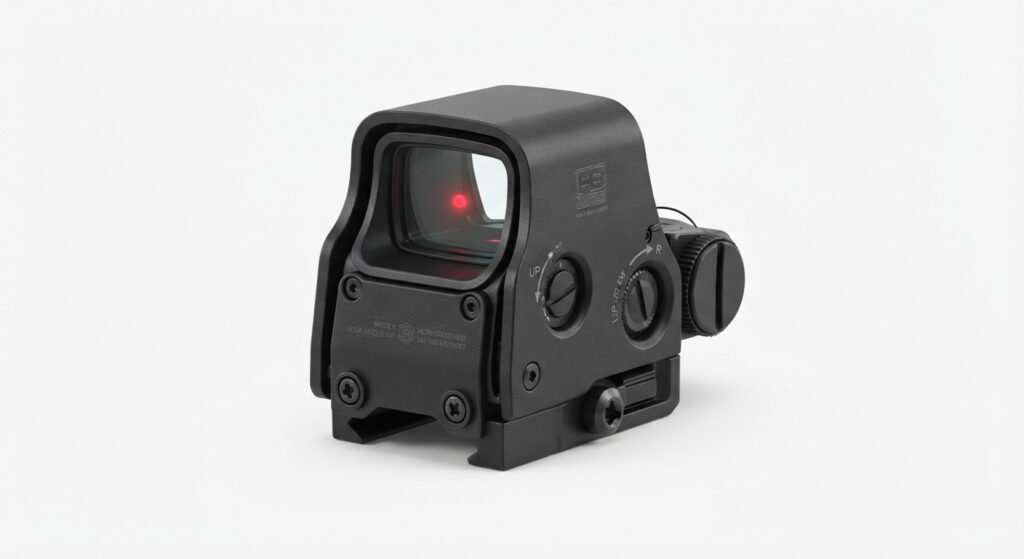
A holographic sight is an optical aiming device that uses a laser diode to record a holographic image of a reticle onto a piece of specially coated glass. When you look through the sight, you see this reticle superimposed onto your target, appearing to float in your line of sight.
This is different from a standard red dot sight, which uses an LED to reflect a dot onto curved glass. The holographic method creates a more complex but more capable sighting system, and that complexity is exactly what gives this optic its edge.
Inside the housing, a laser diode shines through a small hologram of the reticle pattern. That light bounces between two internal mirrors before reaching the front window, where the shooter sees the final image. Because the reticle is recorded as a hologram rather than simply reflected, it behaves more like a real object placed in front of the target, rather than a flat dot painted onto glass.
This engineering difference is subtle on paper but noticeable in practice. It’s the reason this category of optic tends to feel more natural for shooters who need to move quickly between targets or operate in changing light.
Key Advantages of Holographic Sights
Below are the core benefits that set this optic apart from simpler alternatives. Each one addresses a specific real-world shooting challenge, from speed to visibility to long-term durability.
1. Faster Target Acquisition
One of the biggest advantages of holographic sights is speed. Because the reticle appears to float directly on the target plane, shooters can acquire targets almost instantly without needing to align the dot precisely at the center of the lens.
This matters most in fast-paced scenarios like home defense, tactical training, or competitive shooting, where every fraction of a second counts. The holographic reticle allows for quick, intuitive aiming even under stress.
2. Works Well With Both Eyes Open
Holographic sights are designed to be used with both eyes open, which improves situational awareness. Instead of tunnel vision through a single lens, shooters maintain a wider perspective of their surroundings while still keeping the reticle locked on target.
This advantage is especially valuable for law enforcement, military use, and anyone who needs to track multiple threats or moving targets at once.
3. Superior Low-Light Performance
Compared to standard red dot sights, holographic sights generally perform better in low-light and nighttime conditions. The laser-based reticle remains crisp and visible even when ambient light is minimal, which gives shooters a real advantage during early morning hunts, dusk operations, or indoor environments with limited lighting.
Many holographic sights also offer adjustable brightness settings, allowing the reticle to stay visible without washing out the shooter’s view of the target.
4. Wider Field of View
Because this optic doesn’t rely on a small reflective lens the way red dot sights do, it typically offers a wider field of view. A wider field of view means the shooter can see more of the surrounding environment while aiming, which improves both speed and situational awareness.
This is one of the reasons the technology is commonly chosen for close-quarters shooting, where scanning the environment quickly is just as important as hitting the target.
5. Reticle Stays Accurate Even With Magnification
A less obvious but important advantage of holographic sights is how they behave when magnifiers are added. A red dot sight’s reticle size increases proportionally with added magnification, which can obscure smaller or distant targets.
Holographic sights don’t have this problem in the same way. Because the reticle is a projected hologram rather than a reflected point of light, it maintains better proportional accuracy even when combined with magnifying optics, giving shooters more precision at extended ranges.
6. More Durable Against Lens Damage
Standard red dot sights depend on a functioning reflective lens to display the dot. If that lens becomes cracked or damaged, the sight can become unusable.
This type of optic is generally more resistant to this issue. Since the reticle is generated through a laser and hologram process rather than a simple reflection, minor damage to the front lens doesn’t always compromise the shooter’s ability to use the sight effectively. This makes it a dependable option in demanding tactical or field conditions.
7. Versatile and Complex Reticle Options
Holographic sights often support more advanced reticle patterns, such as circle-dot combinations, chevrons, or multiple aiming points. These reticle styles can be useful for range estimation, faster target transitions, or shooting at varying distances.
This versatility gives shooters more flexibility depending on their shooting style, whether that’s close-range defense, mid-range engagement, or general-purpose use.
8. Better for Moving Target Engagement
Because holographic sights allow for a wider field of view and quick target acquisition, they tend to perform well when engaging moving targets. Shooters can track motion more naturally without losing sight of the reticle or needing to reposition their head significantly.
This advantage is often highlighted by competitive shooters and instructors who train for dynamic, real-world scenarios rather than static range shooting.
Holographic Sight vs Red Dot Sight: A Quick Comparison
Many shooters compare holographic sights to red dot sights before making a purchase decision. Both fall under the broader “reflex sight” category, but they operate differently.
Red dot sights use an LED that reflects off curved glass to create a simple dot. They are lightweight, affordable, and offer excellent battery life, often lasting years on a single battery.
Holographic sights use a laser and internal mirrors to project a more complex reticle. They tend to be heavier, more expensive, and consume more battery power, but they offer better low-light performance, wider field of view, and improved durability.
Neither option is universally “better.” The right choice depends on your shooting environment, budget, and specific performance needs.
Who Benefits Most From Holographic Sights?
Holographic sights are particularly well-suited for:
- Tactical and defensive shooters who need fast target acquisition
- Shooters operating in variable or low-light environments
- Anyone using magnifiers who wants a reticle that stays proportionally accurate
- Competitive shooters who value a wide field of view for tracking movement
- Users who prioritize durability in demanding conditions
That said, holographic sights are not always necessary for casual range use or beginners on a budget, where a simpler red dot sight may be more practical.
Maintenance and Long-Term Reliability
Another practical factor worth mentioning is upkeep. This type of optic is generally built with sealed, weather-resistant housings designed to handle recoil, moisture, and temperature swings without losing zero.
Routine care is simple: keep the lens clean, store the unit properly when not in use, and check the battery periodically since the internal laser system draws more power than a basic LED. Many models also include automatic shutoff features to preserve battery life when the sight isn’t in motion for an extended period.
For shooters who rely on their equipment in demanding conditions, this combination of weather resistance and consistent zero retention adds real long-term value, even if the upfront cost is higher than a basic optic.
Things to Consider Before Choosing a Holographic Sight
While the advantages of holographic sights are significant, it’s worth understanding the trade-offs. Holographic sights typically cost more than standard red dot sights and consume battery power faster due to the laser and internal mirror system.
They also tend to be bulkier, which may not suit every firearm setup. Before purchasing, it’s a good idea to consider your intended use case, budget, and whether the added performance benefits align with your shooting needs.
If you’re evaluating optical components or considering custom optical solutions for tactical or industrial applications, consulting with an experienced optical design and manufacturing partner can help ensure the right specifications for your specific use case.
Conclusion
Holographic sights offer a genuine performance upgrade over traditional red dot sights in several key areas: faster target acquisition, wider field of view, better low-light visibility, and improved durability. Their laser-based reticle technology also holds up better under magnification, making them a strong choice for shooters who need precision at varying distances.
That said, the right sight ultimately depends on your specific shooting needs, environment, and budget. Understanding these advantages puts you in a better position to make an informed decision, whether you’re upgrading a home defense firearm, outfitting a tactical setup, or exploring optical technology for professional applications.
FAQs
1. What is the main advantage of a holographic sight over a red dot sight? The main advantage is faster, more intuitive target acquisition combined with better performance in low-light conditions and a wider field of view.
2. Are holographic sights better for low light shooting? Yes, holographic sights generally perform better in low-light and nighttime conditions compared to standard red dot sights, thanks to their laser-generated reticle.
3. Do holographic sights work well with magnifiers? Yes, holographic sights tend to maintain more proportional reticle accuracy when combined with magnifiers, compared to red dot sights.
4. Are holographic sights more durable than red dot sights? Holographic sights are generally more resistant to functional loss from minor lens damage, since the reticle isn’t solely dependent on a reflective lens.
5. Is a holographic sight worth the extra cost? For tactical, low-light, or precision-focused applications, the added cost is often justified by the performance benefits. For casual or budget-conscious use, a standard red dot sight may be sufficient.
Ultimately, the best way to decide is to physically test both types of optics if possible, under conditions that match your actual use case, whether that’s a home defense scenario, a hunting trip, or a competitive shooting environment. Hands-on experience often reveals preferences that spec sheets alone can’t fully capture.