
TL;DR
Micro OLED display applications in AR and VR devices span smart glasses, mixed reality headsets, industrial viewfinders, and medical imaging systems. These displays are chosen for their high pixel density, fast response time, and compact size, all of which matter when a screen sits just millimeters from the human eye. This article explains how micro OLED display technology works, why it fits near-eye devices so well, and where it is being used across the AR/VR industry today.
Quick Answer
These near-eye displays are used in head-mounted displays, smart glasses, viewfinders, and mixed reality headsets, where extremely small, high-resolution panels project sharp images directly in front of the eyes. Because micro OLED panels are built on silicon wafers rather than glass substrates, they achieve much higher pixel density in a very small form factor, making them well suited to devices that require lightweight optics, low power draw, and crisp visual clarity at close viewing distances.
Introduction
Anyone who has tried on a modern AR or VR headset has likely experienced the difference a good display makes. Sharp text, vivid colors, and smooth motion can make virtual content feel believable. Blurry pixels or visible screen-door effects can break that illusion almost instantly.
This is where micro OLED display applications in AR and VR devices have become so important for near-eye hardware. Unlike standard OLED panels used in phones or televisions, these microdisplays are built on silicon backplanes instead of glass. This allows manufacturers to pack far more pixels into a much smaller area, which is exactly what wearable optical devices need.
Over the past few product cycles, hardware teams across the AR and VR industry have shifted toward this display type for exactly this reason. As headsets and smart glasses get lighter and more compact, the pressure on display components to shrink without losing sharpness has only increased.
In this article, we will look at how the technology works, why it has become a preferred choice for AR and VR hardware, and the specific use cases where these panels are making the biggest impact. We will also cover the technical advantages that set this display type apart from alternatives like micro LED and LCD panels, along with the practical challenges manufacturers still face when producing them at scale.
What Is a Micro OLED Display?
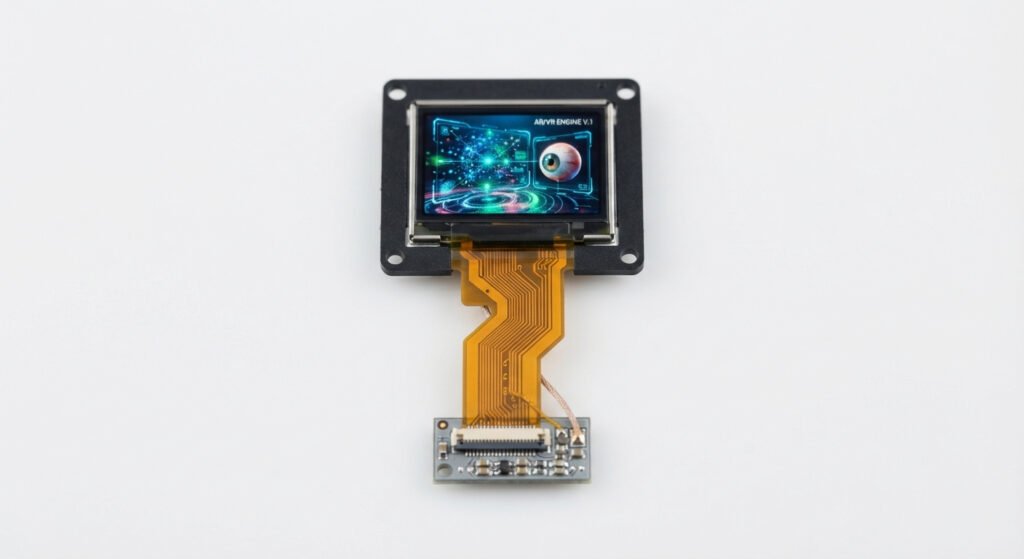
A micro OLED display, sometimes called OLED-on-Silicon or OLEDoS, is a microdisplay built by depositing organic light-emitting materials directly onto a silicon wafer instead of a glass substrate. Because silicon manufacturing allows extremely fine circuit patterns, these displays can achieve pixel densities far beyond what traditional OLED or LCD panels offer.
The result is a display small enough to fit inside a pair of glasses or a compact headset, yet sharp enough to be viewed through magnifying optics without the image breaking apart into visible pixels. This combination of small size and high resolution is the main reason micro OLED display applications in AR and VR devices have expanded so quickly across near-eye hardware over the past few years.
Most micro OLED panels measure well under an inch diagonally, yet can contain millions of individual pixels. That density is what allows a headset or a pair of smart glasses used in micro OLED display applications in AR and VR devices to present text, video, and 3D graphics that look crisp even when the display sits only a few centimeters from the eye.
Why Micro OLED Fits AR and VR Devices So Well
Extremely High Pixel Density
Because AR and VR displays sit so close to the eye and are viewed through lenses, any visible pixel structure becomes distracting in micro OLED display applications in AR and VR devices. Micro OLED panels can reach pixel densities of several thousand pixels per inch, which allows images to appear smooth and detailed even under heavy magnification.
Compact Form Factor
Silicon-based manufacturing allows micro OLED display applications in AR and VR devices to be produced in sizes often smaller than an inch diagonally. This makes them ideal for devices where space and weight are tightly constrained, such as smart glasses or lightweight headsets designed for all-day wear.
Fast Response Time
Motion blur and lag can cause discomfort in AR and VR environments, particularly during head movement. Micro OLED panels typically offer very fast pixel response times, helping reduce ghosting and motion artifacts that would otherwise disrupt immersion.
Deep Contrast and Wide Color Range
Like other OLED technologies, micro OLED displays produce their own light at the pixel level rather than relying on a backlight. This allows for true blacks, high contrast ratios, and vivid color reproduction, all of which contribute to a more realistic viewing experience.
Lower Power Consumption for Small Screens
Because only the pixels that are actively displaying content draw power, micro OLED panels tend to be efficient for small, high-brightness displays. This matters significantly in battery-powered wearable devices where every milliwatt affects comfort and usability.
Micro OLED Display Applications in AR and VR Devices
This is where the technology’s real-world impact becomes clear. Across consumer, industrial, medical, and defense hardware, engineers are turning to these compact panels to solve the same basic problem: how to deliver a sharp image in a very small space without adding weight or draining the battery. The sections below cover the main areas where this is happening today.
Smart Glasses and Lightweight AR Wearables
One of the fastest-growing use cases for micro OLED display applications in AR and VR devices is in smart glasses. These devices need displays that are small enough to fit into a normal-looking eyewear frame while still projecting clear, readable content such as navigation prompts, notifications, or translated text.
Because micro OLED panels are so compact, they can be paired with waveguide optics or small projection lenses to deliver this content without adding significant bulk to the frame.
Mixed Reality and VR Headsets
High-end VR and mixed reality headsets increasingly rely on micro OLED panels to deliver the sharp, immersive visuals users expect. Since these headsets place the display just centimeters from the eyes and often magnify the image through wide-angle lenses, pixel density becomes critical to avoiding a visible screen-door effect.
Several premium headsets released in recent years have adopted micro OLED, or OLEDoS, panels specifically to improve visual clarity compared to earlier LCD-based designs.
Industrial and Professional Viewfinders
Beyond consumer devices, micro OLED display applications in AR and VR devices extend into professional tools such as electronic viewfinders for cameras and industrial inspection equipment. These use cases benefit from the same core advantages: a small physical footprint combined with high resolution for precise visual feedback.
Quality control systems in electronics and precision manufacturing also use near-eye microdisplays to give technicians a magnified, detailed view of components that would otherwise be difficult to inspect with the naked eye.
Medical and Surgical Visualization Systems
This technology is not limited to consumer electronics. In medical settings, near-eye displays built with these panels are used in devices like surgical loupes and diagnostic imaging headsets. The high contrast and color accuracy can help clinicians view fine detail more clearly, which is valuable in procedures where visual precision matters. As with any medical device, manufacturers must also meet applicable regulatory and safety standards before such systems are used in clinical settings.
Defense and Simulation Training
Military and simulation training systems have also adopted micro OLED displays for head-mounted targeting systems and immersive training headsets. The combination of low latency, high brightness, and compact size makes these panels well suited to demanding operational environments.
Micro OLED vs Other Near-Eye Display Technologies
It’s worth briefly comparing micro OLED with two other technologies often discussed alongside it: micro LED and traditional LCD-based microdisplays.
Micro LED technology offers extremely high brightness and long lifespan, but manufacturing challenges around pixel uniformity at very small sizes have limited widespread adoption in consumer AR/VR devices so far. Traditional LCD-based microdisplays, on the other hand, are generally more affordable but cannot match the contrast, color depth, or response time of OLED-based panels.
There is also LCoS, or liquid crystal on silicon, which shares some manufacturing similarities with OLED-on-silicon but relies on reflected light rather than self-emissive pixels. This makes LCoS panels dependent on an external light source, which can add bulk and complexity to the optical system.
Micro OLED currently sits in a practical middle ground, offering strong visual performance with manufacturing processes that are more mature and scalable than micro LED at comparable resolutions. This balance is a major reason why this display type has grown faster than competing technologies in recent AR and VR product cycles.
Challenges in Micro OLED Manufacturing
Despite their advantages, panels used for micro OLED display applications in AR and VR devices are not without production challenges. Achieving consistent brightness and color uniformity across a silicon wafer at such small pixel sizes requires tight manufacturing tolerances. Long-term brightness degradation, sometimes referred to as burn-in, is also a consideration for organic light-emitting materials, particularly in devices used for extended periods.
Manufacturers addressing these challenges typically invest heavily in precision coating processes, wafer-level testing, and optical calibration to ensure each unit meets consistent performance standards before integration into a finished device.
Yield rates also play a significant role in cost. Because these displays are manufactured on silicon wafers similar to semiconductor chips, even small defects during fabrication can affect the number of usable panels per wafer. Improving yield without compromising resolution or brightness remains an ongoing focus for suppliers in this space.
How Manufacturers Select the Right Micro OLED Panel
Choosing the right panel for micro OLED display applications in AR and VR devices involves balancing several factors, including resolution, brightness, refresh rate, and physical size. A device designed for outdoor use, for example, may require significantly higher brightness than one intended for indoor use only.
Working with an experienced optical and display integration partner can help hardware teams navigate these tradeoffs, particularly when the display needs to be paired with custom optics, waveguides, or lens assemblies to achieve a specific field of view.
Thermal performance is another factor worth considering. Because these panels are often housed in enclosed, lightweight frames with limited airflow, heat dissipation can affect both display longevity and user comfort during extended wear. Suppliers with experience in optical structure design are often better positioned to account for this during the integration stage rather than after a prototype is built.
The Future of Micro OLED in AR and VR
As demand for lighter, more immersive AR and VR devices continues to grow, use of this display technology is expected to expand further into both consumer and enterprise markets. Continued improvements in manufacturing yield, brightness efficiency, and cost reduction are likely to make these displays accessible to a wider range of product categories over the next several years.
Some industry analysts also expect closer integration between micro OLED panels and advanced optical systems, such as pancake lenses and waveguides, to further reduce device size while maintaining or improving image quality.
Conclusion
Micro OLED display applications in AR and VR devices have moved well beyond early prototypes and into mainstream product categories, from smart glasses to professional-grade headsets. Their combination of high pixel density, compact size, fast response time, and strong contrast makes them particularly well suited to devices worn close to the eyes.
While manufacturing challenges remain, ongoing improvements in production processes continue to expand where and how this technology is used. For hardware teams developing AR or VR products, understanding these display characteristics is an important step toward building devices that are both visually impressive and comfortable for everyday use.
Frequently Asked Questions
What makes micro OLED display applications in AR and VR devices different from regular OLED screens? Micro OLED displays are built on silicon wafers instead of glass, allowing for much higher pixel density in a significantly smaller physical size, which is why they are used in near-eye devices rather than phones or TVs.
Why are micro OLED displays commonly used in VR headsets? Because VR headsets place the screen very close to the eyes and view it through magnifying lenses, the high pixel density of micro OLED panels helps prevent visible pixel structure and screen-door effects.
Are micro OLED displays more power-efficient than LCD panels? For small, high-brightness applications like AR and VR devices, micro OLED panels are generally more power-efficient since only active pixels consume energy, unlike LCD panels that require constant backlighting.
Can micro OLED displays be used outside of AR and VR devices? Yes, beyond AR and VR, micro OLED displays are also used in camera viewfinders, industrial inspection tools, and certain medical imaging devices where a compact, high-resolution display is needed.
What is the main manufacturing challenge with micro OLED displays? Maintaining consistent brightness and color uniformity across extremely small pixels on a silicon wafer is one of the biggest manufacturing challenges, requiring precise coating and calibration processes.