
TL;DR
An optical prism is a transparent block of glass or crystal with flat, precisely angled surfaces that bends, splits, or redirects light. Engineers rely on prisms for tasks that lenses and mirrors can’t handle alone, from separating white light into a spectrum to flipping an image without distortion. Choosing the right prism depends on geometry, material, coating, and the specific optical path you’re trying to build.
Quick Answer
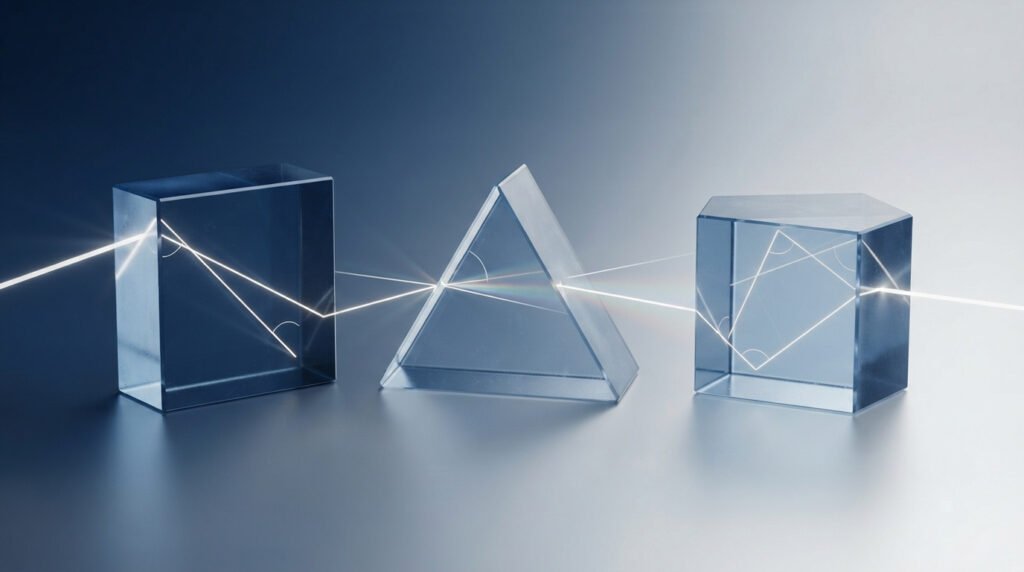
An optical prism is a solid piece of optical-grade material, usually glass, bounded by flat surfaces set at defined angles. When light enters a prism, it bends according to the material’s refractive index and the angle of each surface. This lets prisms disperse light into colors, redirect a beam by a fixed angle, or flip and rotate an image. Right-angle, dove, penta, and equilateral prisms are among the most common types, each suited to a different job in cameras, spectrometers, binoculars, and laser systems.
Introduction
Anyone who has watched sunlight split into a rainbow through a glass block has already seen an optical prism at work. That simple demonstration hides a surprising amount of engineering.
Modern optical prisms show up in places most people never think about. They sit inside rifle scopes, laboratory spectrometers, projector systems, and even the microdisplays used in AR and VR headsets. Each application asks something slightly different of the prism, which is why so many shapes and materials exist.
This guide walks through what an optical prism actually does, how the different types compare, what materials and coatings matter, and how to think about choosing one for a real project. Whether you’re a student trying to understand the physics or an engineer sourcing a component, the goal here is to give you a clear, practical picture.
What Is an Optical Prism
At its core, an optical prism is a transparent object with at least two flat, non-parallel surfaces. Light passes through the material and changes direction at each surface, based on the angle of incidence and the refractive index of the glass.
That single description covers a huge range of components. Some prisms are small enough to fit inside a microdisplay lens stack. Others are large, heavy blocks used in astronomical instruments. What ties them together is the underlying physics: refraction, reflection, and sometimes total internal reflection.
Unlike a simple lens, which curves light gradually across a curved surface, a prism works with flat faces and sharp angles. This makes prisms predictable and repeatable, which is exactly why they’re trusted in precision instruments where a fraction of a degree matters.
How an Optical Prism Works
Understanding the physics behind an optical prism makes it much easier to choose the right one later.
Refraction and Dispersion
When light moves from air into glass, it slows down and bends. The amount of bending depends on the wavelength, which is why white light separates into its component colors as it passes through a triangular prism. Blue light bends more than red light, spreading the spectrum out across a visible arc.
This dispersion effect is the classic textbook demonstration, but it’s also the working principle behind spectrometers and refractometers used in real laboratories.
Total Internal Reflection
Many prisms don’t rely on dispersion at all. Instead, they use total internal reflection, or TIR, to redirect light with almost no loss. When light hits the internal surface of the glass at an angle steeper than the critical angle, it reflects completely back into the material instead of passing through.
Right-angle prisms use this property to act as efficient mirrors, often outperforming metal-coated mirrors because there’s no reflective coating to degrade over time.
Image Rotation and Inversion
Some prism designs exist purely to manipulate the orientation of an image. A dove prism, for example, can rotate an image as the prism itself rotates, without shifting the light path. Penta prisms bend light by exactly 90 degrees while keeping the image upright, which is why they’re common in viewfinders and levels.
Common Types of Optical Prisms
Not every prism looks like the triangular shape most people picture. The industry uses several distinct geometries, each solving a different optical problem.
Right-Angle Prism
A right-angle prism has a 90-degree angle between two of its faces. It’s often used as a mirror substitute, bending a light path by 90 or 180 degrees depending on how it’s oriented. Because it relies on total internal reflection, there’s no coating to wear out, which makes it a durable choice for long-term optical setups.
Dove Prism
Shaped like a truncated triangle, the dove prism rotates an image at twice the rate the prism itself rotates. This makes it useful in rotating optical systems, image de-rotators, and certain interferometer designs.
Penta Prism
A penta prism bends light by a fixed 90 degrees without inverting or reversing the image. Camera viewfinders rely heavily on this property, since photographers need to see a scene right-side up and correctly oriented, not flipped.
Equilateral Prism
This is the classic triangular shape used for dispersion. All three sides are equal length, and it’s the type most associated with splitting white light into a rainbow. Equilateral prisms remain a staple in optics education and in real spectroscopy equipment.
Wedge Prism
A wedge prism has two flat surfaces set at a small angle to each other, rather than a large triangular shape. It’s typically used to make small, precise adjustments to a beam’s direction, often in pairs to allow fine beam-steering control.
Porro and Roof Prisms
These designs show up constantly in binoculars and telescopes. Porro prisms fold the optical path to make an instrument shorter and wider, while roof prisms achieve a similar folding effect in a more compact, straight-through housing.
Materials Used in Optical Prisms
The material a prism is made from affects almost everything about its performance, including the wavelength range it can handle and how well it survives real-world conditions.
BK7 glass is one of the most widely used materials, valued for its good optical clarity across the visible spectrum and reasonable cost. It works well for general-purpose applications where extreme precision isn’t the top priority.
Fused silica is the material of choice when ultraviolet or infrared performance matters. It handles a much broader wavelength range than standard glass and tolerates temperature changes better, which matters in laser systems or outdoor equipment exposed to heat.
Optical crown and flint glasses each bring their own refractive properties to the table, and the two are sometimes combined in a single assembly when a designer needs to correct for chromatic effects. Choosing between these materials usually comes down to the wavelength range, budget, and mechanical durability a project demands.
The Role of Coatings
An uncoated prism surface reflects a small percentage of incoming light at every glass-to-air boundary. That might sound minor, but across multiple surfaces, the losses add up quickly and can noticeably reduce brightness or signal strength.
Anti-reflective coatings address this directly. A well-designed coating can push reflection losses down to a fraction of a percent per surface, which matters enormously in imaging systems, laser alignment, and any instrument where signal strength or image clarity is critical.
Reflective coatings serve a different purpose, applied to surfaces where the prism is meant to act like a mirror rather than transmit light. Some prisms use no coating at all, relying purely on total internal reflection to achieve near-perfect reflectivity without a metal or dielectric layer.
How Optical Prisms Are Manufactured
Producing a precision optical prism is a slower, more exacting process than most people expect. It typically starts with a rough-cut blank of glass, cut close to the final shape but oversized to allow for grinding and polishing.
Each face then goes through a series of grinding steps, gradually removing material and refining the angle tolerance. Surface flatness is measured in fractions of a wavelength of light, which means even a barely visible imperfection can throw off performance in a demanding application.
Polishing follows grinding, bringing the surface to an optical-grade finish free of scratches or digs. After polishing, prisms are typically inspected under interferometers or autocollimators to confirm the angles and surface flatness meet specification before any coating is applied.
Volume production introduces its own challenges. Manufacturers need repeatable tooling and quality control to keep every unit within tolerance, especially for OEM customers building thousands of identical optical assemblies.
Choosing the Right Optical Prism for Your Project
Picking a prism isn’t just about geometry. A handful of practical questions can save a lot of trial and error.
Start with the optical function you actually need. If you’re trying to fold a light path without inverting the image, a penta prism makes sense. If you need to rotate an image as part of a scanning system, a dove prism is the more logical choice. Matching the geometry to the function first narrows the options considerably.
Wavelength range matters just as much. A prism built from standard BK7 glass may perform poorly outside the visible spectrum, so any UV or infrared application usually calls for fused silica or another specialized material.
Tolerance requirements should be defined early, since tighter angle and surface tolerances drive up both cost and lead time. It’s worth being honest about how precise a system actually needs to be, rather than defaulting to the tightest tolerance available.
Finally, consider whether a standard catalog part will work or whether the application calls for a custom design. Standard prisms are faster to source and generally cheaper, while custom geometries make sense when an off-the-shelf shape simply won’t fit the optical path.
Common Applications of Optical Prisms
Optical prisms turn up across a wide range of industries, often doing quiet, essential work behind the scenes.
In spectroscopy, prisms remain a reliable way to separate light into its wavelength components for analysis, even as diffraction gratings have become common alternatives in modern instruments. Laboratories still use prism-based spectrometers where robustness and simplicity matter more than extremely fine resolution.
Binoculars and telescopes depend on porro and roof prisms to fold long optical paths into compact, handheld housings. Without this folding effect, many optical instruments would be far too long to use comfortably.
Camera systems and rangefinders use penta prisms to present a correctly oriented image to the viewer, a small detail that makes a significant difference in usability.
Laser alignment systems frequently rely on right-angle and wedge prisms to steer or redirect a beam with high precision, particularly in setups where a mirror’s coating might degrade under intense laser power over time.
More recently, miniature prisms have become essential in AR and VR headsets, where they help magnify and redirect the image from a tiny microdisplay toward the user’s eye in a compact optical path.
Optical Prism vs. Diffraction Grating
It’s worth briefly addressing a common point of confusion. Both optical prisms and diffraction gratings can separate light into its component wavelengths, but they work through different physical mechanisms.
A prism disperses light through refraction, bending different wavelengths by different amounts as they pass through the material. A diffraction grating, by contrast, uses closely spaced grooves to diffract light, producing a different dispersion pattern and often higher resolution for spectroscopic work.
In practice, prisms tend to offer simpler alignment and lower cost, while gratings often deliver finer spectral resolution. The right choice depends on the resolution needed and the budget available for the instrument.
Quality Standards and Testing for Optical Prisms
Specification sheets only tell part of the story. Verifying that an optical prism actually meets its stated tolerances is just as important as the design itself.
Angle tolerance is usually one of the first things checked, since even a few arc-seconds of error can throw off an entire optical path in a sensitive instrument. Manufacturers typically use autocollimators to confirm that each face sits at the correct angle relative to the others.
Surface flatness gets measured against a fraction of a wavelength, commonly expressed as λ/4 or λ/10 depending on how demanding the application is. Interferometers are the standard tool here, comparing the prism’s surface against a known reference to reveal even tiny deviations.
Surface quality, often listed as a scratch-dig rating like 20-10 or 10-5, describes how free the surface is from cosmetic defects such as scratches, digs, or embedded particles. For laser applications especially, even small surface defects can cause scattering or localized heating that damages the coating or the glass itself over time.
Buyers sourcing prisms in volume should also ask about batch consistency. A single sample meeting spec doesn’t guarantee the next thousand units will behave identically, so it’s worth understanding a supplier’s inspection process before committing to a large order.
Conclusion
An optical prism looks simple on the surface, just a shaped block of glass, but the physics and manufacturing behind it are anything but basic. From bending a beam of light by a precise 90 degrees to splitting sunlight into a spectrum, prisms remain one of the most versatile components in optical engineering.
Choosing the right prism comes down to understanding the function you need, the wavelength range involved, and how tight your tolerances really have to be. Whether you’re specifying a standard catalog part or working with a manufacturer on a custom design, getting these fundamentals right up front will save time and rework later in the project.
Frequently Asked Questions
What is an optical prism used for?
An optical prism is used to bend, redirect, disperse, or rotate light within an optical system. Common uses include splitting white light into a spectrum, folding a light path in binoculars, correcting image orientation in viewfinders, and steering laser beams in alignment systems.
What material is best for an optical prism?
It depends on the application. BK7 glass works well for general visible-light use, while fused silica is better suited to ultraviolet or infrared applications and offers better thermal stability. The right material choice depends on wavelength range, budget, and environmental conditions.
How does a prism disperse light into colors?
A prism disperses light because different wavelengths bend by slightly different amounts as they pass through the glass. Blue light bends more sharply than red light, causing white light to spread out into a visible spectrum as it exits the prism.
What is the difference between a right-angle prism and a penta prism?
A right-angle prism typically bends light by 90 or 180 degrees using total internal reflection and can invert or reverse an image. A penta prism also bends light by 90 degrees but is designed to keep the image upright and correctly oriented, which is why it’s common in viewfinders.
Do all optical prisms need an anti-reflective coating?
Not necessarily. Prisms that rely on total internal reflection don’t need a coating to function, since the reflection happens naturally within the glass. However, an anti-reflective coating is often applied to entry and exit surfaces to reduce light loss and improve overall transmission efficiency.