
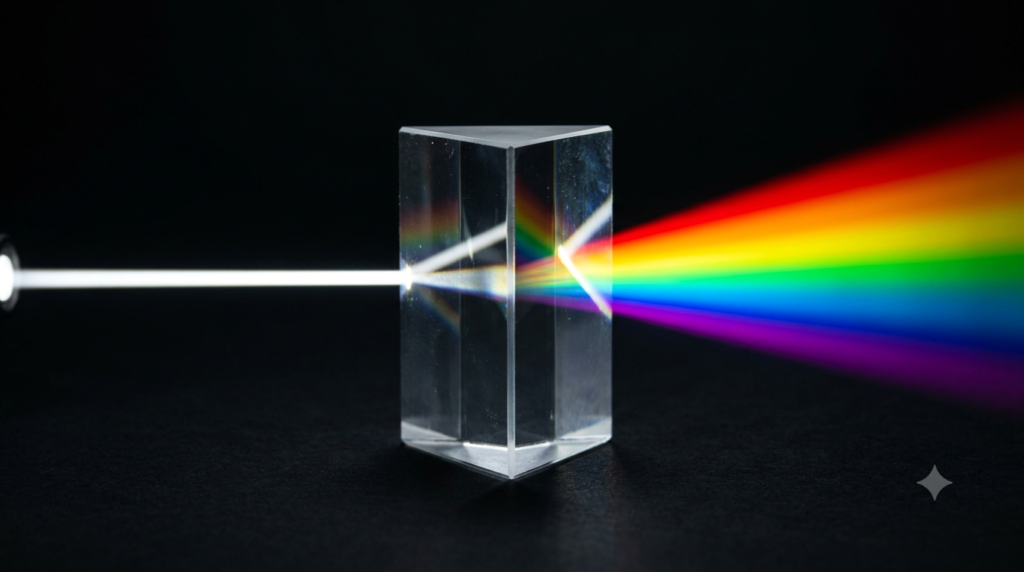
How Prisms Split Light: The Science Explained
How prisms split light comes down to a phenomenon called dispersion, where different wavelengths of light bend at slightly different angles as they pass through the prism’s glass. Because each wavelength corresponds to a different color, this uneven bending separates white light into the familiar rainbow spectrum, from red through violet. The effect depends on the prism’s material, its refractive index, and the angle at which light enters the surface, which is why engineers carefully select prism geometry and glass type for applications ranging from spectroscopy to laser systems.
In short, how prisms split light is explained by the fact that a prism’s refractive index is not the same for every wavelength of light, a property known as dispersion. When white light enters a prism, it slows down and bends, or refracts, but shorter wavelengths like violet bend more sharply than longer wavelengths like red. This difference in bending angle causes the colors to separate as they exit the prism, spreading out into a visible spectrum. This same principle underlies instruments used in spectroscopy, telecommunications, and precision optical imaging.
Introduction: Why Understanding Light Dispersion Matters
The image of white light entering a triangular glass prism and emerging as a rainbow is one of the most recognizable demonstrations in physics, famously popularized by Sir Isaac Newton in the 17th century. Yet for engineers and product designers working with optical systems, understanding exactly how prisms split light is not just a classroom curiosity, it is a practical foundation for designing spectrometers, laser systems, imaging devices, and optical communication equipment.
This guide walks through the physics behind light dispersion, explains why different colors bend at different angles, and covers how material choice and prism geometry affect real-world optical performance. Whether you are sourcing components for a scientific instrument or designing an optical system from scratch, understanding this core principle helps you make better decisions when selecting prism types and materials.
The Basic Physics of How Prisms Split Light
To understand how prisms split light, it helps to start with refraction, the bending of light as it passes from one medium into another with a different optical density. When light travels from air into glass, it slows down and changes direction. The amount of bending depends on the refractive index of the glass, which itself varies slightly depending on the wavelength of the light passing through it.
This wavelength-dependent variation in refractive index is called dispersion. White light is not a single wavelength but a mixture of many wavelengths, each corresponding to a different color that the human eye perceives. Because violet light has a shorter wavelength than red light, it experiences a slightly higher refractive index in most glass materials, causing it to bend more sharply than red light as it passes through the prism.
Why the Triangular Shape Matters
A traditional dispersive prism uses a triangular cross-section, which is important because light bends twice, once when entering the first angled surface and again when exiting the second angled surface. Each bending event adds to the overall separation between wavelengths, which is why the triangular shape produces a much more visible spectrum than a flat piece of glass, where the two refractions at parallel surfaces would largely cancel each other out.
Step-by-Step: What Happens When Light Enters a Prism
Breaking down exactly how prisms split light step by step makes the process easier to visualize, especially for anyone new to optical design.
Step 1: Light Enters the First Surface
As a beam of white light strikes the first angled face of the prism, it slows down upon entering the denser glass medium and bends toward the normal, an imaginary line perpendicular to the surface. Because different wavelengths bend by slightly different amounts, the light begins to separate internally within the glass, even though this separation is not yet visible to the eye.
Step 2: Light Travels Through the Glass
Inside the prism, each wavelength continues traveling in a slightly different direction due to the small differences in bending angle established at the entry surface. The longer the light path inside the glass, the more pronounced this internal separation becomes, which is one reason why larger prisms or specific geometries can produce a more distinct spectral spread.
Step 3: Light Exits the Second Surface
When the light reaches the second angled surface and exits back into air, it bends again, this time away from the normal as it speeds back up in the less dense medium. This second bending event further amplifies the separation between wavelengths, and by the time the light exits the prism, the different colors have spread apart enough to be visible as a distinct spectrum, commonly projected onto a screen or surface for demonstration purposes.
What Determines How Much a Prism Splits Light
Several factors influence the degree of dispersion a prism produces, which is critical knowledge when selecting or designing prisms for specific optical applications.
Glass Material and Refractive Index
Different optical glass materials have different dispersion properties, often described using a value called the Abbe number. Materials with a low Abbe number exhibit high dispersion, meaning they separate colors more dramatically, while materials with a high Abbe number show less color separation. Common materials used in prism manufacturing include BK7 optical glass, fused silica, and specialized high-dispersion glass types, each chosen based on the specific spectral separation required for the application.
Prism Angle and Geometry
The apex angle of the prism, meaning the angle between its two refracting surfaces, directly affects how much the light path bends and, therefore, how much dispersion occurs. A larger apex angle generally increases the total bending and separation of wavelengths, though it also increases the physical size and potential optical aberrations of the system, so engineers must balance dispersion strength against overall system design constraints.
Angle of Incidence
The angle at which light strikes the first surface of the prism also affects the degree of separation. Many precision optical systems use a specific entry angle, sometimes referred to as minimum deviation angle, to achieve the most symmetric and predictable dispersion pattern for accurate measurement applications.
Real-World Applications of Light-Splitting Prisms
Understanding how prisms split light becomes especially useful when looking at how this principle is applied across different industries and technologies.
Spectroscopy and Scientific Analysis
In spectroscopy, dispersive prisms separate light from a sample into its component wavelengths, allowing scientists to analyze the chemical composition of materials based on which wavelengths are absorbed or emitted. This principle underlies instruments used in chemistry, astronomy, and environmental monitoring, where identifying specific wavelength signatures reveals information that would otherwise be invisible to the naked eye.
Optical Communication Systems
In fiber optic communication networks, prisms and related dispersive components are used to separate or combine different wavelength channels, a process known as multiplexing and demultiplexing. This allows multiple data streams to travel simultaneously through a single fiber, each carried on a slightly different wavelength of light, significantly increasing the data capacity of optical communication systems.
Imaging and Photography Equipment
Dispersive prisms also play a role in certain imaging applications, including specialized cameras and instruments that need to separate light into specific wavelength bands for analysis or filtering purposes. In these systems, controlling dispersion precisely is essential to avoid unwanted color fringing or blurring in the final image.
Laser Systems and Beam Shaping
In laser applications, prisms are often used not for splitting white light but for precisely steering, compressing, or shaping laser beams that are already a single wavelength. Even though these prisms are not producing a visible rainbow effect, the same underlying refraction principles apply when designing prism geometry for beam control in high-precision laser cutting, marking, or scientific instrumentation.
Dispersive Prisms vs Other Prism Types
It’s worth noting that not all prisms are designed to split light into colors. While dispersive prisms are specifically engineered to maximize wavelength separation, other prism types, such as reflective prisms and beam-splitting prisms, are designed for entirely different purposes, including redirecting, inverting, or dividing light beams without significant color separation. Understanding this distinction is important when selecting the right prism for a given optical system, since choosing a dispersive design when a reflective function is actually needed can lead to unwanted spectral artifacts in the final system.
Common Misconceptions About How Prisms Split Light
One common misconception is that prisms create color rather than separate it, when in fact white light already contains all visible wavelengths, and the prism simply reveals this hidden composition by bending each wavelength differently. Another frequent misunderstanding is assuming that any triangular piece of glass will produce a strong, visible spectrum, when in reality the degree of dispersion depends heavily on the specific glass material, apex angle, and precision of the optical surfaces involved.
It is also worth remembering that achieving consistent, high-quality dispersion for scientific or industrial applications requires careful attention to surface polish, coating quality, and manufacturing tolerances, since even small imperfections can distort the spectral output. Working with an experienced optical film design partner ensures that coatings applied to prism surfaces do not interfere with the intended dispersion behavior of the component.
Conclusion
How prisms split light ultimately comes down to the physics of dispersion, where different wavelengths of light experience slightly different refractive indices as they pass through the glass, causing them to bend at different angles and separate into a visible spectrum.
This principle, first clearly demonstrated by Newton centuries ago, remains foundational to modern optical engineering, powering everything from laboratory spectrometers to fiber optic communication networks. When selecting or designing a prism for your application, factors like glass material, apex angle, and surface quality all play a critical role in achieving the desired optical performance. If you need guidance selecting the right prism geometry or material for your project, feel free to contact our optical engineering team for a tailored recommendation.
Frequently Asked Questions
Q1: Why does a prism split white light into a rainbow? A prism splits white light into a rainbow because different wavelengths of light bend at slightly different angles when passing through the glass, a phenomenon called dispersion, which causes the colors that make up white light to separate visibly.
Q2: Does every prism split light into colors? No, only dispersive prisms are specifically designed to maximize color separation. Other prism types, such as reflective or beam-splitting prisms, are designed for redirecting or dividing light rather than separating it by wavelength.
Q3: What factors affect how much a prism splits light? The main factors include the glass material’s refractive index and Abbe number, the apex angle of the prism, and the angle at which light enters the surface, all of which influence how strongly different wavelengths separate.
Q4: Is prism dispersion the same as a rainbow in the sky? The underlying physics is similar, since both involve light being refracted and separated by wavelength, but a natural rainbow is produced by refraction and reflection inside water droplets rather than a solid glass prism.
Q5: Why is understanding light dispersion important in optical engineering? Understanding dispersion is essential for designing accurate spectrometers, efficient fiber optic communication systems, and precise laser or imaging equipment, since unwanted or uncontrolled dispersion can distort measurements or degrade image quality.