
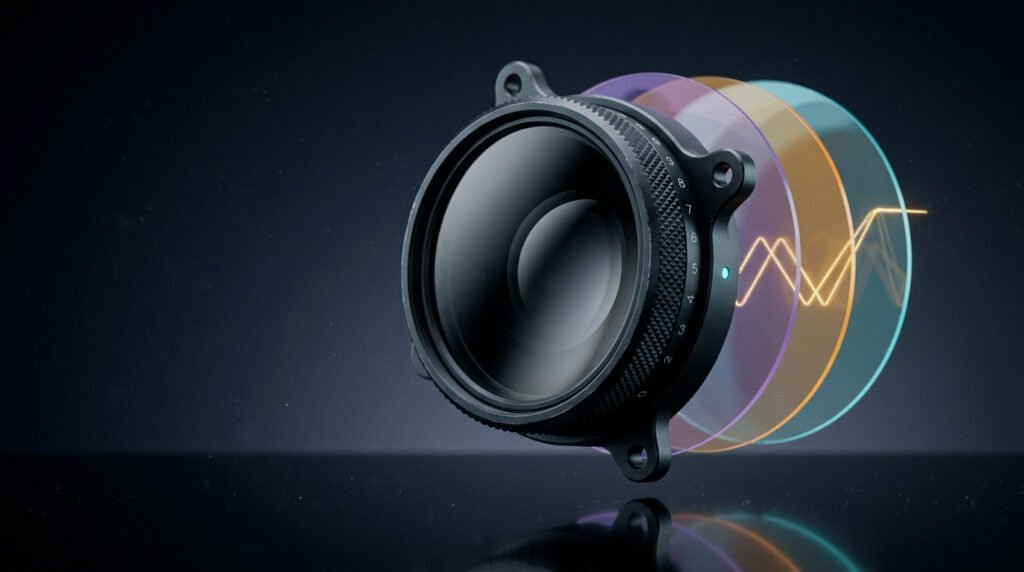
TL;DR
Pancake VR optics fold the light path inside a headset by bouncing it between a half mirror and a reflective polarizer. This lets the lens stack be far thinner than older Fresnel designs. The trade-off is lower light efficiency, a higher risk of ghosting, and tighter manufacturing tolerances. For anyone building or sourcing a headset, the quality of the films, coatings and alignment in pancake VR optics matters as much as the lens shape.
Quick Answer
Pancake VR optics are a type of folded lens system used in modern VR and mixed reality headsets. Light from the display passes through polarizing films and a half mirror, bounces back and forth inside a thin lens stack, and then exits toward the eye. Because the light covers the same optical distance in much less physical space, the headset can be slimmer and lighter. The compromise is that only a fraction of the display’s light reaches the viewer, so the display must be brighter.
Introduction
Put an older VR headset next to a recent one, and the difference is clear before you switch either on. The newer unit sits closer to the face, feels less front-heavy, and looks more like a pair of goggles than a box strapped to your head. A large part of that change comes from the lenses.
Pancake VR optics are the main reason. The idea of folding light inside a lens is not new, but it only became practical for consumer headsets once polarizing films, precision coatings and high-resolution small displays caught up. Headsets such as the Meta Quest Pro, Meta Quest 3 and Pico 4 use pancake VR optics, while earlier mainstream headsets like the Quest 2 relied on Fresnel lenses.
This matters for more than looks. The lens design affects comfort, weight balance, image sharpness, power consumption and even how a product team approaches industrial design. If you are an engineer, a product manager or a buyer evaluating optical suppliers, you need to understand what is happening inside that thin module.
This guide explains what pancake VR optics are, how the folded light path works, what the main components do, how the design compares with Fresnel lenses, and what to look for when you evaluate a module.
What Are Pancake VR Optics?
A plain definition
Pancake VR optics are compact lens systems that use polarization to fold the optical path. Instead of light traveling in a straight line from the display, through a thick lens, to the eye, it makes three passes through a short gap. That folding is what lets designers reduce the distance between the display and the eye without changing the effective focal length.
The word “pancake” comes from the flat, thin shape of the assembly. The term is sometimes used loosely, but in VR it almost always means a polarization-based folded design built around a partially reflective mirror and a reflective polarizer.
Where the idea comes from
Folded optics have a long history in cameras, telescopes and flight simulators. The same principle, using reflection to shorten a long optical path, has been applied for decades. What changed in VR is the scale. Engineers had to fit a folded system into a lens only a few centimeters across, keep it light enough to wear, and make it good enough that a person looking at it from a few centimeters away does not see flaws.
That requirement pushed the supporting technology forward, especially optical films and coatings, which is why modern pancake VR optics look so different from early prototypes.
How Pancake VR Optics Work
Folding the light path
The simplest way to understand pancake VR optics is to follow a single beam of light from the display to the eye. The sequence looks like this:
- Light leaves the display and passes through a polarizer, so it has a defined polarization state.
- It passes through a quarter-wave plate, which converts the linear polarization into circular polarization.
- It reaches a half mirror, where part of the light passes through and part is lost.
- The transmitted light goes through a second quarter-wave plate and meets a reflective polarizer.
- The reflective polarizer bounces the light back, because its polarization has been rotated to the state that the polarizer reflects.
- The light travels back and hits the half mirror, which reflects part of it forward again.
- After another pass through the quarter-wave plate, the polarization has rotated once more, so the reflective polarizer now lets the light pass.
- The light exits toward the eye.
The beam crosses the gap between the components three times, which is why the physical space needed is roughly a third of what an unfolded path would require. This is the central trick behind every pancake design.
Why polarization is the key
Without polarization control, the light would simply leak straight through or bounce randomly. The quarter-wave plates and the reflective polarizer act like a gate that only opens for light in the right state at the right moment. The first time the light meets the reflective polarizer, the gate is closed and the light reflects. The second time, the polarization has changed, and the gate is open.
This is also why small errors matter so much in pancake VR optics. If a film is slightly off in its retardation, or a plastic lens element introduces unwanted birefringence, some light does not follow the intended path. That stray light is the source of ghost images, one of the most common complaints about folded designs.
Lens power and curvature
Folding is only part of the design. The lens surfaces still provide the focusing power that lets the eye see a virtual image at a comfortable distance. In many designs, the half mirror is coated on a curved lens surface, so it contributes optical power while also reflecting light. The lens group works together with the mirror to correct distortion and chromatic aberration. This coupling is one reason designing pancake VR optics is more demanding than designing a single Fresnel lens.
Key Components Inside a Pancake VR Optics Module
The half mirror
The half mirror, sometimes called a partial reflector or beam splitter coating, is applied to one lens surface. A common target is a 50/50 split between transmission and reflection. The coating must be uniform across the curved surface, because variation shows up as brightness differences across the field of view.
Quarter-wave plates and reflective polarizer
The quarter-wave plates convert between linear and circular polarization, and the reflective polarizer decides whether light passes or reflects. These are thin films, often laminated onto lens surfaces. Their performance across wavelength and angle matters. A film that works well for green light at the center may behave differently for blue light at the edge, and the viewer will notice that as color shift or loss of contrast.
Lens elements
Most pancake VR optics use two or three lens elements, often described as 2P or 3P configurations. Fewer elements mean a lighter and thinner module but less freedom to correct aberrations. More elements improve control but add weight, cost and alignment complexity. Aspheric surfaces are common because they let designers correct aberrations with fewer pieces.
Material choice is more important here than in a conventional lens. Plastic elements that show stress birefringence can disturb the polarization state and create ghosting, so low-birefringence optical resin or glass is often preferred in critical positions.
Coatings
In pancake VR optics, anti-reflection coatings on the lens surfaces suppress unwanted reflections that would otherwise create secondary images. Some modules also add anti-fog or hard coatings on the outer surface, because the lens sits close to the face and the environment is warm.
The display
The display is not part of the lens, but it is designed together with pancake VR optics as a pair. The panel’s size, resolution, brightness and polarization behavior all affect how well the optics perform. This is why most serious projects treat the display and optical module as a single system rather than two separate purchases.
Pancake VR Optics vs Fresnel Lenses
Fresnel lenses have been the default in consumer VR for years. They use concentric grooves to reduce thickness while keeping focusing power, and they are inexpensive to produce. Their weaknesses are well known: visible rings, glare, and “god rays” around bright objects on dark backgrounds.
Pancake VR optics address several of these issues, although they bring new ones. The table below summarizes the practical differences.
| Factor | Fresnel lens | Pancake lens |
|---|---|---|
| Module thickness | Thicker, display sits farther from the eye | Noticeably thinner |
| Weight balance | More front-heavy | Easier to balance |
| Edge sharpness | Often drops toward the edges | Generally better across the field |
| Glare and god rays | More common | Reduced, but ghosting can appear |
| Light efficiency | Higher | Lower, since light is lost at the half mirror |
| Cost and complexity | Lower | Higher, with more films and tighter tolerances |
The honest summary is that pancake VR optics improve form factor and image quality at the cost of efficiency and complexity. Fresnel designs remain a sensible choice for products where cost matters more than thickness, but for premium and mixed reality devices, the pancake approach has become the standard direction.
Advantages of Pancake VR Optics
The most obvious benefit of pancake VR optics is size. A thinner optical module moves the center of gravity closer to the user’s face, which reduces the pressure on the nose and neck during longer sessions. Comfort is not a minor feature in VR; it directly affects how long people are willing to use a headset.
Image quality is the second benefit. Because pancake VR optics use a multi-element lens group working together with the folded path, designers have more control over aberrations. Many users report sharper images toward the edges of the view compared with Fresnel lenses, and the visible ring structure disappears.
Industrial design is the third. A slimmer module opens up options for headset shapes, including visor-style designs that would be difficult with a deep lens barrel. For mixed reality headsets that rely on passthrough cameras, pancake VR optics also leave more room for sensors thanks to the shorter optical stack.
Limitations and Challenges of Pancake VR Optics
Light efficiency
This is the best-known drawback of pancake VR optics. With a standard 50/50 half mirror, light passes through the mirror once and reflects off it once, so at most about a quarter of the light can reach the eye, before any losses from polarizers and films are counted. In practice the figure is often lower.
That loss has consequences. The display has to be brighter, which increases power use and heat, and that affects battery life and thermal design. This is one reason high-brightness micro displays have attracted so much interest in this field.
Ghosting and stray light
Ghost images appear when some light follows an unintended path, for example by leaking through the reflective polarizer without folding. Even a small percentage of leakage can be visible against dark scenes, especially in VR where the viewer’s eyes adapt to dim content. Controlling ghosting in pancake VR optics requires well-matched films, low-birefringence materials, and careful coating design.
Tolerance sensitivity
The components must be aligned precisely, and the lens surfaces must match their design shape closely. Small deviations in tilt, spacing or surface curvature can reduce contrast, shift focus or introduce visible artifacts. This makes pancake VR optics harder to manufacture at volume than simple Fresnel assemblies.
Cost
More films, tighter tolerances and more testing all increase cost. As volumes grow and processes mature, costs tend to come down, but pancake VR optics still sit at a higher price point than Fresnel equivalents.
Matching the Display: Micro OLED vs Fast-LCD
Display choice influences how well pancake VR optics perform. LCD panels generally emit light that is already polarized, which means the first polarizer in the optical stack removes less light. OLED panels emit unpolarized light, so adding a polarizer typically costs about half the output before the folded path even begins.
Micro OLED displays, also called OLED-on-silicon, offer very high pixel density in a small size, which suits compact optical modules and high-resolution headsets. Fast-LCD panels offer good brightness and cost advantages, which is why they appear in several consumer headsets. Neither is universally better. The right choice depends on target resolution, brightness, power budget, contrast expectations and price.
What matters for the optical designer is that the panel’s size, pixel structure and polarization behavior are known before work on pancake VR optics begins. Changing the display late in a project often forces a redesign of the optics.
Design Considerations for Pancake VR Optics
Field of view and eyebox
Field of view describes how much of the virtual world the user sees at once. The eyebox is the region within which the eye can move while still seeing a good image. Pancake VR optics involve trade-offs between these two, along with module thickness and image quality. Pushing for a wider field of view can increase aberrations near the edges, while a larger eyebox often needs larger optics.
Eye relief and IPD
Eye relief is the distance between the eye and the last optical surface. Users who wear glasses need more of it. Interpupillary distance, or IPD, varies from person to person, and a good product has to accommodate that range, either with mechanical adjustment or with a sufficiently large eyebox.
Diopter adjustment
Some headsets include diopter adjustment so users with different eyesight can focus comfortably without glasses. This adds mechanical complexity to a thin module and must be considered at the start of the design.
Distortion and chromatic aberration
Pancake VR optics still produce distortion and color fringing, and software correction is usually part of the pipeline. Better optical correction reduces how much the software has to do, which helps preserve image sharpness and lowers processing load.
Manufacturing and Quality Control
A pancake VR optics module is only as good as its weakest process. Lens elements are made by precision injection molding for plastic or by glass molding and polishing for glass. Films are laminated onto curved surfaces without wrinkles or bubbles, which is a skill in itself. Coatings are applied in controlled vacuum processes to keep thickness uniform across the surface.
Assembly often relies on active alignment, where the element position is adjusted while the module is measured, rather than relying only on mechanical tolerances. This improves consistency but adds time and equipment.
Testing pancake VR optics typically covers several areas:
- Resolution and contrast, measured with MTF testing
- Ghost image and stray light levels
- Distortion and field uniformity
- Brightness and color uniformity
- Polarization leakage, which is closely linked to ghosting
Display testing equipment, such as conoscope-based systems, is often used alongside optical inspection to evaluate how the module and panel behave together. A supplier with strong in-house testing can catch problems early, while one without it often discovers them after assembly.
How to Evaluate Pancake VR Optics Suppliers
Whether you are comparing samples of pancake VR optics or choosing a long-term partner, a few questions separate serious suppliers from the rest.
Ask how they control birefringence in lens materials, since this directly affects ghosting. Ask what measurements they use to quantify ghost images and whether they can share test data for comparable products. Find out how they handle film lamination and what yield they typically achieve, because poor lamination is a common source of defects.
Check whether they can support design work, not just production. A partner who can handle optical system design, structural design and film design under one roof reduces the number of handoffs, and handoffs are where errors creep in. Ask about sample lead times, tolerance capability, and how they handle design changes when the display or housing changes.
Finally, request a clear specification sheet and verify the numbers yourself with your own test setup where possible. Reputable suppliers expect that.
Where Pancake VR Optics Are Heading
Several directions are being explored. Designers are working on improving light efficiency through better films and coatings, and on reducing ghosting through improved polarization control. Higher-brightness micro displays are making the efficiency loss easier to tolerate. Research into alternative approaches, including holographic and metasurface-based optics, may eventually offer different trade-offs, although these are not yet common in consumer products.
For now, pancake VR optics remain the practical choice for slim, high-quality headsets, and most progress is likely to come from refinement rather than replacement.
Conclusion
Pancake VR optics solve a real problem: how to give a headset a sharp image without a thick lens stack. They do it by folding the light path with polarization, and that clever idea brings both benefits and costs. The benefits are slimmer designs, better balance and improved image quality. The costs are lower light efficiency, a greater risk of ghosting and higher manufacturing demands.
If you are developing a product, treat the optical module, the display and the mechanical design as one connected system, and involve optical specialists early. If you are sourcing pancake VR optics, focus on how a supplier manages films, materials, alignment and testing, since those factors decide whether a design performs well in volume. Always verify specifications against your own measurements, because published figures rarely tell the whole story.
FAQs
What are pancake VR optics?
Pancake VR optics are folded lens systems that use polarizing films and a half mirror to bounce light back and forth within a thin module. This shortens the physical distance needed between the display and the eye, allowing slimmer and lighter headsets.
Why are pancake VR optics thinner than Fresnel lenses?
Pancake VR optics fold the light path so the beam crosses the same gap three times. That means the lens stack needs only a fraction of the depth that an unfolded design would require. A Fresnel lens, by contrast, focuses light in a single pass and needs more space between the display and the eye.
Do pancake VR optics make the image dimmer?
They reduce the amount of light that reaches the eye, because part of the light is lost at the half mirror and polarizing films. With a standard 50/50 half mirror, at most about a quarter of the light can get through. Headsets compensate with brighter displays.
What causes ghosting in pancake VR optics?
Ghosting appears when some light takes an unintended path, such as leaking through the reflective polarizer without folding. Common causes include imperfect polarization control, stress birefringence in plastic lens elements, film mismatch and weak anti-reflection coatings.
Are pancake VR optics better than Fresnel lenses for every headset?
Not necessarily. Pancake designs offer a slimmer form factor and often better edge sharpness, but they cost more and need brighter displays. Fresnel lenses remain a reasonable choice for products where cost, efficiency or simplicity matter more than thickness.