
TL;DR
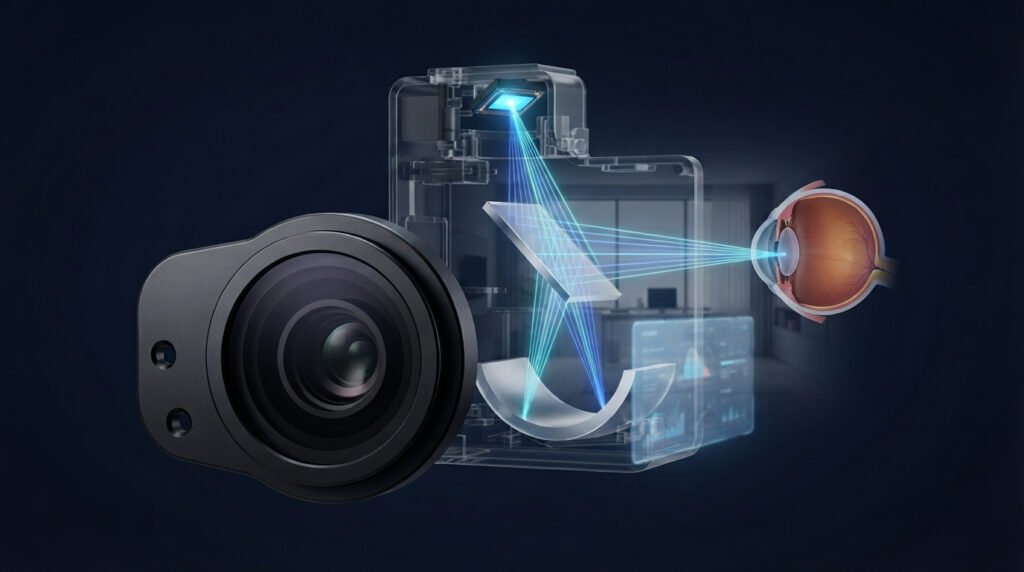
A birdbath optical solution is an optical design for AR glasses that uses a beam splitter and a curved mirror to deliver a display image to the eye while keeping the real world visible. It is popular because it offers good image quality at a reasonable cost. The trade-offs are lower light efficiency and a thicker front section than some alternatives. This guide covers how it works, how it compares with waveguides, and what to check before choosing one.
Quick Answer
A birdbath optical solution is an augmented reality optical architecture. A microdisplay sends light to a partially reflective beam splitter, which directs it onto a concave mirror. The mirror collimates the light and sends it back through the beam splitter into the eye. The user sees a virtual image floating in front of them, layered over the real world. It is valued for clear, color-accurate images, but it loses a large share of the display’s light.
Introduction
Walk through any AR trade show and you will notice that smart glasses come in two broad shapes. Some look like thin, ordinary spectacles. Others have a visible lens block sitting in front of each eye, a bit like small sunglasses with an extra layer.
Many of the second group rely on a birdbath optical solution. It is one of the oldest and most practical ways to put a bright, sharp virtual image in front of the eye without using exotic components.
Understanding it matters whether you design headsets, source optics, test displays or simply want to understand what you are buying. The design affects image clarity, battery demands, comfort and cost all at once.
In this guide, you will learn what a birdbath optical solution is, how the light travels through it, and which components matter. You will also see how it compares with waveguides and other approaches, where it works best, and how to avoid common selection mistakes.
What Is a Birdbath Optical Solution?
A birdbath optical solution is a type of optical combiner. A combiner is the part of an AR system that merges the virtual image from a display with the real scene in front of the user.
In this design, the combiner is built from two main elements: a partially reflective flat surface, called a beam splitter, and a curved concave mirror. The microdisplay is usually mounted above or beside these elements, and the image reaches the eye after bouncing off the mirror and passing back through the beam splitter.
The key point is that the optics do two jobs at once. They magnify the small display image so it appears large and distant, and they overlay it on the real world. That dual role is why this architecture became a common starting point for consumer AR glasses.
Why Is It Called “Birdbath”?
The name comes from the shape of the optical layout. Looking at the cross-section, the curved mirror sits like a shallow bowl, and the beam splitter hovers above it like a flat surface. To many engineers, the arrangement resembled a garden birdbath, and the nickname stuck.
It is an informal term rather than a formal optical classification. You may also see it described as a “beam splitter plus curved mirror” design or a catadioptric combiner. All of these names point to the same basic idea.
How a Birdbath Optical Solution Works
The easiest way to understand the system is to follow a single beam of light from start to finish.
Step 1: The display emits light
A small microdisplay, often an OLED-based panel or another compact display technology, produces the image. Because the panel is tiny, the picture it forms is very small and would be impossible to focus on if you held it close to your eye.
Step 2: The beam splitter redirects the light
The display light travels toward the beam splitter. This element reflects part of the light and transmits part of it. The reflected portion is sent toward the curved mirror, while the rest is lost or absorbed depending on the design.
Step 3: The concave mirror collimates the image
The concave mirror is the heart of the system. It reshapes the diverging rays from the display so they become nearly parallel. When parallel rays reach the eye, the brain interprets the image as being far away, which is exactly what makes AR comfortable to look at.
The mirror usually has a partially reflective coating, which also lets some outside light pass through.
Step 4: Light returns through the beam splitter to the eye
After reflecting off the mirror, the light heads back toward the beam splitter. This time a portion of it passes straight through and continues to the eye. The user perceives a sharp virtual image, and because the mirror and splitter are partly transparent, the real world remains visible behind it.
Main Components of a Birdbath Optical Solution
Every working birdbath optical solution is a combination of several parts. Each one has a direct effect on image quality.
Microdisplay
The display determines brightness, contrast, color and resolution. Because so much light is lost along the path, the display needs to be bright enough to make up for it. Pixel density matters too, since the optics magnify the panel and make any pixel structure more visible.
Beam splitter
The beam splitter is usually a coated glass or plastic surface. Its reflect-to-transmit ratio is one of the biggest design decisions, because it controls the balance between display brightness and how clearly the real world shows through.
Curved mirror
The curved mirror sets the focal behavior, the field of view and much of the image quality. Its surface accuracy and coating uniformity directly affect sharpness and color consistency.
Lens group and polarization elements
Many designs add small lenses to correct aberrations before the light reaches the combiner. Some also use polarization components, such as polarizers and quarter-wave plates, to manage how light travels through the splitter. These can improve efficiency and reduce stray reflections when carefully matched to the display’s polarization.
Dimming or tinting layer
Since AR glasses are used indoors and outdoors, many systems add a tint or an electrically controlled dimming layer. This helps the virtual image stay visible in bright surroundings by reducing the amount of real-world light that reaches the eye.
Light Efficiency: The Central Trade-Off
If there is one topic that every buyer and engineer should understand about a birdbath optical solution, it is light efficiency.
Light from the display usually has to interact with the beam splitter twice. It is reflected once on the way to the mirror and transmitted once on the way back. With a simple 50/50 splitter, each interaction passes about half of the light, so only around a quarter of the display’s output can reach the eye in the ideal case. Real designs lose more to coatings, absorption and imperfections.
This is not a flaw so much as a physical consequence of the layout. The practical result is that the display has to be bright, which affects power consumption and heat. Designers often balance the splitter ratio, the display brightness and the dimming layer to find an acceptable compromise.
Polarization-based designs can recover some of this loss, although they add complexity and require careful alignment with the display’s output.
Advantages of a Birdbath Optical Solution
A birdbath optical solution remains widely used because its strengths are practical rather than theoretical.
Strong image quality
Because the light travels through simple reflective and refractive surfaces rather than diffractive gratings, the image tends to be clean and color-accurate. There is generally less of the rainbow-like color artifacts that some grating-based waveguides can produce.
Reasonable cost and manufacturability
The components are relatively straightforward to make compared with complex waveguides. Established optical manufacturing methods can be used, which helps with supply chain stability and unit cost.
Good field of view for consumer glasses
Birdbath designs can support a comfortable field of view for media viewing and productivity. Many consumer products in this category offer a viewing experience that feels like watching a large screen.
Flexible display choices
Several microdisplay types can work with the architecture, as long as the brightness and polarization characteristics are compatible. This gives product teams room to choose a panel that fits their performance and budget goals.
Limitations to Consider
No optical approach is perfect, and a balanced view helps buyers make better decisions.
Lower light efficiency
As explained earlier, a large portion of the display light is lost. This places pressure on display brightness and thermal management.
Thicker front profile
The beam splitter and mirror need physical space, so the front of the glasses tends to be bulkier than a thin waveguide design. This can affect the appearance and comfort of the device, especially for all-day wear.
Reduced real-world transparency
Since the splitter and mirror absorb or reflect some outside light, the real world can look slightly darker. That is acceptable for many uses but may not suit applications that need a very clear see-through view.
Stray light and ghosting
Multiple surfaces create opportunities for unwanted reflections. Without good coatings, baffles and polarization control, faint secondary images can appear. These are sometimes called ghost images, and they are a common focus during quality checks.
Birdbath Optical Solution vs Other AR Optical Approaches
Choosing an architecture means comparing it with the alternatives. The table below gives a general overview rather than a ranking, since the right choice depends on the product.
| Approach | General strengths | General limitations |
|---|---|---|
| Birdbath optical solution | Clean image, moderate cost, good color | Lower light efficiency, thicker front |
| Diffractive waveguide | Thin, light form factor | Color uniformity and efficiency challenges, complex manufacturing |
| Reflective (geometric) waveguide | Good image quality in a slim profile | Demanding manufacturing, higher cost |
| Freeform prism | Compact, efficient light path | Shape complexity, limited see-through in some designs |
Compared with waveguides
Waveguides guide light through a thin piece of glass and release it toward the eye, which allows a much slimmer look. However, producing them consistently is difficult, and they can show uneven color or lower efficiency. A birdbath optical solution trades some thinness for simplicity and image quality.
Compared with freeform prisms
Freeform prisms use a single shaped piece of optical material to fold the light path. They can be compact and efficient, but the design and tooling are demanding. Birdbath designs are often easier to prototype and adjust.
Compared with VR pancake optics
Pancake lenses also use folded light paths and partial mirrors, so the concept can feel familiar. The difference is purpose: pancake optics are built for fully immersive headsets, while a birdbath optical solution is designed to keep the real world visible.
Where a Birdbath Optical Solution Is Used
This architecture appears across several product categories, mostly where image quality and cost need to be balanced.
Consumer AR glasses
Lightweight display glasses for watching video, playing games or extending a phone or computer screen are the most visible example. Here, a large and crisp virtual screen matters more than ultra-thin styling.
Productivity and virtual monitor devices
Some glasses act as portable monitors. A stable, sharp image with good text clarity is the priority, and a birdbath optical solution handles this well.
Enterprise and training headsets
Training, remote assistance and visualization tools can benefit from the architecture when image clarity and affordability both count. The slightly bulkier form is usually acceptable in a work setting.
Prototyping and research
Because the optics are comparatively easy to assemble and modify, engineers often use birdbath layouts for early prototypes and research systems before moving to more advanced approaches.
Key Specifications to Evaluate
When comparing options, it helps to know which numbers actually matter. Datasheets can be long, but a few specifications drive the real experience.
Field of view
Field of view describes how large the virtual image appears. A wider field feels more immersive, but it also increases design difficulty and can reduce sharpness at the edges. Choose a field that fits your content rather than the largest number available.
Eyebox
The eyebox is the region within which the eye can move and still see the full image. A larger eyebox is more forgiving, which improves comfort for people with different face shapes and for small movements of the glasses. A tight eyebox can cause the image to fade or clip.
Brightness and efficiency
Look at the brightness delivered at the eye, not just the display’s peak brightness. Because a birdbath optical solution loses light in the path, the effective figure is what counts, especially for outdoor or bright-room use.
See-through transmittance
This tells you how much of the real world passes through the combiner. A higher value gives a clearer view of the surroundings, but it can compete with display brightness in the design. Look for a balance suited to your use case.
Image sharpness and distortion
Sharpness is often described with measures such as modulation transfer function, which indicates how well fine detail is preserved. Distortion shows how much straight lines appear curved. Both can be corrected to some extent in software, but good optics reduce the burden.
Ghosting and stray light
Ask how stray light was evaluated. A faint secondary image may not show up in a simple demo but can become distracting with high-contrast content such as white text on a dark background.
Weight, size and adjustability
Comfort decides whether people keep using the device. Check the weight, how the optics sit relative to the face, and whether the design includes adjustments for interpupillary distance or prescription lenses.
Design and Manufacturing Challenges
Behind a simple-looking birdbath optical solution are demanding engineering choices.
The curved mirror must be accurate across its whole surface. Small errors in shape can show up as blur or distortion, and coating variations can cause color shifts or uneven brightness across the field.
Alignment is another challenge. The display, beam splitter and mirror must sit in precise positions relative to each other. Even tiny shifts can change focus, image position or ghosting. Good mechanical design and repeatable assembly processes are as important as the optical prescription.
Thermal behavior also needs attention. Bright displays generate heat, and heat can change materials slightly or affect user comfort. Teams usually evaluate the design under realistic operating conditions rather than only at room temperature.
Finally, there is the question of tolerances in volume production. A design that works in a lab prototype must also work when thousands of units are built. Discussing tolerances early with the manufacturer helps avoid surprises later.
Testing and Quality Control
Good testing separates a promising prototype from a reliable product. Several measurements are common for any birdbath optical solution.
Luminance and color uniformity across the field show whether the image looks even. Contrast measurements reveal how ghosting and stray light affect dark areas. Distortion and focus checks confirm that the image stays sharp and geometrically accurate.
Because AR optics are viewed through a small pupil that moves slightly, testing instruments need to mimic the position and size of the eye. Systems that measure how light behaves across viewing angles are particularly useful here. Techniques related to conoscope optics, for example, are often applied to study angular behavior in near-eye devices.
Whatever the method, consistent setup and calibration matter. A measurement is only meaningful when the instrument itself is well characterized.
How to Choose the Right Birdbath Optical Solution
Selecting a solution works best when you start from the user’s experience, not the component list.
Start with the use case
Decide whether the product is for media viewing, productivity, training or something else. A device meant for long movie sessions has different priorities from one used for short, glanceable information.
Define the performance targets
Write down the field of view, brightness, transmittance, weight and cost you need. Knowing your priorities makes it easier to judge trade-offs, since improving one specification often affects another.
Consider the display together with the optics
Because the display and the optics work as a pair, evaluate them together. A supplier who recommends a design without asking about your display’s brightness, size and polarization may not be looking at the full picture.
Ask for measured data
Request evidence for sharpness, distortion, ghosting and efficiency on the actual model you will receive. A demonstration on your own content is more convincing than a brochure.
Think about manufacturing and support
Ask about lead times, tolerances, calibration and what support is available after delivery. A solution that performs well but cannot be produced consistently will cause problems later.
Plan for customization
Standard designs fit many needs, but unusual form factors, prescription support or specific display types may require a customized birdbath optical solution. Raising this early keeps the schedule realistic.
Common Mistakes to Avoid
A few errors show up repeatedly when teams choose or evaluate optics.
One is focusing on field of view alone. A very wide field can bring weaker edge sharpness, a thicker design or lower brightness, so it should be balanced against everything else.
Another is ignoring efficiency. A beautiful demo in a dim room can hide the fact that the image looks washed out in daylight.
A third is overlooking comfort. Weight, balance and eyebox size affect how long people can wear the device without strain.
A fourth is skipping stray light testing. Ghosting can look minor in a short test but become obvious with real-world content.
Finally, some teams treat the optics in isolation. The display, software correction, mechanical frame and user fit all influence the final experience, so the whole system should be evaluated together.
The Future of Birdbath Optics
Waveguides continue to improve, and thinner designs are likely to become more common over time. Even so, a birdbath optical solution is expected to remain relevant, especially where image quality, cost and development speed are important.
Improvements are also happening within the architecture itself. Brighter and more efficient microdisplays reduce the penalty of light loss. Better coatings and polarization strategies recover more usable light. Advances in molded optics and manufacturing precision help produce smaller, lighter components.
In practice, the market is likely to stay diverse. Different products have different needs, and no single optical approach is best for all of them.
Conclusion
A birdbath optical solution works by combining a beam splitter and a curved mirror to place a sharp virtual image over the real world. Its appeal lies in clean image quality, manageable cost and a design that engineers can understand and refine.
Its main compromises are light efficiency and a thicker front section. Those are not reasons to avoid it, but they are reasons to match it carefully to the product and the way people will use it.
If you are evaluating options, begin with your real-world use case, then compare field of view, eyebox, brightness, transmittance and comfort as a set. Ask for measured data, test with your own content and consider how the display and optics behave together. A clear brief and honest testing will usually lead you to the right choice faster than any single specification.
Frequently Asked Questions
What is a birdbath optical solution?
It is an AR optical design that uses a beam splitter and a concave mirror to project a display image to the eye while keeping the real world visible. The name comes from the bowl-like shape of the layout.
Why is a birdbath optical solution less bright than other designs?
Display light is partly reflected and partly transmitted by the beam splitter, and it interacts with it twice. This means only a fraction reaches the eye, so the display usually needs to be quite bright to compensate.
Is a birdbath optical solution better than a waveguide?
Neither is better in every case. Birdbath designs often offer cleaner images at a lower cost, while waveguides allow thinner, lighter glasses. The right choice depends on your priorities for size, image quality and budget.
What are birdbath optics used for?
They are commonly used in consumer AR glasses, virtual monitor devices, enterprise training headsets and research prototypes. They suit situations where a sharp image and reasonable cost matter more than the thinnest possible design.
How can I check the quality of a birdbath optical solution?
Look at measured sharpness, distortion, brightness at the eye, color uniformity and ghosting. Testing with your own content and in realistic lighting gives a better picture than specifications alone.