
TL;DR
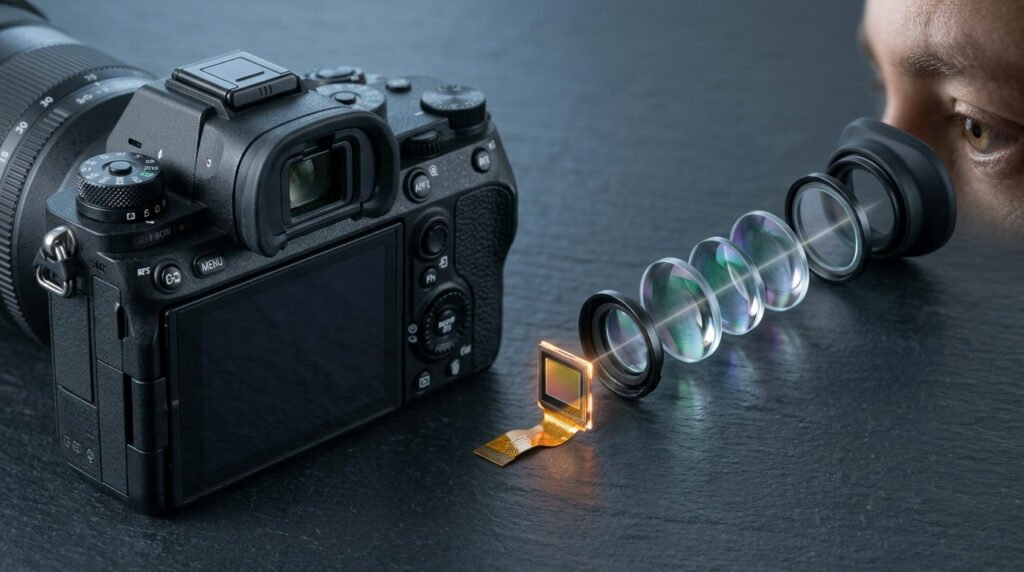
A camera viewfinder micro OLED is a tiny, self-emitting display built on a silicon chip and placed behind an eyepiece, so the photographer sees a sharp, high-contrast live image. It is popular because it packs high pixel density, deep blacks and quick response into very little space. Choosing one well means looking at the whole viewfinder system: resolution, size, brightness, interface and optics.
Quick Answer
A camera viewfinder micro OLED is a miniature OLED-on-silicon display used as the screen inside an electronic viewfinder (EVF). A magnifying eyepiece enlarges it, so the user sees a detailed, high-contrast live view of what the sensor captures. Compared with LCD panels, it generally offers higher pixel density, deeper blacks and faster response. The key specifications to review are resolution, diagonal size, brightness, interface type and compatibility with the eyepiece optics.
Introduction
Look through the viewfinder of a modern mirrorless camera and you are not seeing the scene directly. You are looking at a tiny screen, enlarged by a lens, showing what the sensor captured a moment ago. For that screen to feel like a window and not a small monitor, it has to be sharp, fast and truly dark where the scene is dark. That is the job a camera viewfinder micro OLED is designed to do.
Optical viewfinders, with their mirrors and prisms, dominated cameras for decades. Electronic viewfinders have since become standard in mirrorless designs, and the display inside has changed along with them. Small LCD panels were joined by OLED, and more recently by micro OLED panels built on silicon.
This guide explains how a camera viewfinder micro OLED works, how it compares with other panel types, which specifications matter most and what to check before committing to one for a product. It is written for camera designers, sourcing engineers and anyone curious about what sits behind the eyepiece.
What Is a Camera Viewfinder Micro OLED Display?
A micro OLED display, also called OLEDoS (OLED on silicon) or a silicon-based OLED microdisplay, is an organic light-emitting display built directly on a silicon wafer instead of glass. The wafer carries the CMOS circuitry that drives each pixel, and the organic light-emitting layers are deposited on top. Semiconductor processes can produce very fine features, so the pixels can be extremely small, typically in the single-digit to low double-digit micron range.
In a viewfinder, the panel is usually less than an inch across the diagonal. That is far too small to use with the naked eye, which is why it is always paired with an eyepiece. A tiny panel plus magnifying optics is what the user experiences as a large, detailed image. A camera viewfinder micro OLED is therefore both a display component and one half of an optical system.
One point of confusion is worth clearing up. “Micro OLED” refers to the small size and silicon construction of the panel. It is not the same as micro LED, which uses inorganic LEDs and is a separate technology.
How the Electronic Viewfinder Works
The signal path is simple. The sensor captures light, the image processor turns the data into a video-style image, and that image is sent to the viewfinder panel. The eyepiece then enlarges the panel into a virtual image that appears at a comfortable distance. A diopter adjustment lets users with different eyesight bring that image into sharp focus.
Everything on the panel is generated by the camera, so an EVF can show more than the scene. Exposure preview, focus peaking, histograms, level indicators and menus can all be overlaid. A camera viewfinder micro OLED with enough resolution and contrast keeps those overlays crisp without cluttering the picture.
Optical Viewfinder vs Electronic Viewfinder
An optical viewfinder shows the real scene through glass, with almost no delay and no power draw. It also has limits. It cannot preview exposure, and it adds mirrors, a prism and moving parts to the camera body.
An EVF trades that directness for information. The photographer sees the effect of exposure compensation, white balance and picture styles before pressing the shutter. In dim conditions the EVF can brighten the preview so the scene stays visible, which an optical finder cannot do. A well-built camera viewfinder micro OLED narrows the gap in feel, because high resolution and fast response make the electronic image look natural. Some photographers still prefer optical finders, and that is a fair choice. It depends on what you shoot.
Micro OLED vs LCD vs Conventional OLED
Three display families have been used in EVFs. Small LCD panels were common in earlier and lower-cost designs. Some of them used field-sequential color, which can cause brief color flashes when the eye moves quickly. Conventional OLED panels on glass improved contrast and response. Micro OLED on silicon went further by allowing much smaller pixels in a much smaller package.
| Feature | Small LCD | Conventional OLED (glass) | Micro OLED (silicon) |
|---|---|---|---|
| Light source | Needs a backlight | Self-emitting | Self-emitting |
| Black level | Limited by backlight leakage | Very deep | Very deep |
| Pixel density | Moderate | High | Very high |
| Panel size | Larger for the same resolution | Medium | Very compact |
| Relative cost | Lower | Medium | Higher |
The table is a general comparison, and individual products vary. It still explains why a camera viewfinder micro OLED has become the choice for premium bodies: it gives the highest sharpness in the smallest space, at a higher component cost.
Why Designers Choose a Camera Viewfinder Micro OLED
Pixel density. Photographers judge a viewfinder by whether they can see the pixel structure. When the panel is magnified several times by the eyepiece, any gap between pixels becomes visible. Very small pixels keep that grid hard to notice, so the image looks continuous.
Contrast. OLED pixels make their own light, so a black pixel is simply off. In a dim scene, the viewfinder does not glow gray the way a backlit panel can. This helps when composing at night or indoors.
Response. Organic pixels change state quickly, which reduces smearing when you pan or follow a moving subject. Panel response is only one part of total latency, but a slow panel would make everything else harder.
Size and power. A small silicon die takes little room in a crowded camera body. Because an emissive panel only lights the pixels that are showing content, power use scales with image brightness, which helps in a battery-powered device.
Understanding Resolution and the “Dots” Number
Camera makers often describe viewfinders as 2.36 million-dot, 3.69 million-dot, 5.76 million-dot or 9.44 million-dot. These numbers count subpixels, not full pixels. Each full-color pixel has red, green and blue subpixels, so the figure is roughly three times the pixel count. A 1024 × 768 panel gives about 2.36 million dots, 1280 × 960 gives about 3.69 million, 1600 × 1200 gives about 5.76 million and 2048 × 1536 gives about 9.44 million.
This is a marketing convention, so check the actual pixel dimensions on the datasheet when selecting a camera viewfinder micro OLED. Higher resolution gives a smoother image, but it also raises cost and increases the data the processor must send every frame. Past a certain point, the extra detail may not be visible through the eyepiece anyway. Matching panel resolution to optical magnification matters more than chasing the largest number.
Size, Magnification and Eye Relief
Panel diagonal and eyepiece magnification work together. A bigger panel or stronger magnification produces a larger apparent image, which feels more immersive. Camera specifications usually quote magnification as a 35mm-equivalent figure, which compares the viewfinder image with that of a full-frame optical finder.
There is a trade-off. Higher magnification can push the image corners out of view for people who wear glasses, because the eye must sit very close to the eyepiece to see everything. This is where eye relief comes in. It is the distance from the rear of the eyepiece at which the whole image remains visible. Designers usually balance magnification against eye relief so that glasses wearers can still see the frame edges comfortably.
Another factor is the eyebox, the area in which the eye can move and still see a complete image. A tight eyebox feels fussy. Panel size, optical design and eyecup shape all affect it, which is why the choice of a camera viewfinder micro OLED should not happen in isolation.
Brightness, Contrast and Color
A viewfinder has to work in a dim theater and in direct sun. The eyecup shields the eye from ambient light, so the problem is smaller than on a rear LCD, but brightness still matters. Check the rated luminance on the datasheet and ask under what conditions it was measured, since peak and full-screen values can differ.
Color deserves attention too, especially for video shooters who judge exposure and white balance through the viewfinder. Look at the supported color gamut, the unit-to-unit consistency of the white point, and whether the supplier provides calibration data. A camera viewfinder micro OLED that looks slightly warmer or cooler from one unit to the next creates an inconsistent experience across a production run.
Refresh Rate, Latency and Blackout
Many viewfinders run at 60 Hz, with higher-end models offering 120 Hz modes. A higher refresh rate makes motion look smoother and can make tracking fast subjects easier.
Latency is the delay between a change in the scene and the viewfinder showing it. The display is only one contributor. Sensor readout, image processing and the interface all add time. The panel’s own response is usually the smallest part of the chain, but it should never be the weak link.
Blackout, the brief dark interval during burst shooting, comes mainly from how the sensor and processor handle exposure and readout. It is not mostly a display property, though a panel that accepts a fast, stable refresh gives designers more room to reduce it.
Interfaces and Electronics
Micro OLED panels are not plug-and-play like a phone screen. They usually need a driver or timing-controller arrangement, a flexible printed circuit (FPC) for connection and carefully designed power rails. Common interface options include MIPI DSI, LVDS and parallel RGB, depending on the panel and driver board. Always confirm the exact interface in the datasheet instead of assuming.
FPC length and routing deserve attention, because a long, poorly shielded cable can introduce noise. The camera’s image pipeline must also output the panel’s native resolution and refresh rate without scaling artifacts. An evaluation kit or driver board from the supplier shortens early testing considerably, and it is a useful question to put to any vendor of a camera viewfinder micro OLED.
The Eyepiece: Half of the System
It is easy to treat the panel as the star and the optics as an accessory. In practice, the eyepiece decides how good the final image feels. A typical design uses several lens elements, often including aspheric surfaces, to correct distortion and color fringing across the field. If the lens quality is poor, even an excellent panel looks soft at the edges.
Coatings matter as well. Anti-reflection coatings reduce ghost images and internal reflections, which otherwise wash out dark areas, exactly where the deep blacks of an OLED should shine. A protective window with a durable coating guards the optics, and an anti-fog treatment on the outer surface helps in humid or cold conditions when a warm eye meets cool glass.
For this reason, experienced teams specify the panel and the optics together and test them as a module. Mismatched optics can hide the advantages of a camera viewfinder micro OLED, while well-matched optics let them show.
Where You Find Micro OLED Viewfinders
The most visible use is in mirrorless and hybrid still cameras, where the EVF sits above the rear screen. Video-oriented cameras use it too, since a viewfinder allows steadier handheld shooting with the camera braced against the face. Cinema cameras often accept external viewfinders, which are essentially a micro OLED panel, an eyepiece and interface electronics in a separate housing.
Beyond consumer photography, similar modules appear in thermal and night-vision imagers, industrial inspection cameras and some medical imaging equipment, such as endoscope camera heads. The logic is the same each time: a small, sharp panel plus magnifying optics gives a large-feeling image in a compact device. This broad demand helps explain why suppliers offer a camera viewfinder micro OLED in standard sizes and resolutions, not only as custom parts.
Limitations and Trade-offs
No display technology is perfect. Micro OLED panels cost more than small LCD panels, and the supply base is narrower. Peak brightness can be lower than what some other technologies reach, which may matter for certain outdoor uses and is worth checking against your needs.
A camera viewfinder micro OLED also ages with use, like any OLED. In a viewfinder the picture changes constantly, so visible image retention is less of a concern than in a device showing static content. Permanent overlays such as grid lines or icons can, over long periods, age some pixels faster than others. Reputable suppliers describe lifetime under defined test conditions and may offer pixel-shifting or other mitigation, so ask for those details.
Thermal design needs thought as well. A small enclosure near the sensor and processor can run warm, and temperature affects both brightness and lifetime. These issues are manageable, but they belong in the design review from day one.
A Hypothetical Design Scenario
Consider a team designing a compact hybrid camera for travel photographers. This is an illustrative example, not a real project.
The team wants a viewfinder that works for glasses wearers, fits a slim body and keeps battery life reasonable. They set the eyepiece goals first: comfortable eye relief and moderate magnification. That tells them how large the panel can be and how many pixels they need to keep the image smooth at that magnification.
Next they shortlist panels in the right size range and compare interface options with the camera’s processor. One panel looks attractive on paper but needs an interface the processor does not support, which would add a bridge chip and board space. Another draws slightly more power than the thermal budget allows near the sensor. They request samples of two candidates, build test modules with the same eyepiece and view them side by side.
In the end the decision does not rest on a single number. It comes from how each module looks in real shooting conditions, how stable the supply appears and how well the supplier answers technical questions. That is a realistic way to approach the selection of a camera viewfinder micro OLED, because small differences only show up when optics, electronics and thermal design are tested together.
How to Choose a Camera Viewfinder Micro OLED: A Practical Checklist
These questions help narrow the field before you request samples:
- What resolution and diagonal size suit the planned eyepiece magnification?
- What brightness, contrast and color gamut does the product need?
- Which interface does the camera’s processor support?
- What operating temperature and lifetime does the datasheet guarantee, and under what conditions?
- What are the acceptance criteria for dead or stuck pixels?
- What are the lead time, minimum order quantity and long-term supply commitment?
- Is an evaluation kit or reference design available?
Work through these in order. Start from the optical design and user experience, then move to electrical and supply questions. Teams that start with price alone often end up redesigning the eyepiece or the board later, which costs more than any saving on the panel.
When you compare suppliers of a camera viewfinder micro OLED, ask each for the same set of data so the numbers are comparable, and request samples instead of relying on brochures.
Customization and Supply Considerations
Standard panels cover many projects, but some products need changes: a particular FPC length or connector, a different orientation, tuned gamma or brightness settings, or a modified driver board. Custom work usually brings extra development time and higher minimum quantities, so decide early whether it is truly needed.
Supply continuity deserves equal attention. Camera products can stay on sale for years, and a panel that goes out of production forces a redesign. Ask suppliers about product lifecycle plans and last-time-buy policies. For any camera viewfinder micro OLED program, also keep track of the origin and export requirements that apply to your market, and confirm compliance with qualified advisors where needed.
Testing and Quality Checks Before Production
Once samples arrive, test them in the real optical assembly, not only on a bench. Measure luminance and uniformity across the panel, check white point and color accuracy, and look for pixel defects against the agreed criteria. Run flicker checks, since some panels control brightness with pulse-width modulation, and view test patterns for image retention.
Alignment is another item that is often missed. If the panel is off-center or tilted relative to the optical axis, the image looks soft on one side. Mechanical tolerances in the holder, the FPC bend and the eyepiece mount all play a part.
Environmental testing, including temperature cycling and humidity, shows whether the module behaves in the field as it does in the lab. Finally, build a final inspection routine into production so that each camera viewfinder micro OLED is checked against the same standard.
Common Mistakes in Viewfinder Projects
The first mistake is choosing resolution by headline number without checking whether the optics can resolve it. The second is ignoring eye relief, which leaves glasses wearers frustrated. The third is leaving interface and driver decisions until late, which creates schedule risk. A fourth is skipping supplier questions about lifetime, defect criteria and long-term availability. A fifth is evaluating the panel alone instead of as part of the module.
Most of these come from treating the display as a standalone part. A camera viewfinder micro OLED performs best when optics, electronics and mechanics are designed around one another.
Where Camera Viewfinder Micro OLED Technology Is Heading
The general direction is clear, even if exact timelines are not. Panels are moving toward higher resolution and refresh rates, makers continue to work on brighter output, and driver electronics keep shrinking. Costs tend to fall as production matures, which can bring micro OLED to a wider range of devices.
Because the same microdisplay and eyepiece approach is used in cinema cameras, thermal imagers, inspection cameras and medical equipment, progress in one field often helps the others. That shared demand supports a healthier supply base over time.
Conclusion
A camera viewfinder micro OLED gives photographers a sharp, high-contrast view that feels close to looking at the scene itself. Its strengths come from very small pixels, self-emitting light and a compact silicon-based design. Its limits include cost, brightness range and the need for careful thermal and lifetime planning.
Good results come from treating the display and the eyepiece as one system. Define the user experience first, then match resolution, size, interface and optics to it, and verify the result with real samples and tests. If you are evaluating a camera viewfinder micro OLED for a new product, request datasheets and sample modules from more than one supplier, and ask each the same technical questions before deciding.
Frequently Asked Questions
What is a camera viewfinder micro OLED?
It is a very small OLED display built on a silicon chip and used as the screen inside an electronic viewfinder. A magnifying eyepiece enlarges it so the user sees a detailed live view.
Is micro OLED better than LCD for a viewfinder?
For most premium uses, yes, because it offers higher pixel density, deeper blacks and fast response. LCD can still make sense for cost-sensitive designs or where very high peak brightness is the priority.
What does “5.76 million dots” mean?
It counts subpixels. Divide by three to get the approximate number of full-color pixels, so 5.76 million dots is about 1.92 million pixels, for example 1600 × 1200.
Can a camera viewfinder micro OLED suffer from burn-in?
OLED materials age, and long-term static elements can in principle cause uneven wear. Because viewfinder content changes constantly, it is usually a smaller concern, but check the supplier’s lifetime data and test conditions.
What should I ask a supplier of a camera viewfinder micro OLED?
Ask for the datasheet, interface details, pixel defect criteria, lifetime test conditions, lead time, minimum order quantity and whether an evaluation kit is available.