
TL;DR
A reliable optical window manufacturer does far more than cut glass to size. The right partner helps you pick the material, hold tight flatness and parallelism tolerances, apply a suitable coating, and back everything up with real inspection data. Compare each optical window manufacturer on material range, tolerance capability, coating options, testing equipment, and communication. Then validate with samples before you commit to volume.
Quick Answer
An optical window manufacturer produces flat, plane-parallel plates of glass, fused silica, sapphire, or infrared crystal. These plates protect optical systems and sensors while letting light pass with minimal distortion. When comparing suppliers, look at four things: the materials they work with, the tolerances they can actually measure, their coating capability, and their ability to scale from prototype to production.
Introduction
Every sealed camera, laser, sensor, and display module has to look out through something. In most designs, that something is an optical window. Because a window has no focusing power, it looks like the simplest part in the system, and it often gets the least attention during design.
That assumption can get expensive. A window with poor flatness can distort a wavefront. One with weak surface quality scatters light and creates glare. The wrong material can absorb the wavelength you need or crack under heat. These problems tend to appear late, after the housing is built and testing has started, when fixing them is slow and costly.
This is why choosing an optical window manufacturer deserves real thought. The supplier you pick shapes not only the part itself but also your lead time, your yield, and how smoothly a product moves from prototype to production.
In this guide, you will learn what an optical window is, how it differs from a lens or filter, which materials and specifications matter, how windows are made and inspected, and how to evaluate an optical window manufacturer before placing an order.
What Is an Optical Window?
A Simple Definition
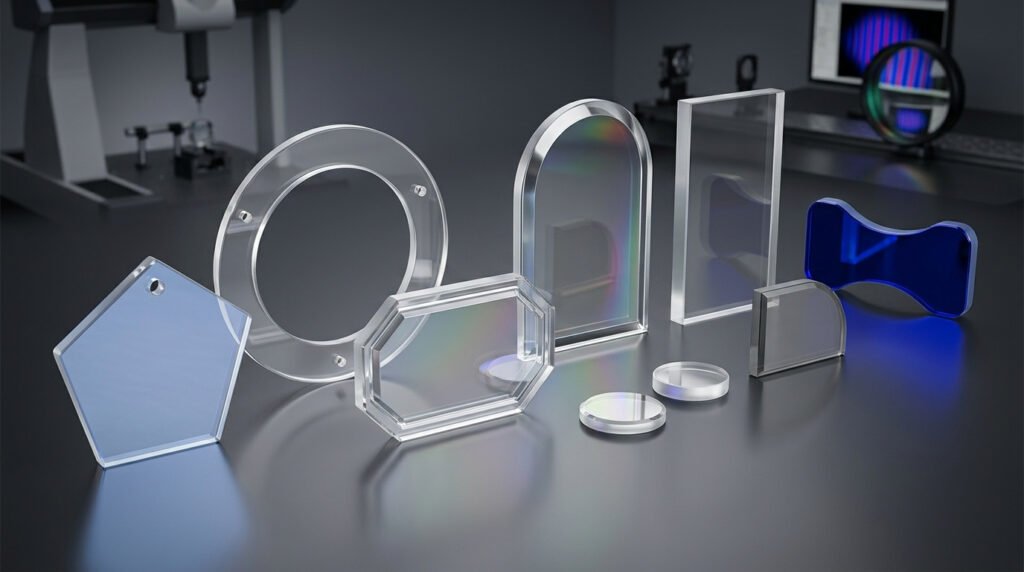
An optical window is a flat, parallel-sided piece of transparent material that transmits light while protecting an optical element, sensor, or enclosure behind it. Ideally, it changes the light as little as possible. It does not focus, magnify, or select wavelengths. Its job is to be a clear, stable, durable barrier.
Optical Window vs. Lens vs. Filter
These three parts are often confused, so a quick comparison helps. A lens shapes light with curved surfaces to focus or spread it. A filter controls which wavelengths pass, usually through coatings or absorbing materials. A window simply lets light through while keeping dust, moisture, and impact away from what sits behind it.
The boundaries do blur in practice. A window can carry an anti-reflective coating, and many filters are built on window substrates. Still, the design intent differs, and so do the specifications. A manufacturer who understands this will ask what you are trying to achieve, not just request a drawing.
Why Windows Are Not “Just Glass”
Ordinary architectural glass is made for appearance and safety. Optical-grade material is made for controlled composition, uniformity, and low internal defects. The surfaces are processed differently too: they are lapped and polished until flatness is measured in fractions of a wavelength of light rather than in millimeters. That level of control is what separates an optical window manufacturer from a general glass fabricator.
What Does an Optical Window Manufacturer Do?
An optical window manufacturer handles the chain from raw material to finished, inspected part. That usually means sourcing optical-grade substrate, cutting blanks, grinding and polishing both faces, finishing the edges, applying coatings, cleaning, inspecting, and packaging.
Some companies specialize in standard round windows in common glass types. Others take on custom work: unusual shapes, tight tolerances, exotic materials such as sapphire or germanium, and specialized coatings. Neither approach is better in general. What matters is whether the manufacturer’s strengths match your project.
A good optical window manufacturer also acts as a technical partner. They should be able to review your application and suggest changes, such as proposing fused silica for a UV system or relaxing a tolerance that adds cost without improving performance. Teams that handle optical design, mechanical design, and coating together often make this conversation easier, because decisions about the window, its mount, and its coating can be made at the same time.
Common Optical Window Materials
Material choice is the first big decision, and it depends mostly on the wavelength range you need. The table below gives approximate ranges. Values vary by grade, thickness, and coating, so always confirm against the supplier’s datasheet.
| Material | Approximate useful range | Typical strengths | Watch out for |
|---|---|---|---|
| N-BK7 / B270 glass | Visible to near-infrared | Cost-effective, easy to polish and coat | Poor fit for deep UV or mid-infrared |
| UV fused silica | UV to near-infrared | Strong UV transmission, low thermal expansion | Higher cost than standard glass |
| Sapphire | UV to mid-infrared | Very hard, scratch-resistant, handles harsh conditions | Difficult to machine, higher cost |
| Calcium fluoride (CaF2) | UV to mid-infrared | Wide range, low absorption | Soft, sensitive to thermal shock |
| Zinc selenide (ZnSe) | Visible to long-wave infrared | Common in CO2 laser and thermal systems | Soft, needs careful handling |
| Germanium | Mid- to long-wave infrared | High refractive index, thermal imaging | Opaque to visible light, performance changes with temperature |
Standard Optical Glass
N-BK7 and similar borosilicate crown glasses are the everyday choice for visible-light windows. They polish well, accept coatings easily, and cost less than specialty materials. For cameras, displays, and general sensing in the visible range, they are often all you need.
UV Fused Silica
When your system works in the ultraviolet, or when the window sees large temperature swings, fused silica is a common answer. It transmits deep into the UV and expands very little when heated, which helps it stay stable under thermal load, including some laser applications.
Sapphire
Sapphire is chosen for durability. It is extremely hard, resists scratching, and tolerates harsh environments, which is why it appears in rugged sensors and protective covers. The tradeoff is that it is harder to cut and polish, so it typically costs more and takes longer.
Infrared Crystals
For infrared work, materials like calcium fluoride, zinc selenide, and germanium come into play. Each covers a different slice of the spectrum and has its own handling needs. Some are soft or sensitive to thermal shock, and germanium blocks visible light entirely. A knowledgeable optical window manufacturer will ask about your wavelength, temperature, pressure, and chemical exposure before recommending a material. If a supplier quotes without asking any of these, treat that as a reason to dig deeper.
Key Specifications for Optical Windows
Specifications are where a drawing becomes a real part. The main ones are worth understanding even if an engineer handles the final details.
Dimensions and Thickness Tolerance
Diameter or length and width, plus thickness, define the physical fit. Thickness tolerance matters when the window sits in a tight housing or inside a stack of components.
Surface Flatness
Flatness describes how closely a surface follows a perfect plane. It is commonly expressed in fractions of a wavelength, measured at 632.8 nm with an interferometer. A value like λ/4 suits many general applications, while λ/10 or better is used for demanding imaging and laser systems. Tighter flatness costs more, so match it to your real need.
Parallelism and Wedge
Parallelism tells you how closely the two faces align. If they are not parallel, the window behaves slightly like a weak prism and can shift or distort the image. Parallelism is usually given in arc minutes or arc seconds.
Surface Quality (Scratch-Dig)
Scratch-dig describes visible scratches and pits, commonly following MIL-PRF-13830B or ISO 10110. A grade such as 60-40 is widely treated as a standard quality, while 20-10 is a much stricter grade for precision work. Ask your optical window manufacturer which standard they inspect against and how they check it.
Clear Aperture and Edge Finish
The clear aperture is the area that must meet the full specification. The outer edge can carry chamfers or bevels, which reduce chipping and protect handlers. Specifying the clear aperture, rather than demanding perfection across the whole surface, can reduce cost without affecting performance.
Transmitted Wavefront
For high-end optics, the total effect on the wavefront as light passes through matters, not just each surface. Specifying it is only worthwhile if you can verify it, so it is worth confirming that the optical window manufacturer you choose has the instruments to measure it.
Coatings: What They Do and What to Ask
Uncoated glass reflects roughly four percent of light at each surface at normal incidence. With two surfaces, that adds up, and the reflected light can cause ghost images and reduce signal. Anti-reflective (AR) coatings address this by reducing reflection across a chosen wavelength range.
Other coatings serve different goals. Hydrophobic coatings help water bead and roll off. Anti-fog treatments suit windows used in humid or temperature-changing environments. Hard or scratch-resistant coatings protect softer substrates, and some infrared windows carry durable protective layers. Bandpass or filter-type coatings let the window double as a wavelength selector.
Coating quality depends on both design and process. Ask whether the work is done in-house or outsourced, what durability tests are applied (such as adhesion, humidity, and abrasion checks), and whether spectral results are measured on actual production parts. When you evaluate an optical window manufacturer, in-house coating usually means better control and quicker iteration, although some outsourced partnerships work well too.
How an Optical Window Manufacturer Makes Precision Windows
Understanding the workflow helps you judge a quote and spot where problems might arise.
Cutting and preparation. Raw material is inspected, then cut or cored into blanks slightly larger than the final size.
Grinding and lapping. Both faces are ground to bring thickness and parallelism close to target, removing the damage left by cutting.
Polishing. Fine abrasives and polishing media bring the surfaces to the required flatness and scratch-dig quality. This is where much of the skill lies, particularly for hard or soft materials that behave very differently.
Edging. The outer shape is finished, and chamfers are added for protection and mounting.
Coating. Thin films are deposited in vacuum chambers, then measured.
Cleaning and packaging. Parts are cleaned and packed to prevent scratches and contamination during shipping.
Each stage affects the next. A shortcut in grinding shows up in polishing, and a contaminated surface ruins a coating. This is why the optical window manufacturer’s process control tends to matter more than any single machine.
Inspection and Quality Control
Claims about quality only mean something if they are measured. A trustworthy optical window manufacturer typically uses an interferometer for flatness, a microscope or comparison method for scratch-dig, a spectrophotometer for transmission and reflection, and precision tools for thickness, dimensions, and parallelism.
Ask for inspection reports or certificates of conformance on samples and, where appropriate, production lots. Check whether the manufacturer keeps records that allow traceability from material batch to finished part. A quality system such as ISO 9001 is a helpful sign of process discipline, though it does not guarantee optical performance on its own.
The simplest test is practical: request sample parts, measure them yourself or through a third party, and compare the results with the supplier’s report. Any optical window manufacturer confident in its process should welcome that.
Where Optical Windows Are Used
Optical windows appear wherever light must cross a protective boundary.
In AR/VR and display systems, windows and protective covers keep delicate modules clean while preserving image clarity. Machine vision and industrial sensing rely on windows to shield cameras from dust, coolant, and impact. Laser systems use windows that handle high energy and specific wavelengths. In medical and endoscopic equipment, windows must be clear, durable, and compatible with cleaning and sterilization. Automotive sensing, including LiDAR and camera modules, uses windows that withstand vibration and weather. Thermal imaging uses infrared materials to see heat signatures.
Because the demands vary so much, optical window manufacturers rarely serve every market equally well. A supplier strong in visible-light glass windows may not be the right choice for germanium or high-power laser optics, and the reverse is also true.
How to Choose an Optical Window Manufacturer
Choosing an optical window manufacturer comes down to evidence. Instead of relying on claims, look for proof in the following areas.
Material and Coating Range
Check whether the supplier regularly works with the material you need, not just whether they list it. Ask about recent projects in similar materials and wavelengths. A broad range is helpful, but depth in your specific material matters more.
Demonstrated Tolerance Capability
Every optical window manufacturer can write a tolerance on a quote. The real question is whether they can hold it consistently. Ask what flatness, parallelism, and scratch-dig levels they achieve in normal production, and what equipment verifies those numbers.
Inspection Equipment and Documentation
Look for interferometers, spectrophotometers, and calibrated measuring tools, along with clear reporting. If a supplier cannot explain how a specification will be verified, it is probably not being verified.
Prototype-to-Volume Flexibility
Many projects start with a handful of samples and grow into thousands. Ask how the optical window manufacturer handles small prototype runs, what minimum order quantities apply, and how process stability is maintained when volume increases.
Engineering Support and Communication
Responsiveness during quoting is a good preview of responsiveness during problems. A strong partner asks clarifying questions, flags risky specifications, and answers in clear language. Time zone and language barriers are manageable when both sides communicate carefully.
Quality System and Traceability
Look for documented procedures, incoming material checks, and lot traceability. These details become important if you ever need to investigate a field issue.
Packaging, Logistics, and Confidentiality
Delicate optics can be damaged by poor packing. Ask about packaging methods and shipping experience. If your design is proprietary, discuss a non-disclosure agreement before sharing drawings.
Preparing a Useful Request for Quotation
A clear RFQ saves days of back-and-forth and produces more accurate pricing. When contacting any optical window manufacturer, include:
- Material and grade, or the wavelength range if you want a recommendation
- Dimensions, thickness, and tolerances
- Clear aperture, flatness, parallelism, and scratch-dig requirements
- Coating type with target reflectance or transmission across your wavelength band
- Operating environment, such as temperature, humidity, pressure, or chemicals
- Quantity, delivery schedule, and a drawing in a standard format
If you are unsure about a value, say so. A good supplier would rather help you define it than quote on a guess.
What Drives Cost and Lead Time
Several factors influence the price an optical window manufacturer quotes. Material is the largest: sapphire and infrared crystals cost far more than standard glass. Tighter tolerances need more polishing time and more careful inspection. Larger or thicker windows consume more material. Complex coatings add process steps, and low quantities raise the cost per part because setup time is spread across fewer pieces.
Lead time follows similar logic. Common glass in standard sizes moves quickly, while exotic materials, custom shapes, and multilayer coatings take longer. Coating runs are often batched, so timing can depend on the chamber schedule. Asking about lead time early, before the design is frozen, gives you room to adjust.
Common Mistakes to Avoid
The most frequent mistake is over-specifying. Demanding the tightest flatness and scratch-dig on every window may feel safe, but it raises cost and slows delivery without helping performance. Define what the system actually needs.
Another mistake is ignoring mounting. A perfectly flat window can distort if it is clamped too tightly or bonded unevenly. Discuss mounting method and stress with your optical window manufacturer, since they have often seen what works.
A third mistake is choosing on price alone. A cheaper quote that misses a tolerance can cost far more in rework and delays. Finally, skipping sample validation is risky. Testing a few parts under real conditions before ordering volume is one of the cheapest ways to prevent surprises.
Working With an Overseas Optical Window Manufacturer
Many buyers source optical components from manufacturers in Asia, including China, where there is substantial capacity and a broad supply base. This can offer good value and flexibility, but it works best when handled deliberately.
Start with samples and measure them. Agree on specifications in writing, including inspection methods. Clarify how communication will work and who your technical contact is. Discuss intellectual property and confidentiality upfront. Finally, check export and import rules early, because certain materials, such as some infrared crystals, may be subject to licensing or controls depending on the countries involved. Official guidance and qualified trade advisors are the right sources for current requirements.
Conclusion
Selecting an optical window manufacturer is less about finding the biggest name and more about finding a partner whose capabilities match your application. Start with your wavelength and environment to choose the material. Define only the tolerances your system genuinely needs. Then look for evidence: measured results, clear inspection records, and engineers who ask good questions.
The best relationships start small. Order samples, verify them, and learn how the supplier communicates when something goes wrong. That experience tells you more than any brochure.
Taken together, material fit, verified quality, and honest communication make the difference between a window that quietly does its job and one that causes problems across your whole product. Whichever optical window manufacturer you choose, treat the window as a real component of your optical system, because it is.
FAQs
What does an optical window manufacturer do?
An optical window manufacturer produces flat, plane-parallel transparent plates and finishes them to defined specifications. The work includes cutting, grinding, polishing, edging, coating, inspecting, and packaging, often with technical advice on material and tolerance choices.
Which material is best for an optical window?
It depends on your wavelength and environment. N-BK7 glass suits many visible-light uses, fused silica works well in the UV and under thermal stress, sapphire offers durability, and infrared crystals such as ZnSe or germanium serve thermal and laser applications.
How is an optical window different from a lens?
A lens has curved surfaces that focus or spread light. A window has flat, parallel surfaces and is meant to transmit light with minimal change while protecting what is behind it.
What tolerances should I specify for an optical window?
Specify what your system needs rather than the tightest values available. Flatness, parallelism, scratch-dig, and thickness should follow your application, and your optical window manufacturer can advise on realistic levels.
How can I check quality before placing a large order?
Request sample parts and an inspection report, then verify key specifications yourself or through a third party. Test the samples in real operating conditions, and confirm that results stay consistent on a small pilot lot before scaling up.