
TL;DR
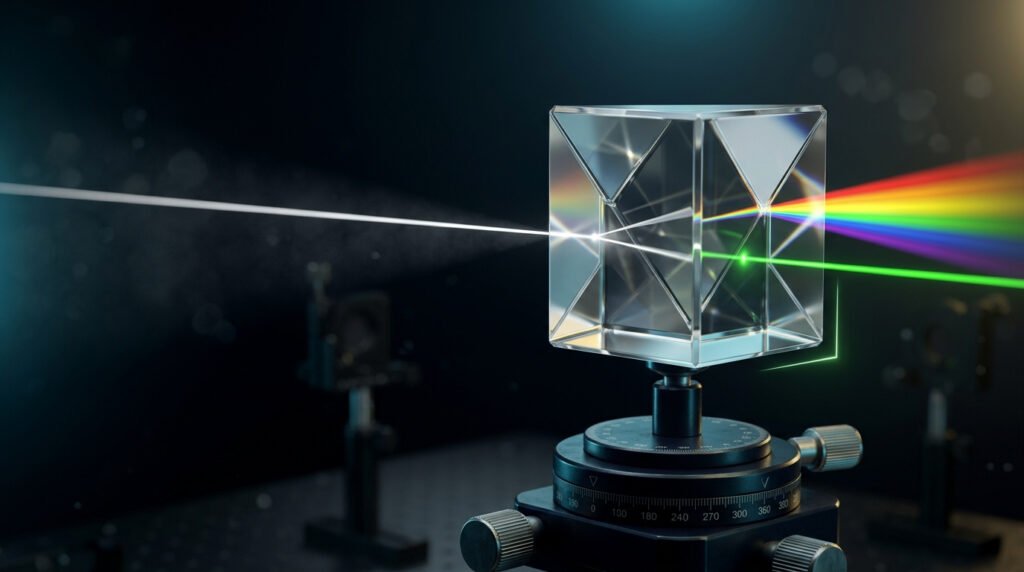
A Pellin-Broca prism is a four-sided dispersive prism that splits light into its wavelengths and sends one chosen wavelength out at exactly 90° to the incoming beam. Rotating the prism changes which wavelength exits at that fixed angle, so the rest of the optical setup never has to move. This guide covers the geometry, the working principle, common uses, and a practical checklist for specifying one.
Quick Answer
A Pellin-Broca prism is a constant-deviation dispersive prism with four sides and internal angles of 90°, 75°, 135° and 60°. Light enters one face, reflects once by total internal reflection, and leaves through a third face. The selected wavelength always exits at 90° to the input beam, so you can rotate the prism to pick a wavelength without changing the output direction. It is widely used to separate laser harmonics and to clean up beams in spectroscopy.
Introduction
Anyone who has tried to separate a green laser beam from the infrared light that produced it knows the problem. An ordinary prism bends every wavelength by a different amount, and the output direction changes each time you adjust the setup.
The Pellin-Broca prism solves this with a neat piece of geometry. Instead of sending the whole beam somewhere new whenever you change wavelength, it keeps the exit direction fixed and lets you choose the colour by turning the glass.
Despite being more than a century old, the Pellin-Broca prism is still a standard part in laser labs, spectrometers and teaching benches. It is compact, efficient and easy to align once you understand what it is doing.
In this guide, you will learn what a Pellin-Broca prism is, how its shape produces a constant deviation, where engineers use it, and how it compares with other dispersive elements. You will also get a simple checklist for specifying one, plus alignment tips and common mistakes to avoid.
What Is a Pellin-Broca Prism?
A Pellin-Broca prism is a four-sided dispersive prism cut from a single piece of optical glass or crystal. Its cross-section is a quadrilateral with angles of 90°, 75°, 135° and 60°.
It belongs to the family of constant-deviation prisms. That means the angle between the entering beam and the leaving beam stays the same for the wavelength you have selected. In this case, that angle is 90°.
The design is credited to two French contributors, the instrument maker Philibert Pellin and the physicist André Broca. It dates from around the turn of the twentieth century, and their names have stayed attached to it ever since.
One helpful way to picture a Pellin-Broca prism is as two 30-60-90 prisms and one 45-45-90 prism joined into a single block. The beam is refracted by the first section, turned by the middle section, and refracted again by the last. In practice the component is polished from one solid piece, so there are no joints inside the glass.
Key terms worth knowing
Dispersion is the spreading of mixed light into separate wavelengths, which happens because the refractive index of glass changes with wavelength. Deviation is the angle through which the prism turns the beam. Total internal reflection occurs when light inside glass strikes a surface beyond the critical angle, so it reflects fully without any coating.
These three ideas explain nearly everything about how this prism behaves.
How a Pellin-Broca Prism Works
The path of light through the glass
Follow a single beam through the prism. It meets the first face and refracts, which begins to spread the wavelengths apart. Inside the glass it reaches a second face at an angle steep enough for total internal reflection, so it bounces without needing a mirror coating. Then it refracts again as it leaves through the third face.
Every refraction adds dispersion. Two refractions and one reflection produce a clean fan of colours leaving the prism, and one colour in that fan travels at exactly 90° to the original beam.
The wavelength that exits at 90° is the one following the symmetric path through the glass. Other wavelengths leave at slightly different angles on either side of it.
Why rotating the prism selects the wavelength
Turn the Pellin-Broca prism a small amount about an axis perpendicular to the plane of the beam, and a different wavelength meets the symmetric path. That wavelength now leaves at 90°, while the others fan out at their own angles.
This is the main advantage. The user changes colour by rotating one optic, and the output beam keeps pointing in the same direction. Downstream mirrors, slits, detectors and fibres can stay exactly where they are.
A simple way to remember it
Think of the prism as a wavelength gate fixed in space. You do not move the gate. You turn a dial, and a different wavelength steps into it.
The Geometry Behind the Pellin-Broca Prism
The angles of 90°, 75°, 135° and 60° are not arbitrary. They are chosen so that, at one rotation position for each wavelength, the beam follows a symmetric path through the glass. Symmetric here means the beam makes equal angles with the entrance and exit faces inside the prism, which is the condition for minimum deviation.
At that position, the geometry turns the beam by 90° regardless of the exact refractive index of the material. This is why the same shape works across different glasses and different wavelengths. The material changes how far apart the colours spread, but the 90° turn at the selected wavelength is a property of the shape.
Each refraction follows Snell’s law, which relates the angle of the beam on either side of a surface to the refractive index of each medium. Because the refractive index of glass changes slightly with wavelength, every colour bends by a different amount at each face. That small difference, repeated at two refracting surfaces, is what produces the visible spread inside a Pellin-Broca prism.
The reflecting face does a different job. It does not add dispersion in the same way. Its role is to fold the beam so that the entrance and exit directions end up perpendicular to each other, which is what makes the compact 90° layout possible.
What Determines the Performance of a Pellin-Broca Prism
A Pellin-Broca prism looks simple, but several design choices decide how well it works in a real system.
Material and wavelength range
The glass or crystal sets the usable wavelength range and the amount of dispersion. N-BK7 and similar optical glasses suit visible and near-infrared work. Fused silica is the usual choice for ultraviolet, for high-power lasers and for applications where low fluorescence matters. Calcium fluoride and other crystals can extend the range further when the application needs it.
Dispersion is also uneven across the spectrum. It is stronger in the blue and ultraviolet than in the red and infrared, so a given prism separates short wavelengths more widely than long ones.
Angle accuracy
The 90° deviation is the whole point, so angle errors turn directly into pointing errors. A well-made prism holds its angles to within a few arcminutes or better. Always confirm the figure with the manufacturer rather than assuming it, because the tolerance you need depends on how far the beam travels after the prism.
Surface quality and flatness
Surface flatness and scratch-dig quality affect wavefront distortion and scattered light. Laser applications generally need tighter figures than classroom demonstrations. The total internal reflection face deserves particular care, since defects there can scatter light into the output.
Coatings and polarisation
The entrance and exit faces can carry anti-reflection coatings matched to your wavelength range. This reduces loss and ghost reflections. The reflecting face is normally left uncoated, because it works by total internal reflection, and any film or contamination on it can spoil that.
In some arrangements, a Pellin-Broca prism can also be used near Brewster’s angle with p-polarised light to cut reflection loss. Whether that works depends on the exact geometry and wavelength, so check it by calculation or with your supplier before relying on it.
Clear aperture and size
The clear aperture must be large enough for your beam, with some margin so the edges do not clip it. Larger prisms cost more and are harder to mount, so choose the smallest size that comfortably fits the beam.
Common Applications of the Pellin-Broca Prism
Separating laser harmonics
This is the classic use. A frequency-doubled or frequency-tripled Nd:YAG laser emits its infrared fundamental at 1064 nm together with harmonics at 532 nm and 355 nm. A Pellin-Broca prism spreads these beams apart so the wanted wavelength can be isolated and the others blocked.
Because the selected beam always leaves at 90°, the experimenter can retune or swap wavelengths without realigning everything downstream.
Tunable laser and optical parametric systems
Optical parametric oscillators produce pump, signal and idler beams at different wavelengths. A Pellin-Broca prism can separate them at the output. It can also serve as a wavelength-selective element in some tunable laser designs.
Spectroscopy and Raman setups
Raman and fluorescence measurements often need a clean excitation line. A Pellin-Broca prism can remove unwanted background light, such as broadband emission from the laser source, before the beam reaches the sample.
Small spectrometers and monochromators built for teaching also use this prism, because the fixed output direction keeps the detector arrangement simple.
Teaching and demonstration
Physics and photonics courses use a Pellin-Broca prism to show dispersion, total internal reflection and constant deviation in a single component. Students can see the geometry at work and measure the 90° output directly.
Pellin-Broca Prism vs Other Dispersive Elements
Choosing a dispersive element depends on what you need to separate, how much light you can afford to lose, and how often you retune.
| Feature | Pellin-Broca prism | Equilateral prism | Diffraction grating |
|---|---|---|---|
| Output direction when tuning | Fixed at 90° for the selected wavelength | Changes with wavelength and angle | Changes with wavelength and order |
| Spectral resolution | Moderate | Moderate | Usually higher |
| Light efficiency | Generally high | Generally high | Varies with wavelength and polarisation |
| Overlapping orders | None | None | Possible |
| Alignment effort | Low | Moderate | Moderate to high |
| Best suited to | Separating well-spaced wavelengths | General demonstrations | High-resolution spectroscopy |
Compared with an equilateral prism
An equilateral prism disperses light but sends the output in a new direction whenever you change wavelength or rotate the prism. Every change means readjusting the optics that follow. A Pellin-Broca prism removes that burden.
Compared with a diffraction grating
A grating usually resolves closely spaced lines better, but it can produce overlapping orders and an efficiency that depends on polarisation. A Pellin-Broca prism has a single dispersion path and no overlapping orders. For widely spaced wavelengths such as laser harmonics, it is often the simpler and cleaner choice. For closely spaced spectral lines, a grating is usually the better tool.
Compared with an Abbe prism
The Abbe prism is another constant-deviation design, but it turns the beam by a different angle. If your layout needs a 90° turn, the Pellin-Broca prism is the one that matches it.
Advantages and Limitations of a Pellin-Broca Prism
The main benefit of a Pellin-Broca prism is convenience. The output direction stays fixed, tuning is a single rotation, and there are no moving mirrors to realign. It is also usually efficient, since light passes through glass with only a few surface interactions.
Its limitations are just as clear. Resolution is moderate, so closely spaced lines may not separate well. Dispersion is nonlinear, which makes calibration more complex than with a grating. Performance also depends heavily on material and polish quality.
In short, the advantages are:
- Fixed 90° output for the selected wavelength
- Simple tuning by rotation
- No overlapping diffraction orders
- Generally high transmission with good coatings
And the limitations are:
- Moderate spectral resolution
- Nonlinear dispersion
- Sensitivity to angle and surface quality
- Material choice limits the usable wavelength range
The MAPS Checklist for Specifying a Pellin-Broca Prism
Specifying a Pellin-Broca prism goes more smoothly with a short checklist. A simple one is MAPS: Material, Angles, Polish, and Size-and-coating.
- Material: match the glass or crystal to your wavelength range and power level.
- Angles: state the deviation tolerance you need, in arcminutes.
- Polish: specify flatness and scratch-dig for the working and reflecting faces.
- Size and coating: confirm the clear aperture and any anti-reflection requirement.
Material comes first because it decides everything else. A prism made from the wrong glass will absorb or scatter the very wavelengths you want to isolate. Start by listing the shortest and longest wavelengths in your system, then check the transmission range.
Angles come second. Ask how much pointing error your layout can tolerate at the detector or fibre, and work backwards to the tolerance.
Polish is the part buyers most often under-specify. For high-power lasers, ask about inspection methods such as interferometer testing, and keep a record of the results.
Size and coating come last. A matched coating on the entrance and exit faces reduces loss. A supplier with an in-house optical film design capability can tune coatings to the exact wavelengths of your experiment, which simplifies ordering.
Aligning a Pellin-Broca Prism on the Bench
A careful alignment takes only a few minutes. The steps below assume a laser is already running and that proper laser safety measures are in place.
First, mount the prism on a rotation stage so that its rotation axis passes close to the prism centre and stays perpendicular to the plane of the beam. A kinematic mount with fine rotation works well.
Second, make sure the incoming beam runs level and parallel to the table surface. Use two irises to define the input path.
Third, set a reference for the 90° direction. A square, a machined block, or a second pair of irises placed at a right angle to the input beam will do.
Fourth, rotate the Pellin-Broca prism slowly until the wavelength you want passes through the reference irises. Lock the mount once the beam is centred.
Finally, check the other wavelengths and any stray reflections. Place beam dumps where the unwanted beams land, and keep the work area enclosed or marked according to your laser safety rules.
A useful habit is the right-angle check. After locking the mount, place a small target at two different distances along the output path. If the beam lands on the same line at both points, the output is straight and stable.
Handling and Cleaning
Handle the prism by its ground edges, wear powder-free gloves, and never touch a polished face. Fingerprints on the total internal reflection face are especially harmful, because oils change the refractive index at the surface and cause loss and scatter.
If cleaning is needed, use clean lens tissue and a spectroscopic-grade solvent, and follow the supplier’s guidance for the specific coating. Blow off loose dust with clean, dry air first, so it is not dragged across the polish.
Store the prism in its original case, away from moisture and sudden temperature changes.
Common Mistakes to Avoid
The first mistake is treating the Pellin-Broca prism like a mirror. It disperses light as well as turning it, so the other wavelengths exit at other angles, and they need somewhere safe to go.
Another is expecting very high resolution. For closely spaced spectral lines, a grating usually performs better.
A third is ignoring the material. Ultraviolet light sent through the wrong glass is simply absorbed.
Other frequent errors include touching the reflecting face, choosing too small an aperture, and forgetting that polarisation can change reflection losses at the entrance face.
Finally, many users forget to record the stage reading for each wavelength. Write it down once, and you can return to any wavelength in seconds.
Questions to Ask a Supplier
Ask which glass types or crystal grades are available and whether material certificates are provided. Ask for angle tolerance, flatness and scratch-dig figures in writing. Ask how each prism is inspected, for example with an interferometer or autocollimator.
Ask whether coatings are tested at your wavelength, and what lead time to expect for custom sizes.
If you are building a product rather than a one-off experiment, ask about batch-to-batch repeatability. Consistent angles and polish matter much more once units are produced in volume.
Request a sample or an inspection report before committing to a large order. Testing a single Pellin-Broca prism in your own setup will tell you more than a datasheet. Suppliers that list a range of prisms and optical components can usually quote custom dimensions as well.
Key Takeaways
- A Pellin-Broca prism turns the selected wavelength by exactly 90°.
- Rotation chooses the wavelength, while the output direction stays fixed.
- It suits widely spaced wavelengths, such as laser harmonics, better than closely spaced spectral lines.
- Material, angle tolerance, polish and coating decide real-world performance.
Conclusion
The Pellin-Broca prism earns its place through simplicity. One piece of glass separates wavelengths, folds the beam through a right angle, and lets you retune without disturbing anything downstream.
It will not replace a grating when you need high resolution, but for separating laser harmonics, cleaning excitation lines and teaching dispersion, it remains hard to beat. Understanding the geometry helps you align it quickly and specify it correctly.
Before you buy, run through the MAPS checklist, confirm tolerances in writing, and test a sample in your own setup. If you are deciding whether a Pellin-Broca prism fits your design, that small amount of preparation usually saves more time than any later adjustment.
FAQs
What is a Pellin-Broca prism used for?
A Pellin-Broca prism is mainly used to separate wavelengths of light while keeping the output direction fixed at 90°. Common uses include isolating laser harmonics, separating beams from optical parametric systems, and cleaning excitation lines in Raman and fluorescence setups.
Why does a Pellin-Broca prism deviate light by 90°?
Its four-sided shape, with angles of 90°, 75°, 135° and 60°, folds the beam by total internal reflection and refracts it twice. At the symmetric, minimum-deviation path, the combined effect is a 90° turn for the selected wavelength.
How is a Pellin-Broca prism different from a diffraction grating?
A grating usually offers higher resolution but can produce overlapping orders and polarisation-dependent efficiency. A prism has a single dispersion path, no overlapping orders and a fixed output direction, which makes it simpler for separating well-spaced wavelengths.
What material is best for a Pellin-Broca prism?
It depends on the wavelength range and power level. N-BK7 suits visible and near-infrared work, while fused silica is commonly chosen for ultraviolet and high-power lasers. Always check the transmission range against your wavelengths.
Can a Pellin-Broca prism be used with ultraviolet lasers?
Yes, if it is made from a UV-transmitting material such as fused silica and has suitable surface quality and coatings. Confirm the specifications with your supplier, especially for high-power applications.