
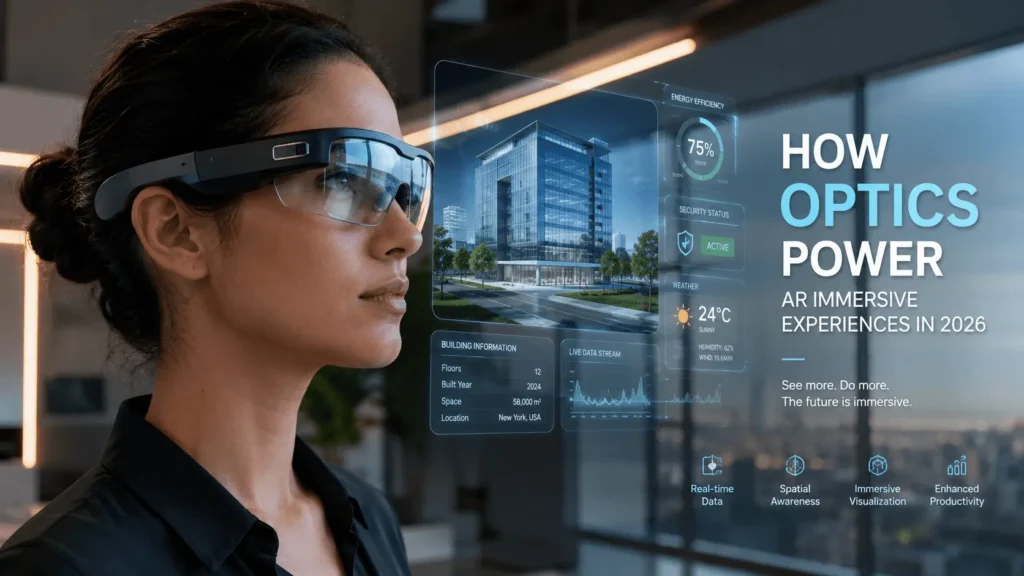
Augmented Reality (AR) and Virtual Reality (VR) are core parts of Extended Reality (XR) systems that are transforming how people interact with digital content. AR adds digital layers to the real world, while VR creates fully immersive virtual environments for users.
Together, these technologies are driving the future of spatial computing and changing industries like gaming, healthcare, and education. Most users focus on software and visuals, but the real performance depends on underlying optical systems inside the device.
True AR immersion depends on how well digital images blend with reality without distortion, delay, or eye strain. This is made possible through advanced optical components like lenses, micro displays, and precision light control systems.
What is Augmented Reality (AR)?
Augmented Reality is a technology that enhances the real-world environment by adding digital elements such as images, text, or 3D objects. It is widely used in AR gaming systems, industrial maintenance, education, and healthcare applications.
AR devices rely heavily on near-eye display (NED) systems that project images close to the user’s eyes using advanced optical components.
What is Virtual Reality (VR)?
Virtual Reality fully replaces the real environment with a digital one using VR headsets. Unlike AR, VR requires complete immersion, where the user is isolated from the physical world.
Both AR and VR depend on precise optical systems to deliver correct depth perception and visual clarity.
Why Optics Matter More Than Software in AR Systems
The performance of any AR headset depends heavily on its optical architecture. Even the most advanced graphics cannot create immersion if the optics are weak.
Key optical factors include:
- Light transmission accuracy
- Lens curvature and distortion control
- Field of View (FOV)
- Eye box alignment
- Depth perception accuracy
These elements define how naturally the human brain perceives digital overlays in real space.
Also Read :
Micro Display Guide to Types, Features, and Common Uses
Pancake Optical Module Explained: Working, Benefits & Future in AR/VR
Bird Bath Optical Module for AR: Uses, Benefits & Working
How Optical Systems Create AR Experiences
AR immersion is created through a carefully designed optical chain that controls how light travels from the display to the human eye.
Role of Micro Displays in AR Devices
At the core of AR systems are Micro OLED displays and Micro LED displays, which generate high-resolution images in a compact space. These displays are widely used in micro display systems due to their brightness and pixel density.
They act as the light source for AR visuals before being processed by optical lenses.
How Lenses Shape Virtual Images
Once light is generated, it passes through an optical lens system that shapes and projects the image into the user’s eye. This process ensures that digital objects appear stable in the real world.
Advanced lens technologies such as aspheric lens and freeform optics help reduce distortion and improve clarity.
Field of View (FOV) and Depth Perception
The Field of View (FOV) determines how wide the virtual environment appears to the user. A larger FOV improves immersion but requires more advanced optics to maintain image quality.
Depth perception is controlled by binocular vision alignment and optical calibration, ensuring that virtual objects appear naturally positioned in real space.
Light Path in AR Optical Systems
The AR optical process generally follows this sequence:
- Micro display generates image
- Light is projected through an optical module
- Lenses or waveguides shape the image
- Image is reflected or transmitted into the eye
- Human brain combines real and virtual visuals
This precise light control system is the foundation of all immersive AR experiences.
Core Optical Technologies Used in AR Devices
Pancake Lens Systems in Compact AR Devices
Pancake lenses are used in modern AR and VR headsets to reduce device size while maintaining image quality. They use folded optical paths to compress light travel distance.
This technology allows compact AR head-mounted display (HMD) systems without losing visual clarity.
Bird Bath Optical Modules Explained
The bird bath optical module is another widely used AR optical architecture. It combines mirrors and lenses to project images into the eye with high brightness and stability.
It is commonly used in early-generation AR smart glasses due to its simplicity and performance balance.
Waveguide Technology in Smart Glasses
Waveguide optics represent the future of AR display systems. They use light propagation through transparent materials to project images directly into the user’s field of view.
This technology is essential for lightweight AR glasses and is a key driver of next-generation mixed reality headsets.
Micro OLED Displays for High-Resolution AR
Micro OLED display technology provides ultra-high pixel density and fast response time. It is widely used in AR systems where image quality and contrast are critical.
Compared to traditional display panels, Micro OLED delivers better energy efficiency and sharper visuals.
How Optics Improve User Immersion Experience
Visual Clarity and Lens Precision
High-quality optics reduce blur, distortion, and chromatic errors. This improves user comfort and reduces eye strain during long AR usage sessions.
Real-World Overlay Accuracy
Optics ensure that digital objects align precisely with real-world environments. This accuracy is essential in applications like industrial maintenance and surgical visualization.
Reducing Latency and Visual Distortion
Advanced optical design minimizes delay between movement and visual update, reducing motion sickness (VR sickness) and improving system responsiveness.
Improving Comfort and Eye Strain Reduction
Proper optical alignment ensures that users experience minimal fatigue, which is critical for long-term AR usage in professional environments.
Real-World Applications of AR Optics
Healthcare and Surgical Training
AR systems are used in surgical AR visualization to guide doctors during complex procedures with high precision. This improves surgical accuracy by allowing real-time digital overlays on patient anatomy during operations.
Industrial Maintenance and Engineering
Technicians use AR glasses for real-time data overlay in machine repair and manufacturing environments. This helps reduce downtime and improves efficiency by providing instant access to technical instructions and diagnostics.
Education and Training Systems
AR improves learning experiences by creating interactive and immersive simulations. It also enhances knowledge retention by allowing students to visualize complex concepts in a more practical and engaging way.
Gaming and Entertainment Industry
AR gaming systems rely heavily on optical performance to deliver smooth and realistic experiences. This creates more immersive gameplay by blending digital environments seamlessly with the real world
Defense and Simulation Systems
Military training uses AR and VR systems for simulation-based learning without real-world risk.
Challenges in AR Optical Systems
Limited Field of View
Current AR systems still struggle to provide wide immersive viewing angles.
Motion Sickness and Eye Fatigue
Poor optical alignment can cause discomfort and visual strain.
Hardware Size and Weight Issues
Devices using complex optical modules like bird bath systems are still bulky.
Cost and Manufacturing Complexity
Advanced systems such as waveguides and Micro OLED displays are expensive to produce.
Future of AR Optics in 2026 and Beyond
AI-Powered Adaptive Optical Systems
Future systems will use AI-powered optics to adjust focus and clarity in real time. This will allow AR devices to automatically optimize visual performance based on user movement, environment, and eye behavior.
Lightweight AR Glasses Evolution
Waveguide and pancake lens advancements will enable ultra-light smart glasses. This reduction in size and weight will make AR devices more practical for all-day everyday use.
Evolution of Human-Computer Interaction
AR will become a core part of human-computer interaction (HCI) and spatial computing systems. This shift will enable users to interact with digital content in a more natural and intuitive way using gestures and visual overlays.
Toward Fully Immersive Mixed Reality Environments
The combination of AR, VR, and Mixed Reality (MR) will lead to fully immersive digital environments. These environments will merge physical and virtual worlds so seamlessly that users can interact with both simultaneously in real time.
Conclusion
Optics are the foundation of all AR immersive experiences. Without precise optical engineering, technologies like Micro OLED displays, waveguides, and pancake lenses cannot deliver true immersion.
As we move toward 2026 and beyond, advancements in optical systems will define the future of AR headsets, smart glasses, and spatial computing devices, making digital and physical worlds feel increasingly seamless.