

A Red Dot Sight is a high-tech tool that helps you aim a firearm or airsoft gun faster and more accurately. It is called a “non-magnified” optic because it does not zoom in like a sniper scope. Instead, it provides a clear piece of glass with a glowing red dot that looks like it is floating in the air.
For 30 years, elite operators have moved away from old-style sights toward this technology. Why? Because in a high-stress situation, you don’t want to struggle to see your target. You want to see the threat, place the dot, and take the shot.
This guide explains exactly what they are and how the physics of light makes them work.
What is a Red Dot Sight?

The Modern Reflex Optic Defined
When experts talk about a red dot, they are usually talking about a Reflex Sight. Think of it like a smart mirror. Inside the device, there is a tiny light. That light shines onto the lens, and the lens reflects it back to your eye.
The most important thing to know is that a red dot does not project a laser onto your target. If you are pointing a red dot at a wall, there is no red spot on the wall. The red spot only exists inside the glass of the optic. This is a huge tactical advantage because it means the enemy cannot see where you are aiming.
Red Dots vs. Iron Sights: The Speed Advantage
Before red dots, everyone used Iron Sights. These are the small metal notches on top of a gun. To use them, you have to line up three things: your eye, the rear sight, and the front sight. This is called “sight alignment.”
It is slow. It is hard to do in the dark. And it blocks your view of the target. A red dot removes these steps. You keep both eyes open, looking at the target. When you bring the gun up, the dot appears in your field of view. It is intuitive, natural, and much faster for the human brain to process.
How Does a Red Dot Sight Work?
The Physics: LED and Collimated Light
The “magic” of the red dot comes from a tiny part called an LED (Light Emitting Diode). This LED is positioned at the perfect focus point of a curved lens.
When the LED shines its light, it hits the curved glass. The glass is coated with a special material that acts like a filter. It allows all the “normal” light from the world to pass through so you can see your surroundings, but it reflects the specific wavelength of the red LED light back to your eye.
This light is Collimated. In simple terms, this means the light rays are made perfectly straight and parallel. Because the light is straight, the dot appears to be at “infinity.” This is why the dot stays on your target even if you move your head slightly left or right.
Lens Coatings and Light Reflection
An expert-grade red dot uses a Mangin Mirror system. The lens is not flat; it is a meniscus (curved) lens. One side has a metallic coating that reflects the red dot while staying 95% transparent. Without these high-tech coatings, the dot would look blurry or “ghosted.” In our manufacturing process, we ensure these coatings are durable enough to handle rain, mud, and extreme heat without peeling.
Parallax and Eye Relief Explained
Two words you will hear from experts are Parallax and Eye Relief.
-
Parallax-Free: In cheap sights, if you move your head, the dot moves off the target. In a professional red dot, the dot stays on the target no matter where your eye is behind the glass. This is “Tactical Consistency.”
-
Unlimited Eye Relief: Unlike a magnifying scope, you don’t have to put your eye a specific distance from the glass. You can mount the sight at the very front of your rifle or right next to your eye. It works the same way every time.
The Three Main Types of Optics
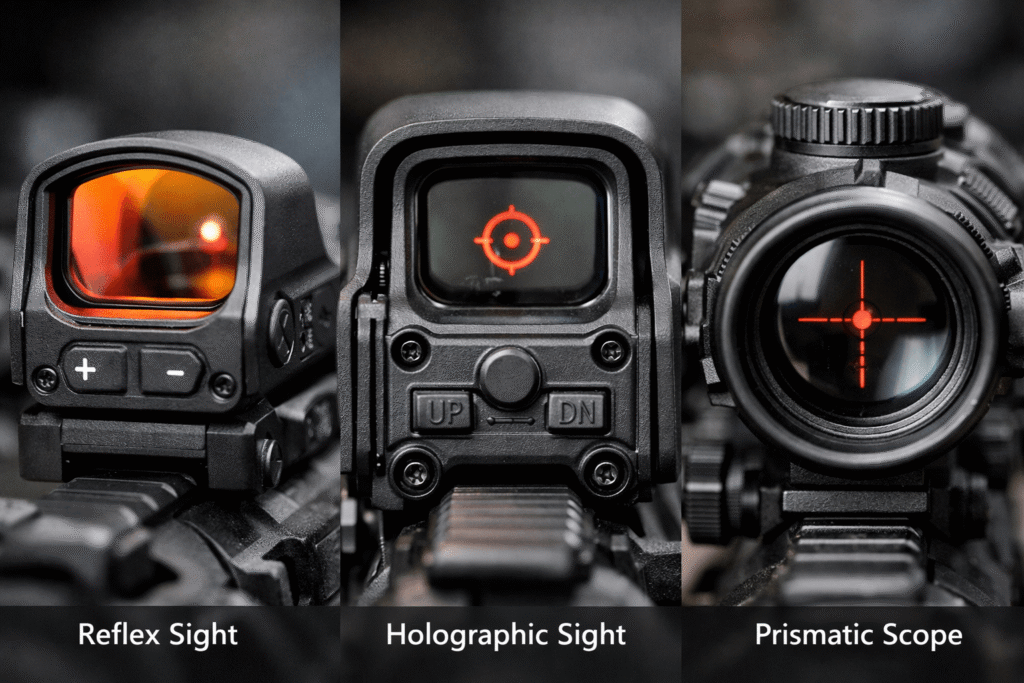
Not all red dots are built the same way. There are three main “species” of optics:
-
Reflex Sights: These are the most popular. They use the LED-and-Mirror system we discussed. They are lightweight and use very little battery.
-
Holographic Sights: Instead of an LED, these use a Laser and a Hologram. They are very expensive and consume more battery, but they have a major advantage: even if the front glass is cracked or covered in mud, the laser can still project the reticle onto the remaining shards of glass.
-
Prismatic Sights: These use a physical glass prism with the reticle etched (carved) into the glass. This is the only choice for shooters with Astigmatism. If a normal red dot looks like a “starburst” or a blurry blob to you, a Prism sight will look perfectly sharp.
Understanding MOA (Minute of Angle)
How big should your dot be? We measure this in MOA.
-
1 MOA equals about 1 inch of space at 100 yards.
-
2 MOA Dot: This is a small, precise dot. It is best for longer distances because it doesn’t cover up the target.
-
6 MOA Dot: This is a big, bright dot. It is best for handguns and close-quarters combat (CQB) because your eye finds it instantly.
Why Use a Red Dot? (Tactical Benefits)
1. Faster Target Acquisition
In a fight, speed is life. A red dot allows you to find your target and process the “aiming solution” much faster than any other system.
2. Enhanced Situational Awareness
Because you keep both eyes open, you maintain your “peripheral vision.” You can see if another threat is coming from the side while you are focused on the target in front of you.
3. Low-Light Performance
Iron sights are black and disappear in the dark. A red dot glows. Whether you are in a dark hallway or out in the woods at dusk, the dot remains visible.
Critical Considerations for Operators
Battery Life and Power Failure
Most modern red dots use “Constant On” technology. High-end models can stay on for 50,000 hours (over 5 years) on a single battery. However, an expert always has a backup plan.
Co-Witnessing with Iron Sights
This is a professional setup where you leave your iron sights on the gun. You can see them through the bottom of the red dot glass. If the battery dies or the optic breaks, you don’t have to take the sight off—you just look slightly lower and use the metal sights.
Optic Size: Micro vs. Full-Sized
-
Micro Red Dots (MRDS): Designed for pistols. They are small enough to fit on a handgun slide.
-
Full-Sized: Designed for rifles. They have a larger “window” which makes it easier to keep the dot in view during heavy movement.
Summary
A red dot sight is a vital force multiplier for any professional operator. It transforms the complex task of aiming into a simple, instinctive action, allowing you to focus on your surroundings and decision-making. By increasing speed and accuracy in high-pressure environments, these optics have become the gold standard for modern missions. Choosing a high-quality, reliable red dot is not just an upgrade; it is a commitment to precision and tactical superiority in the field.
Partner with ARVR Optical for elite precision. As a premier manufacturer and B2B supplier, we provide high-volume, professional red dot sights for your business needs. Contact us for bulk orders.