TL;DR
A birdbath optical module for micro OLED AR glasses folds the light from a tiny, sharp display into your eye using a beam splitter and a curved partial mirror, while still letting you see the real world. It is simple, affordable and gives good image quality, but it loses a lot of light and adds some bulk. This guide covers how it works, key specs, trade-offs and what to check before you pick one.
Quick Answer
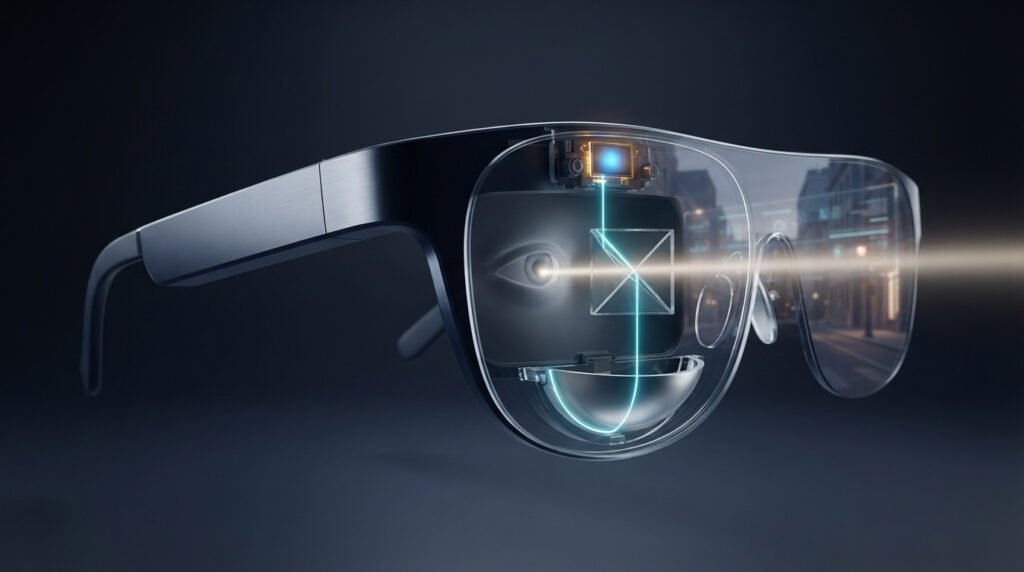
What is a birdbath optical module for micro OLED AR glasses? It is a compact optical assembly that pairs a micro OLED display with a beam splitter and a curved, partially reflective combiner. The display light bounces off the beam splitter, reflects from the combiner and passes back through the beam splitter to the eye. Real-world light also passes through, so the wearer sees digital content overlaid on their surroundings.
Introduction
Pick up a pair of lightweight AR glasses that look almost like sunglasses, and there’s a decent chance a birdbath design sits inside them. It is one of the most common ways to put a bright, sharp image in front of your eye without a huge headset.
The reason is practical. Micro OLED displays are tiny, with very fine pixels. They need optics that magnify the image and place it at a comfortable distance. A birdbath does that job in a small, relatively low-cost package.
But it is not magic. Every choice involves trade-offs in brightness, field of view, transparency and size.
This article explains the birdbath optical module for micro OLED AR glasses from the ground up. You will see how the light travels, why micro OLED is such a natural partner, which specs matter most and where the design struggles. If you are building a product, you will also find a practical checklist for choosing and testing a module.
What Is a Birdbath Optical Module?
A simple definition
A birdbath optical module is a reflective optical system used in near-eye displays. It combines three jobs: carrying the display image, magnifying it and letting outside light through.
The name comes from the shape. The curved mirror at the heart of the design looks a bit like a shallow bowl, similar to a garden birdbath.
The basic parts
Most designs share a small set of elements:
- A display, which in this case is a micro OLED
- A beam splitter, which is a partially reflective surface
- A curved combiner, which is a partially reflective concave mirror
- Supporting lenses, housings and mounts
Each part plays a distinct role. We will go through them one by one below.
Where it fits in AR glasses
Birdbath systems are a type of optical see-through (OST) design. The wearer looks directly at the world and the display image is added on top.
This differs from video pass-through headsets, where cameras capture the world and show it on a screen. Birdbath glasses keep your natural view, which is a big part of their appeal.
How a Birdbath Optical Module Works, Step by Step
The light path is easier to follow in order. Here is the typical journey from pixel to eye.
Step 1: The micro OLED emits the image
The micro OLED sits at the top (or sometimes the side) of the module, facing the beam splitter. Each pixel creates its own light, so the display does not need a separate backlight.
That self-emissive nature gives deep blacks and strong contrast, which helps overlay images look crisp against a real-world background.
Step 2: Light hits the beam splitter
The beam splitter is angled, often around 45 degrees. A portion of the display light reflects toward the curved combiner. The rest passes through and is lost or absorbed.
This first split is the main source of the design’s light loss.
Step 3: The curved combiner magnifies and reflects
The combiner is a concave mirror with a partially reflective coating. It does two things at once. It magnifies the image so a tiny display looks large, and it reflects the light back toward the beam splitter.
Its curvature sets how far away the image appears, which is called the virtual image distance.
Step 4: Light returns through the beam splitter
On the return trip, light meets the beam splitter again. This time, part of it passes through toward the eye. The rest reflects back toward the display and is wasted.
Meanwhile, light from the outside world travels through the combiner and the beam splitter to the eye, so the user sees both at once.
Step 5: The eye sees the combined view
The user sees a magnified, bright image floating in space, blended with the real scene. The experience depends on how well the module balances brightness, transparency and clarity.
A helpful comparison is a car windshield with a head-up display. The windshield lets you see the road while reflecting an image toward your eyes. The birdbath does the same thing at a much smaller scale.
Why Micro OLED and Birdbath Work So Well Together
Small size, high pixel density
Micro OLED displays are built on silicon and are tiny, often well under an inch across. Despite that, they pack in a huge number of pixels, which gives sharp detail when magnified.
A birdbath is good at magnifying small displays without distortion that ruins the fine detail. That match is one of the main reasons the pairing is popular.
Strong contrast and color
Because each pixel emits its own light, micro OLED offers rich color and deep blacks. When the image overlays the real world, that contrast helps text and graphics stand out.
The brightness challenge
There is a catch. Micro OLED brightness is limited compared to some other display types, and the birdbath wastes a big share of what the display produces.
In a basic design with a 50/50 beam splitter, the light passes through the splitter twice in different ways. In theory, that caps the display light reaching the eye at roughly a quarter. Real systems lose a bit more to coatings and surfaces.
That is why designers pay close attention to coating ratios and display brightness. We will return to this in the efficiency section.
Power and heat
Micro OLED displays generally use modest power for their size, but pushing brightness higher raises heat and power draw. In slim glasses with little room for cooling, that is a real design limit.
Key Specs That Define a Birdbath Module
When you read a spec sheet, a few numbers and terms matter far more than the rest.
Field of view (FOV)
Field of view describes how large the digital image appears, measured in degrees. A wider FOV feels more immersive, but it needs larger optics.
Birdbath designs typically offer a moderate FOV, enough for video and floating screens, but not the wide view of some larger systems. Think of it as a large virtual monitor rather than a full-room overlay.
Eyebox
The eyebox is the area where your eye can move and still see the full image. A larger eyebox tolerates movement and different face shapes.
Birdbath systems can offer a reasonable eyebox, but it is a trade-off with size and FOV. Check how the image holds up when the glasses shift slightly.
Brightness and transparency
Two numbers pull against each other. The more the combiner reflects, the brighter the digital image looks, but the less real-world light passes through.
This balance decides whether the glasses work outdoors, indoors or only in dim settings. Ask suppliers for both figures, not just the display’s peak brightness.
Resolution and pixel density
High resolution matters because the image is magnified. A 1080p micro OLED is common in this category.
What counts to the eye is pixels per degree (PPD). A larger FOV spreads the same pixels over a wider area, lowering PPD. Always read resolution and FOV together.
Distortion and ghosting
Curved mirrors can introduce distortion, which is usually corrected in software or optics. Stray reflections can also cause faint secondary images called ghosting.
Good coatings, careful alignment and light baffling help reduce these issues.
Weight and size
Birdbath modules are lighter than many headsets, but they are not the thinnest option. The beam splitter and combiner need space, which shapes the front of the glasses.
Light Efficiency: Where the Light Goes
Efficiency deserves its own section, because it shapes almost every other decision.
The double-pass loss
As explained earlier, display light interacts with the beam splitter twice. Each time, only part of it goes the right way. The result is that a large share never reaches the eye.
Real-world light also takes a hit. It passes through the combiner and the beam splitter, so the outside view looks somewhat dimmer than with clear glass.
The brightness–transparency trade-off
Designers tune the coating ratios to find a balance. More reflection means a brighter image but a darker view of the world. More transmission means the opposite.
Many consumer glasses also add a tinted layer or electronic dimming to improve image contrast in bright settings. This is a practical fix, though it changes how clear the real world looks.
Why coatings matter
Coatings control how much light each surface reflects, transmits or absorbs. Anti-reflection coatings reduce stray light. Partial-reflective coatings set the split ratio.
For this reason, optical film design is not a finishing touch. It is central to image brightness, contrast and ghosting.
Birdbath vs Other AR Optical Architectures
Choosing a birdbath makes more sense when you compare it with the alternatives.
| Feature | Birdbath | Waveguide | Freeform prism | Pancake (VR) |
|---|---|---|---|---|
| Typical use | Consumer AR glasses | Slim AR glasses | Compact AR/MR | VR headsets |
| Light efficiency | Lower | Varies, often low | Moderate | Lower |
| Image quality | Often strong | Varies | Often strong | Strong |
| Thickness | Moderate | Thin | Moderate | Thin for VR |
| Cost | Generally lower | Generally higher | Moderate | Moderate |
| Manufacturing complexity | Moderate | High | High | High |
| See-through view | Yes | Yes | Yes | Usually no |
Treat the table as a general guide. Individual designs differ, and technologies keep evolving.
When birdbath is a good choice
Birdbath often suits products where image quality and cost matter more than ultra-thin form. Examples include media-viewing glasses, virtual monitors and development kits.
When to consider something else
If you need the thinnest possible lenses or a very wide FOV, a waveguide or another architecture may suit you better. If your product needs very high outdoor brightness, you may need a different display or approach.
Advantages of a Birdbath Optical Module for Micro OLED AR Glasses
The design has real strengths, which explains its popularity.
Image quality. A well-built birdbath can deliver sharp, color-rich images. Its optics are relatively straightforward compared to some alternatives.
Cost and manufacturability. The parts are comparatively simple, so production can be more accessible than for complex waveguides.
Compatibility with micro OLED. The magnification and optical layout suit small, high-density displays.
Design flexibility. Engineers can adjust curvature, coatings and layout to tune the balance of FOV, brightness and size.
Familiar technology. Developers have years of experience with the architecture, which reduces risk.
Limitations to Plan For
Honest evaluation includes the downsides.
Light loss. The double-pass path wastes a large share of display light, as covered above.
Bulk. The beam splitter and combiner add thickness compared with thinner optical types.
Limited FOV scaling. Making the field of view much larger usually means a bigger combiner, which makes the glasses larger.
Outdoor visibility. In strong sunlight, the image can look washed out unless the glasses use tinting or dimming.
Stray light and ghosting. Without good coatings and baffling, secondary reflections can reduce image quality.
Sensitivity to alignment. Small errors in mounting can hurt sharpness or cause distortion.
Design and Manufacturing Challenges
Behind every neat product is a long list of engineering details. Here are the main ones.
Precision alignment
The display, beam splitter and combiner must sit in exact positions. A tiny shift can blur the image or tilt it. Mounts need to hold alignment through temperature changes and everyday knocks.
This is where good optical structure design pays off. Mechanical housings, adhesives and fixtures all influence long-term stability.
Coating consistency
Partial-reflective coatings must be uniform across the surface. Variations show up as uneven brightness or color shifts. Consistent coating processes and quality checks are essential.
Stray light control
Light can bounce around inside the module and reach the eye by unintended paths. Black baffles, matte surfaces and careful geometry reduce that stray light.
Thermal behavior
Micro OLED displays warm up in use. In small glasses, heat can affect comfort and, over time, component stability. Thermal paths and material choices deserve attention early in the design.
Diopter adjustment and prescription support
Many users wear prescription lenses. Designers often add diopter adjustment, a focus mechanism or an insert for corrective lenses. Check how a module handles this, since it affects comfort and usability.
Weight balance
Even small modules add up when you place two of them in a frame. Balance across the nose and ears affects wearing comfort during long sessions.
How to Choose a Birdbath Optical Module for Micro OLED AR Glasses
If you are selecting a module for a product or prototype, a structured checklist keeps you focused.
Start with your use case
Decide whether the glasses are for media, productivity, industrial use or development. This choice shapes the FOV, brightness and weight you need.
Match the display and optics
Confirm the micro OLED size, resolution and brightness, and make sure the optics are designed for it. A mismatch can waste resolution or cause distortion.
Ask for the full set of numbers
Request FOV, eyebox, display brightness, transmittance, resolution, weight and dimensions. Ask how each was measured, since methods vary.
Check image quality in person
Test for sharpness across the field, distortion, color uniformity and ghosting. Try it indoors and in bright light.
Review the interface and electronics
Check the video input, driver board options, power requirements and cable arrangement. Integration effort can matter as much as the optics.
Consider customization
Standard modules work for many projects, but some designs need custom FOV, coatings or mechanical fit. Ask what changes are possible and what the lead times look like.
Plan for volume and consistency
A good sample doesn’t guarantee consistent production. Ask about quality control, test methods and yield.
If you want to explore options, you can browse the ARVR optical module and micro OLED display categories at ARVR Optical, or contact the team to discuss a specific project.
Testing and Quality Checks
Before approving a module for production, run a series of checks.
Visual inspection. Look for scratches, dust, coating defects and bubbles in cemented parts.
Image sharpness. Check the center and edges using test patterns.
Distortion and alignment. Verify that straight lines look straight and the image sits level.
Brightness and uniformity. Measure how evenly the image lights across the field.
Transmission and color. Check that the real-world view is clear and color-neutral enough for your needs.
Stray light and ghosting. Test in dark and bright settings with high-contrast content.
Environmental tests. Temperature changes, humidity and vibration can reveal weak points.
Long-duration wear tests. Real users wearing the glasses for an hour or more reveal comfort and heat issues that short tests miss.
Common Mistakes to Avoid
Teams building AR glasses repeat a handful of errors.
Judging by display brightness alone. The number on the micro OLED spec sheet is not what reaches the eye.
Ignoring transmittance. A bright image behind dark optics may fail in practice.
Overpromising field of view. A wider FOV often means larger, heavier optics.
Skipping prescription planning. Many users need vision correction.
Underestimating alignment tolerance. A prototype that works on the bench may drift in the field.
Choosing on price alone. Cheap coatings and loose tolerances show up as ghosting and uneven images.
Not testing outdoors. Indoor demos hide visibility problems.
Applications for Birdbath-Based AR Glasses
The design suits a range of uses where a bright, sharp, see-through image is valuable.
Media and entertainment. Watching video on a large virtual screen while staying aware of your surroundings.
Productivity. Virtual monitors for laptops and phones, useful while travelling.
Training and remote assistance. Overlaying instructions or live video during hands-on tasks.
Industrial and field work. Showing manuals, diagrams or live data in front of a worker.
Development and research. Prototyping new AR experiences using accessible hardware.
Each use has different demands on brightness, comfort and durability, which is why the early choice of specs matters.
What the Future May Hold
Birdbath designs continue to evolve. Better coatings, brighter micro displays and smarter dimming can ease the efficiency problem.
At the same time, other architectures such as waveguides keep improving. It is unlikely that one approach will win everywhere. Instead, different products will pick the design that fits their price, size and performance goals.
For many near-term products, a well-tuned birdbath remains a practical and proven choice.
Conclusion
A birdbath optical module for micro OLED AR glasses solves a clear problem. It takes a tiny, high-density display and turns it into a large, sharp image that floats over the real world. It does this with a simple chain of parts: a beam splitter, a curved combiner and carefully tuned coatings.
Its strengths are image quality, cost and familiarity. Its weaknesses are light loss, bulk and limited scaling of the field of view. Knowing both sides helps you set realistic expectations.
When you evaluate a module, look beyond the headline specs. Compare brightness with transmittance, read resolution alongside FOV, test for ghosting, and check how well the design holds up in real use.
Do that, and you will be much better placed to pick optics that suit your glasses, your users and your budget.
FAQs
What is a birdbath optical module in AR glasses?
It is a reflective optical system that uses a beam splitter and a curved partial mirror to magnify a display image and send it to the eye. It also lets real-world light pass through, so the user sees both at once.
Why is micro OLED used with birdbath optics?
Micro OLED displays are tiny but have very fine pixels, strong contrast and rich color. A birdbath magnifies them effectively, which makes the pairing popular in compact AR glasses.
Is a birdbath better than a waveguide?
Neither is better in every case. Birdbath designs often offer strong image quality at lower cost, while waveguides can be thinner. The right choice depends on your priorities for size, brightness, cost and field of view.
Why do birdbath AR glasses lose so much light?
The display light interacts with the beam splitter twice, and each time only part of it goes the right way. This means a large share of the display’s light never reaches the eye, which is why coating design and display brightness matter so much.
Can birdbath AR glasses work with prescription lenses?
Many designs support it through diopter adjustment, a focus mechanism or a prescription insert. Check how a specific module handles this, since the method affects comfort and image quality.