
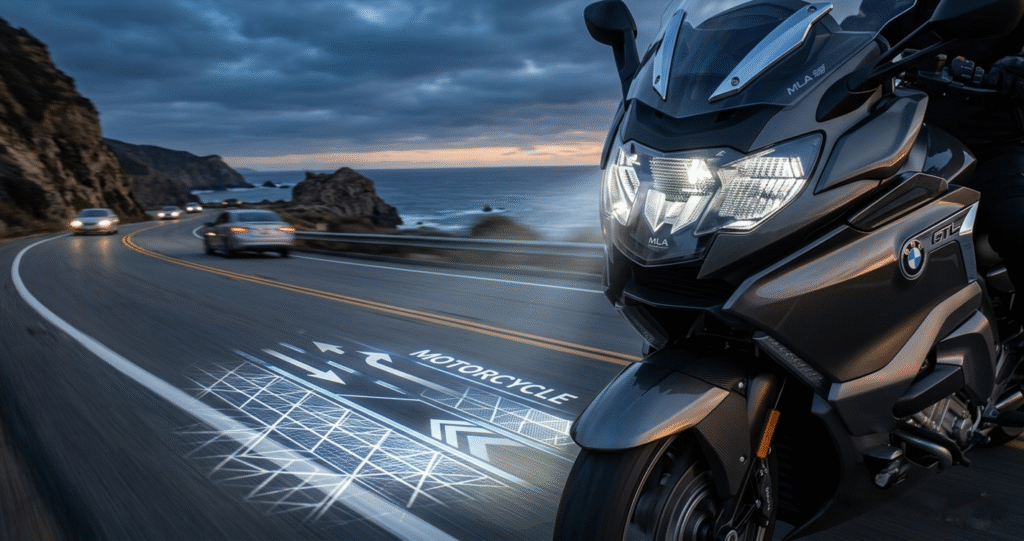
In our 16 years of working with high-precision optics and SEO strategies, we have seen many lighting trends. However, Motorcycle MLA Projection Lighting is not just a trend; it is a total change in how motorcycles communicate with the world.
If you are a product manager, an R&D head, or a procurement officer, you need to understand this tech. In this guide, we will explain everything about Micro Lens Array (MLA) systems. We will use simple words, but we will dive deep into the technical side so you can make the best buying decisions for your brand.
What exactly is MLA Technology?
To understand MLA, we first have to look at how old lights work. Most motorcycle lights use a bulb and a big glass lens. The lens pushes the light forward. It works, but it is heavy and takes up a lot of space.
We define MLA (Micro Lens Array) as a “micro-projector.” Instead of one big lens, we use thousands of tiny lenses. These lenses are so small you can barely see them with your eyes. They are etched onto a small piece of material using a process called lithography—the same way computer chips are made.
Each tiny lens projects a small part of a picture. When all these thousands of tiny beams hit the road, they join together to make one big, beautiful, sharp image. We call this “image stitching.” For a motorcycle, this means we can project logos, safety lines, or paths directly onto the street with perfect clarity.
Why does this matter for OEMs?
In our experience, space is the biggest enemy of motorcycle design. Designers want sleek, thin bikes. Old projectors are bulky. MLA modules are ultra-thin—often only 10mm to 25mm deep. This gives your design team the freedom to put lights in places they never could before, like under the fairings or inside the swingarm.
MLA vs. Standard LED: The Big Difference
We often get asked: “Can’t I just use a regular LED with a mask to project a logo?” The answer is yes, but it won’t look good.
Precision and Clarity
Standard LEDs create “hot spots.” This means the middle of the light is very bright, but the edges are blurry and dark. When we use Motorcycle MLA Projection Lighting, the light is even. The edges of the projection are sharp. If you project a “Turn Left” arrow, every corner of that arrow will be crisp.
Light Efficiency
Standard projection loses a lot of light because it “blocks” the light it doesn’t want. MLA is different. Because each micro-lens is shaped to send light exactly where it needs to go, we waste almost no energy. For electric motorcycles (EVs), this is a huge win because it saves battery life.
Heat Management (Thermal Drift)
In our technical reviews, we have seen that big lenses trap heat. MLA modules are made of materials like glass or high-tech polymers that handle heat very well. This prevents “thermal drift,” which is when a light gets dim or blurry because it gets too hot.
The 5 Projection Modes That Solve Rider Problems
When we talk to B2B buyers, we tell them to focus on intent. Why does the rider need this light? Here are the five modes we recommend every OEM include:
A. The Welcome Mode (The “Wow” Factor)
When the rider walks up to the bike and hits the unlock button, the bike “wakes up.” An MLA module projects a light carpet on both sides of the bike.
-
The Problem: Walking to a bike in a dark parking lot is unsafe. You might step in a hole or a puddle.
-
The Solution: The welcome light illuminates the ground, making the rider feel safe and making the bike look like a premium luxury product.
B. The Dynamic Turn Signal
Standard blinkers only show a flashing light on the bike. MLA projects a flashing arrow on the road next to the bike.
-
The Problem: Cars in a motorcycle’s blind spot often don’t see the small blinker on the bike.
-
The Solution: By projecting the intent onto the road, the motorcycle “claims” its space. The car driver sees the giant arrow on the asphalt and knows not to move over.
C. The High-Intensity Brake Warning
When the rider grips the brakes hard, the MLA system projects a red “grid” or warning sign behind the rear tire.
-
The Problem: Tailgating cars often don’t realize how fast a motorcycle can stop.
-
The Solution: A bright, flashing projection on the road acts as a second brake light that is impossible to miss.
D. The Hazard Perimeter
If the bike is stopped on the side of the road, the MLA system can project a “safety circle” around the entire motorcycle.
-
The Problem: A stopped bike at night is very hard to see from a distance.
-
The Solution: The light carpet makes the bike look much larger than it is, forcing traffic to move around it at a safe distance.
E. The Shutdown Path
After the engine stops, the MLA light stays on for 30 seconds, pointing toward the rider’s path away from the bike.
-
The Problem: Fumbling for keys or walking away from the bike in total darkness.
-
The Solution: It acts as a “guide light,” much like the path-lighting found in high-end luxury cars.
Technical Specs for Your Sourcing Checklist
If you are talking to a manufacturer in China or Germany, you need to speak their language. We suggest using this checklist for your procurement team:
-
FOV (Field of View): We recommend a range of 20° to 26°. Anything less is too narrow; anything more might lose brightness.
-
Lux Values: For a projection to be visible under a streetlamp, you need at least 150lx to 200lx at the center.
-
Projection Range: The ideal distance is 2 to 5 meters.
-
Color Temperature: Most riders prefer a “Cool White” (about 6000K), but for brake functions, you must ensure the “Signal Red” meets road safety laws.
-
Voltage: Ensure the module can handle 9V to 16V. This protects the light from “voltage spikes” when the bike starts.
-
IP Rating: This is critical. Motorcycles live in rain and dirt. We demand IP67 at a minimum.
Why We Recommend Sourcing from China for MLA
As experts in the B2B industrial market, we track where the best tech is made. For MLA, China is currently the global hub.
The Semiconductor Connection
MLA technology is very similar to how smartphone cameras are made. China has invested billions of dollars into “Nano-Imprinting Lithography.” This is the fancy machine used to make micro-lenses. Because they already make millions of phone parts, they can use the same factories to make Motorcycle MLA Projection Lighting.
Cost and Scale
If you try to source these in Europe, the price per unit is often very high because the factories are small. In China, manufacturers can produce 100,000 units a month. This brings the price down, allowing you to put this tech even on mid-priced motorcycles, not just the $30,000 models.
Customization
We have found that Chinese suppliers are very fast at making “custom masks.” If you want your specific brand logo projected on the ground, they can usually have a sample ready for you in less than a month.
How to Avoid Common Problems
We want you to succeed, so we must warn you about a few things we’ve seen go wrong in the field:
-
Vibration: Motorcycles vibrate much more than cars. If the MLA module isn’t built with “solid-state” parts, the micro-lenses can shift. Always ask for a vibration test report.
-
Lens Fogging: If the module isn’t sealed perfectly, moisture gets inside. Because the lenses are so small, even one drop of water can ruin the whole projection. Look for “anti-fog” coatings.
-
CAN Bus Errors: Most modern bikes use a computer (CAN Bus) to talk to the lights. Make sure your MLA supplier provides a “decoder” so the bike doesn’t show an “Error” light on the dashboard.
Conclusion
We believe that within five years, Motorcycle MLA Projection Lighting will be as common as LED headlights. It solves the biggest problem riders face: being seen by others. It also solves a big problem for OEMs: how to make a bike look “premium” without spending a fortune on body changes.
By choosing the right MLA modules today, you are positioning your brand as a leader in safety and technology.
Are you ready to see the difference? We recommend you start with a “Top-Down” content cluster. Start with this pillar page, then read our 29 supporting articles on the engineering details of MLA.
Our Advice: Don’t wait for your competitors to do it first. The 2026 model year is approaching, and MLA is the key to winning the market.